Description
Is this for a living room or for a wall of screens in a lobby?
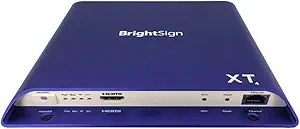
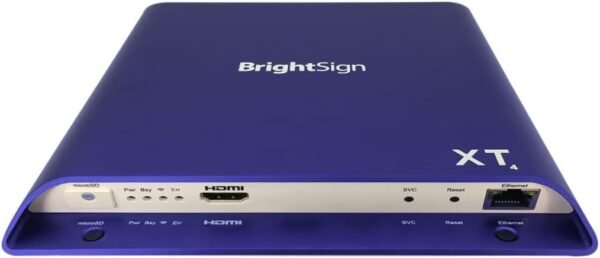
Read the manufacturer’s own one line description before anything else, because it settles the question: an enterprise HTML5 player with true 4K, dual video decode, a standard input and output package and PoE+. That is not how consumer streaming devices are described. It is how digital signage hardware is described, and BrightSign builds signage hardware.
The practical consequence matters more than the vocabulary. A consumer streaming box exists to run subscription apps on a television in a house. A signage player exists to run a scheduled presentation on a screen that nobody in the building operates: a menu board, a lobby display, a wayfinding screen, an in store video wall. It is loaded with content and a playlist and then it runs unattended for years. This listing publishes no streaming service support of any kind, and that absence is a fact about the product rather than a gap in the page.
So the honest framing for anyone who arrived here from a television search is that this is the wrong shelf. For anyone specifying a commercial installation, the rest of this is the useful part.
The features that decide a signage player: decode, I/O and power
Dual video decode is the headline capability. It means the player can decode two video streams at once, which in signage terms is what allows a layout with a main video and a second video zone, or a video with a picture in picture, rather than a single full screen clip. Layouts that mix live video with graphics and text are the normal ask in retail and hospitality, and dual decode is what makes them possible on one box.
True 4K with Dolby Vision support is the second. On a signage screen that is less about film mastering and more about running a single high resolution display at native panel resolution without a scaler in the path.
PoE+ is the specification that changes installation cost and is easy to underrate. Power over Ethernet Plus means a single Ethernet cable carries both the network and the power to the player, so a screen mounted high on a wall or hung from a ceiling needs one cable run rather than a cable run plus an electrician putting an outlet behind it. On a project with twenty screens, that is the line item that decides which player gets specified.
The standard input and output package
BrightSign describes this as the Standard I/O version, which in its product line denotes the tier of physical connectivity, as distinct from higher tiers with expanded interfacing. What the listing does not do is enumerate the ports. There is no list of HDMI versions, no USB count, no serial or GPIO detail, no storage specification and no operating system information. For a product where the input and output package is literally part of the model designation, that is a significant omission.
Living with a player designed to be forgotten
The physical facts on the listing are thin. Product dimensions are recorded as 11.33 by 9.68 by 2.83 inches at 1 pound, which describes the retail packaging rather than the player itself; a device of this class is typically far smaller than its box and is designed to mount behind a display or in a ceiling void. Confirm the actual chassis dimensions and the mounting options with BrightSign if the player has to fit inside a bracket or a recess.
What ownership looks like for signage hardware is different from consumer electronics. There are no consumables and no subscription tied to the device on this listing. What matters instead is content management: how presentations are authored, how they get onto the player, and how a screen that has frozen at three in the morning gets restarted without someone driving to the site. Those are platform questions rather than hardware questions, and none of them are answered on this page. Anyone specifying this should be evaluating BrightSign’s authoring and network management tools alongside the box, because that is where the ongoing work lives.
Thermal design is the other quiet consideration. Signage players run continuously, often inside a sealed enclosure behind a display that is itself producing heat. The listing publishes no operating temperature range, which is a specification a commercial installer would normally want in writing.
Reliability expectations are also different in this class, and they are the reason signage players exist as a separate product category at all. A consumer streaming stick is expected to be power cycled when it misbehaves and replaced every few years. A signage player is expected to survive years of continuous operation behind a screen that nobody can easily reach, recover from a power cut on its own, and resume its schedule without human intervention. Solid state storage, no moving parts and a controlled software image are how that is achieved, and none of those attributes appear in a specification table as a headline number. They are why the price sits where it does compared with consumer hardware that looks similar on paper.
The listing carries 5 ratings at 4.8 stars, a rank of 1,483rd in streaming media players, and an availability date of July 2018, and its feature bullet list is empty. Five ratings is not an ownership signal in any meaningful sense. Commercial equipment sells through integrators rather than retail, so the absence of reviews here says more about the sales channel than about the product.
What would send you elsewhere
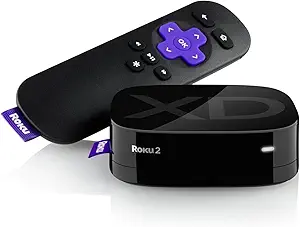
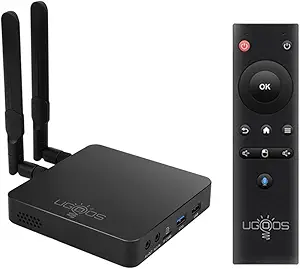
If you want apps on a television at home, look at consumer hardware instead. The Roku 2 XD is the simplest form of that, the Ugoos AM6B Plus is an Android based alternative, and the Kinhank G1 covers similar ground. The streaming media player category collects them together.
If the actual job is producing or distributing a live video feed rather than playing back scheduled content, that is different equipment again. The YoloLiv YoloBox Ultra is a live production and streaming unit, the Inogeni 4K2USB3 handles capture into a computer, and for getting a signal from one format into another the video converter category is the right starting point.
Who it fits and who should skip it
Buy it if you are specifying digital signage, if a layout needs two simultaneous video streams, and if PoE+ saves you running mains power to every screen position.
Skip it if you want streaming apps on a home television, because this player is not built for that and the listing does not claim it is. Before ordering for a commercial installation, get the port list, the chassis dimensions, the storage specification and the operating temperature range from BrightSign, since none of them appear on this page.