Description
Is the bottleneck the television, or the network it is on?
Most people who buy a separate streaming box are trying to fix a slow smart platform on a television that is otherwise fine. That is a legitimate reason, and the Ugoos AM6B Plus is aimed at the harder end of it: households where the content is high bitrate, comes from a local server or a fast connection, and where the usual cheap dongle stutters. The specification that signals this is not the processor. It is the 1000 megabit Ethernet port.
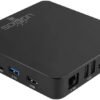
Gigabit Ethernet is the single most consequential item in this listing, and it is what separates this box from most of its competition. A great many Android players, including several on this site, fit a 100 megabit port. That is enough for a streaming service but not for pulling large files from a network drive, and it caps a fast home connection to a fraction of what it can do. If the plan involves a media server in the house, this is the specification to buy on.
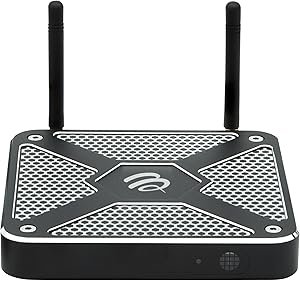
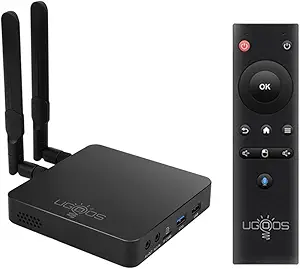
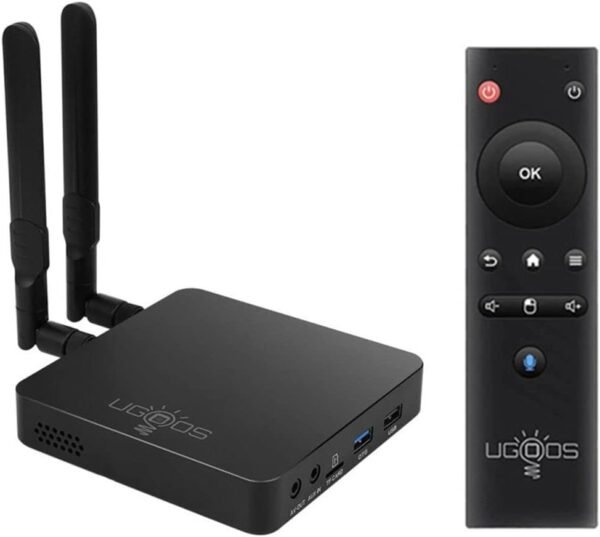
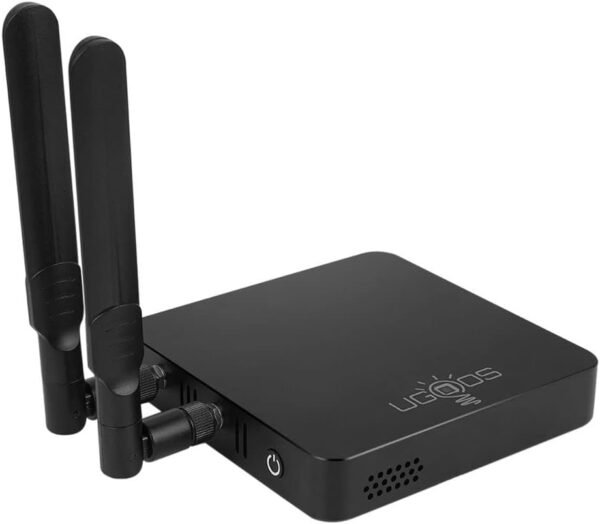
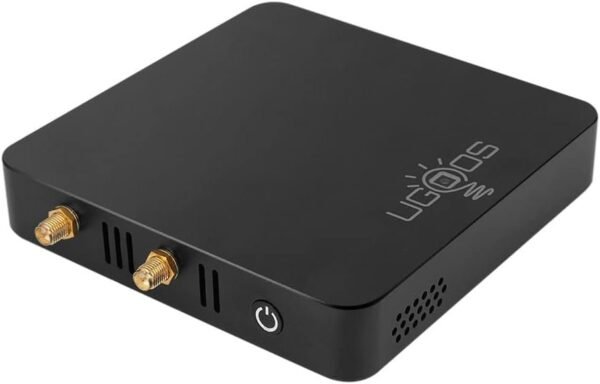
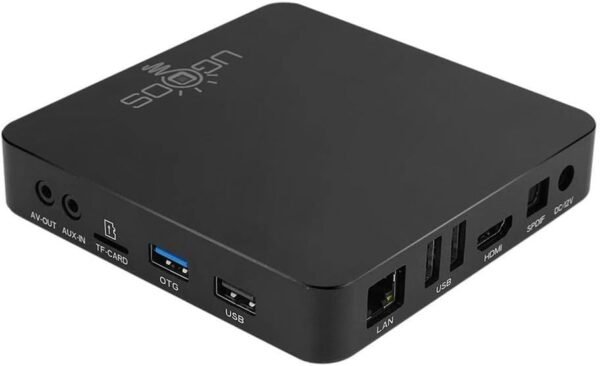
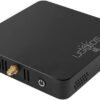
The physical fit is easy. Ugoos lists 4.61 by 4.61 inches and 0.79 inches thick at 10.4 ounces, so it sits on a shelf or behind a television with room to spare. Two external dual band antennas are supplied, which means it needs a little clearance around it rather than being buried, and the antennas themselves are a good sign, since internal antennas are the usual reason a box performs worse than its wireless specification suggests.
The specifications that decide it: 4GB of memory and a hexa core processor
Ugoos specifies an Amlogic S922X-J built on a 12 nanometer process, with four ARM Cortex-A73 cores and two Cortex-A53 cores, making six in total, paired with an ARM Mali-G52 MP6 graphics unit. The important part is not the marketing around it but the pairing with 4GB of LPDDR4 memory and 32GB of storage. Four gigabytes is double what most boxes in this class carry, and it is the difference between switching between applications and reloading them. Thirty two gigabytes of storage means a real application library rather than a handful.
Video capability is stated as 4K at 60 frames with H.265 decoding and high dynamic range. H.265 support matters because it is the codec most high efficiency 4K content uses, and hardware decoding of it is what keeps the processor cool and the playback smooth rather than dropping frames.
Wireless, and what dual band actually means here
Wi-Fi 6 is specified with dual band 2.4 and 5 GHz operation and MIMO with RSDB support. RSDB means the box can use both bands simultaneously rather than choosing one, which is genuinely useful when one band is congested. Bluetooth 5.0 handles controllers and headphones, and USB 3.0 covers external storage at a speed that makes it worth using. Ugoos also states an over the air updater, so firmware updates do not require manual flashing.
Living with it: the Android version, heat, and the plug in the box
The operating system is stated as Android 9.0, which was released in 2018. That is the most significant limitation in this listing and it deserves plain treatment. An Android release that old is very unlikely to be receiving security updates, and this is a device that sits permanently on your home network with an internet connection. Some applications also raise their minimum Android version over time, so an older release narrows what will install as the years pass. Ugoos is known for firmware support on its own boxes, and the over the air updater is stated, but the base Android version is what it is. Decide about that deliberately rather than discovering it later.
Heat is the practical failure mode for every small Android box. Ugoos calls out heat dissipation in its own description, and a 12 nanometer processor runs cooler than older parts, but a device 0.79 inches thick shut inside a closed media cabinet will still throttle. Leave it airflow.
The included accessories are listed as the box, an infrared remote, two dual band antennas, a 12 volt 2 amp power adapter, an HDMI cable and a printed manual. Two points on that. The remote is infrared, so it needs line of sight, and hiding the box behind a wall mounted television will not work without an extender. And the power adapter is listed as US, EU, UK or AU plug, meaning the plug type depends on which variant ships. Confirm the plug before ordering if it is coming from an overseas seller.
The listing publishes no description text at all beyond the feature bullets, and shows 31 ratings at an average of 4.8, which is a high score on a very small sample. It ranks 117th in its category.
When a different player suits better
If gigabit Ethernet is not needed and the budget matters more, the boxes with 100 megabit ports do the same streaming job. The Formuler Z10 and the Formuler Z10 NEO sit in that group, with less memory and slower networking.
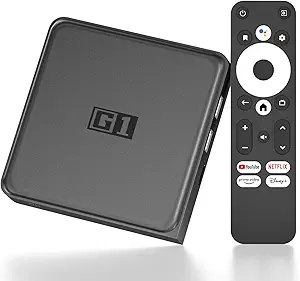
If the household wants a simpler, better supported platform rather than raw specification, a mainstream player with a maintained operating system is the safer long term choice even though it will look weaker on paper. The Kinhank G1 and the BuzzTV X5 are the other Android alternatives here. If the real requirement is bringing an older source device into a modern display, that is a conversion problem and belongs in the video converter category. The rest sit under streaming media players.
Who should buy it and who should not
Buy it if you have a media server or a fast connection you want to use over a wire, you run more than a couple of applications, and the television’s own platform is the thing slowing you down. Gigabit Ethernet, 4GB of memory, 32GB of storage, Wi-Fi 6 with external antennas and USB 3.0 is a genuinely capable combination in a package the size of a coaster.
Skip it if you only stream from one or two services, where a simpler box will do the same job, or if running a 2018 Android release on your home network is not a tradeoff you want to make. Before ordering, confirm which plug type ships, plan for infrared line of sight to the remote, and leave the box some air.