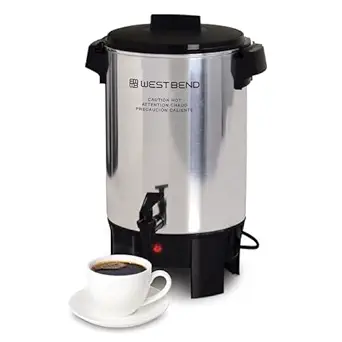
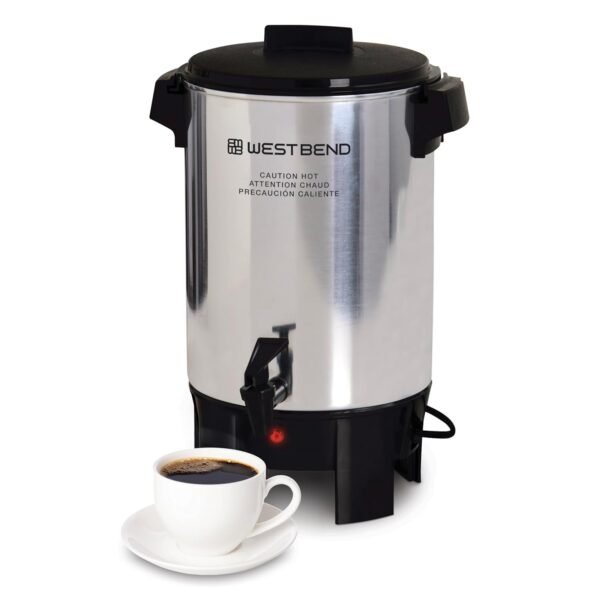
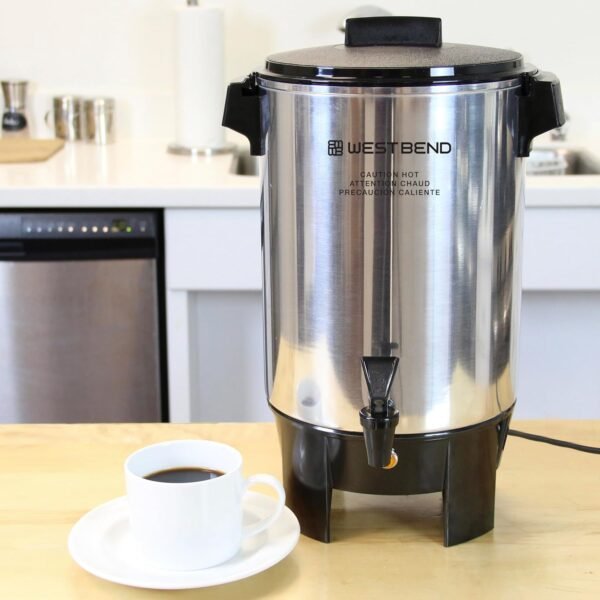
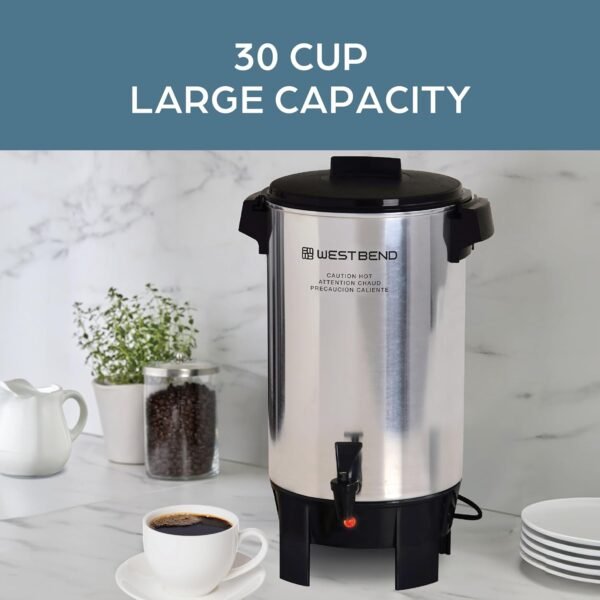

Description
How many people are you actually pouring for?
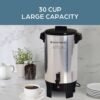
The first thing to settle about a 30 cup urn is what a cup means, because it is not a mug. Coffee urns and coffee makers alike are rated in five ounce servings, which is the traditional coffee cup. Thirty of those is about 150 ounces, and once you pour it into the mugs people actually drink from, you have roughly fifteen to eighteen servings. That is the number to plan a meeting or a gathering around, and it is half what the headline suggests.
That is still a lot of coffee for a household, which is why this is not a kitchen appliance in normal use. It is for the room with the folding tables in it: a meeting, a church hall, a sports club. Once a year that is a rental. Several times a year it is a purchase.
West Bend gives the dimensions as 10.8 inches deep by 10.8 inches wide by 15.6 inches high, which is a tall cylinder that takes up little counter area but needs vertical clearance and a stable surface. Note that the description on the same listing gives the same three numbers with different labels, calling 10.80 the width, 15.60 the depth and 10.70 the height. A 30 cup urn is taller than it is wide, so the specification table is the version that makes sense and the description’s axis labels are the ones to disregard.
The mechanism is a percolator, and that decides how the coffee tastes
The specification table names the coffee maker type as a percolator, and that is the most useful fact on this page. A percolator does not brew the way a drip machine does. Water in the base is heated until it rises up a central tube, spills over the grounds in the basket, drains back into the pot, and goes around again. The coffee is repeatedly recirculated through the grounds until the cycle ends.
The practical effects are consistent and worth knowing before you buy. Percolated coffee is strong and full bodied, it stays hot in the urn without a separate hotplate, and it holds up well when someone adds milk and sugar and drinks it slowly across an hour. It is also brewed with water that has been through the grounds more than once, which extracts more bitterness than a single pass, and specialty coffee people generally do not like it for that reason. For a hall full of people with mugs, that is entirely the right trade. For a careful pour over drinker, it is not.
West Bend states the machine brews at roughly a cup a minute and then switches automatically to a keep warm serving temperature, with a ready light to signal the change. Thirty cups at a cup a minute is about half an hour from a cold start, which is the timing to work backwards from when planning an event.
Why the spigot design matters more than it sounds
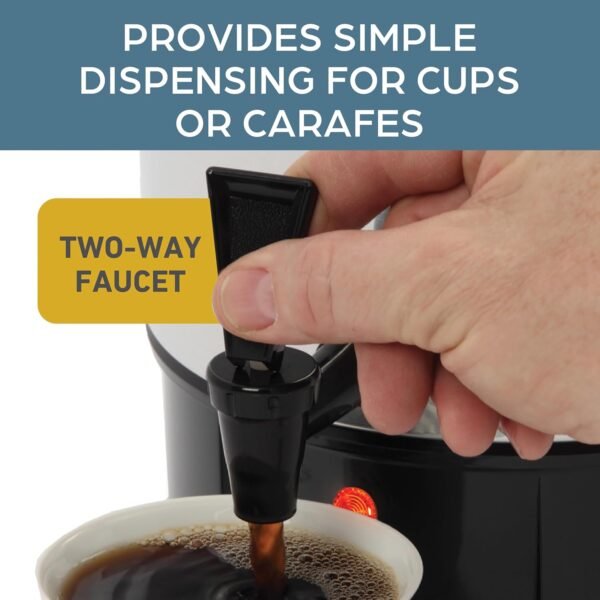
The pouring mechanism is where urns succeed or fail in practice. West Bend describes a no drip spigot for filling individual cups and states that lifting the spigot gives a continuous flow for filling larger coffee servers. That two mode arrangement is what stops a queue forming: individual pours for people, continuous flow for filling a carafe to take to another table.
The cover is described as lockable, designed to prevent accidental spills. On a vessel holding 150 ounces of near boiling liquid that is a safety feature rather than a convenience, and it matters most when the urn is being carried, which brings us to the thing the listing understates.
The stated item weight is 4.1 pounds, and that is the empty machine. One hundred and fifty ounces of water weighs about 9.7 pounds, so a full urn is roughly 14 pounds of hot liquid in an aluminum vessel. It should be filled where it will be used, not filled in a kitchen and carried to a table. The base is described as stay cool, which refers to the plastic pedestal it stands on rather than to the body, and the aluminum body itself gets hot.
Living with it: the material, the cleaning and the duty rating
The body is highly polished aluminum rather than stainless steel, and that has consequences. Aluminum conducts heat well, which is why it brews quickly and why the exterior gets hot. It also reacts with acidic and alkaline cleaners in a way stainless does not, so harsh dishwasher detergent will dull and pit a polished aluminum interior. West Bend calls it easy clean up, and the practical routine is warm water, mild detergent and a soft cloth, with a periodic descale for mineral buildup if you are in a hard water area.
The filter basket is reusable and there is an in basket measuring guide, which removes the need to measure grounds separately. For thirty cups you are using a large volume of ground coffee, and a coarse grind is what a percolator wants, since fine grinds pass through the basket and end up in the cup.
One line in the description deserves emphasis because it is easy to skim past. West Bend states the urn is rated for light duty, non commercial use. It looks like catering equipment and it is not certified as catering equipment. If you are serving the public rather than a private gathering, that distinction may matter to your local health and safety requirements, and a commercial rated brewer is the correct purchase.
Two specification fields contradict each other on the same page. The special feature field reads “Manual” and the operation mode field reads “Fully Automatic”. The manufacturer’s own description settles it, since the urn brews and then switches to keep warm by itself, but the table itself cannot be relied on. The listing also carries no customer rating data at all, which is unusual for a product first listed in December 2003.
When a different brewer is the right call
If you want percolated coffee at household scale rather than event scale, a twelve cup percolator does the same thing in a machine you can keep on a counter. The Cuisinart PRC-12N twelve cup percolator review covers that directly and is the natural step down.
If the setting is an office or a venue where people arrive at different times, a batch of coffee that sits for an hour is the wrong model, and a single serve machine built for volume is the right one. The Keurig K1500 commercial brewer review covers that approach.
If you simply want a normal amount of coffee at home, the Cuisinart DCC-1500TG twelve cup programmable review and the Mr. Coffee twelve cup review cover the drip machines that suit a kitchen. The rest of the range sits in the coffee machines category, and the percolators specifically in the electric coffee percolators category.
Who should buy it and who should not
It suits someone who repeatedly needs coffee for fifteen to eighteen people in a room without a kitchen: a committee, a congregation, a club, a family that hosts. The automatic switch to keep warm, the ready light, the lockable lid and the two mode spigot are all designed around exactly that situation, and a product that has stayed on sale since 2003 has a long track record.
It does not suit a household of two, anyone who cares about how the coffee tastes to a specialty standard, or any commercial food service operation, since West Bend states plainly that it is rated for light duty non commercial use. Anyone in a hard water area should also plan on descaling, because there is no water window and scale in an aluminum urn is invisible until the brew time changes.