

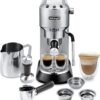



Description
How much counter width can you actually spare?
Espresso machines are usually wide, and that is what stops people buying one. The Dedica Arte is built around that single constraint. De’Longhi states it is just 6 inches wide, which is narrower than most kettles and narrow enough to sit in a gap beside a toaster. Note that the specification table gives the dimensions as 5.9 inches deep by 13 wide by 12 high, which reads as a wide machine, while the feature bullet says 6 inches wide. Those two describe the same object with the depth and width transposed. The 5.9 inch figure is the width and the 13 inch figure is the depth. Measure the gap for width and the counter for depth accordingly.
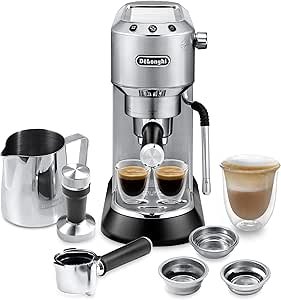
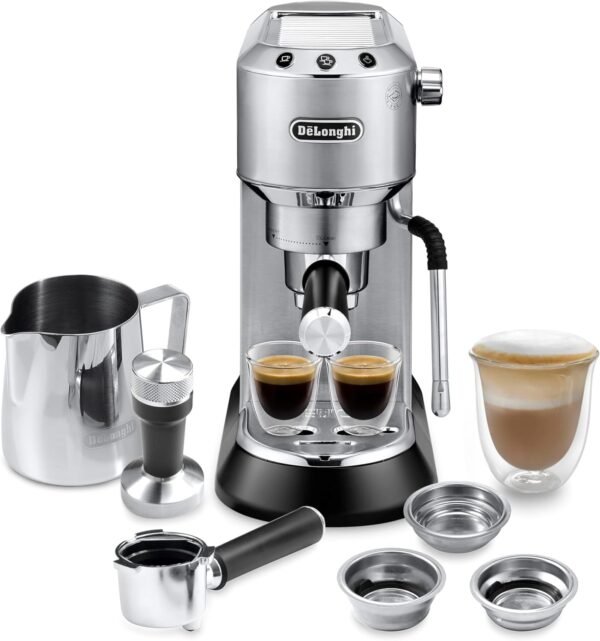
The second question is whether you will grind. The machine takes a large filter basket accommodating up to 18 grams of ground coffee, and comes with a professional tamper, a single filter, a double filter and an ESE pod filter. Eighteen grams is a proper double dose, and filling it consistently means espresso fine ground coffee. The included ESE pod filter is the escape route: pre packed paper pods that need no grinder at all, at the cost of choice and freshness. That option is genuinely useful for a household where one person wants to grind and another does not.
Third, what are you actually drinking? If the answer is espresso, this machine covers it. If the answer is milk drinks, the steam wand is what you are buying and it deserves its own look.
The specifications that decide it: 15 bar pressure and three temperature levels
Fifteen bar is the standard pump rating advertised across almost every domestic espresso machine, and it is worth understanding rather than treating as a quality score. Espresso is extracted at around nine bar at the coffee. A fifteen bar pump means the pump is capable of more than that, with the excess regulated. A higher number on the box does not mean better espresso, and machines advertising twenty bar are not proportionally better.
The specification that does matter here is the three level temperature control. Brew temperature has a large effect on how espresso tastes, and most machines in this price range give you no control at all. Three settings is not infinite adjustment, but it is enough to move a dark roast down and a light roast up, which is the adjustment most people actually need. It is the feature that separates this from an entry level machine.
Automatic flow stop dispenses a set volume rather than running until you stop it. That removes one variable for a beginner and takes one away from anyone who wants to pull to weight, which is the usual tradeoff on machines aimed at both audiences.
The steam wand is the real reason to choose this model
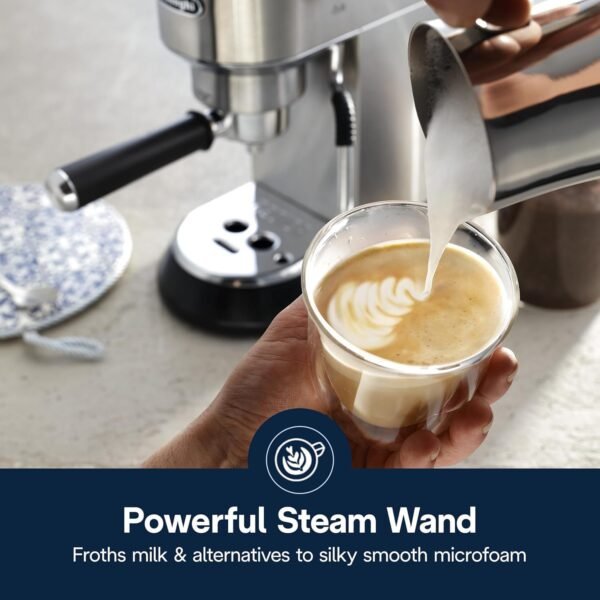
De’Longhi calls it the My LatteArt wand and describes it as commercial style. What that means in practice is a wand with a single hole tip that you position and control yourself, rather than an automatic frothing attachment that produces stiff foam with no technique required. A manual wand is harder and produces much better milk once you learn it, because you control where the air goes in and when it stops. If milk drinks are the point of the purchase, this is the specification to buy on, and it is unusual at this size.
Living with it: the tank, cleaning, and contradictory fields
The water tank is 35 ounces, removable, with a visible level. On a machine this narrow, a removable tank matters because there is no room to pour into a fixed one. A water hardness test strip is included, which signals that De’Longhi expects you to descale on a schedule based on your water rather than a fixed interval. That is the single maintenance job that decides how long an espresso machine lasts, and scale is what kills them.
The double drip tray adjusts or removes to fit taller cups, which is the practical fix for a compact machine where the standard clearance suits an espresso cup and nothing else.
Two fields in the published data contradict each other. The special feature reads Manual while the operation mode in the same table reads Fully Automatic. Neither describes a semi automatic espresso machine with a manual steam wand and an automatic volume stop. The listing also publishes no wattage figure at all, which is a gap for an appliance with a heating element, and no shot temperature figures for the three settings, so the three levels are relative rather than absolute.
One figure deserves plain statement. This listing shows 1,616 ratings at an average of 3.9. That is a substantial sample and a below average score for a well known brand, and it is worth reading recent reviews before committing rather than relying on the brand name.
When a different machine is the better answer
If you want the milk texturing handled for you, an automatic wand removes the learning curve, and the Breville Bambino Plus is the comparison at a similar footprint. If the grinder problem is the sticking point, an integrated machine solves it in one purchase and the Breville Barista Touch is that route.
If the routine itself is the objection, a capsule machine removes grinding, dosing and tamping entirely, and the Nespresso VertuoPlus covers that at the cost of a closed capsule supply. At the simplest end, the IMUSA electric espresso maker is the minimum version of the idea. The rest sit under coffee machines and coffee makers.
Who should buy it and who should not
Buy it if counter width is the binding constraint, milk drinks matter and you are willing to learn a manual steam wand, and you either own a grinder or will use the included ESE pod filter. Three level temperature control and an 18 gram basket in a body under six inches wide is a genuinely unusual combination, and the accessory set is complete rather than minimal.
Skip it if you want automatic milk texturing, or if you want the machine to hold a shot to a weight rather than a volume. Before ordering, read the dimensions as 5.9 inches wide by 13 deep rather than as printed in the specification table, note that no wattage is published, and read recent reviews given the 3.9 average across 1,616 ratings.