
Description
Are you cooking for a family, or for a room?
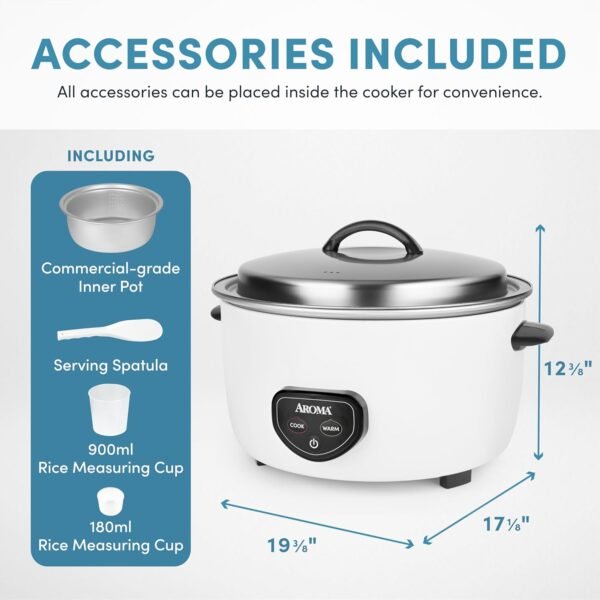
The number on this machine is 60 cups of cooked rice, and the first thing to understand is what a cup means here. Rice cookers are measured in rice cups, not American measuring cups. Aroma settles it by shipping two measures with the machine: a standard 180 millilitre rice cup and an oversized 900 millilitre cup for filling the pot to capacity. The specification table gives the pot as 14 quarts, which is the figure to plan around if you think in volume rather than in cups.
However you count it, this is a catering appliance. Sixty cups of cooked rice serves a hall, a canteen, a restaurant service or a very large family event. For a household of four it is roughly ten times too much, and a rice cooker that is run a tenth full does not cook well, because the heating profile is designed around a filled pot.
The physical numbers follow from that. Aroma lists it at 19.38 inches deep, 12.88 inches wide and 17.13 inches high, weighing 15.39 pounds empty. Nearly seventeen inches of height means the lid needs clearance above it, and a filled 14 quart pot adds a substantial amount of weight, so the machine wants a permanent station on a solid surface rather than a spot in a cupboard.
The one touch design and the sensor are what make volume cooking practical
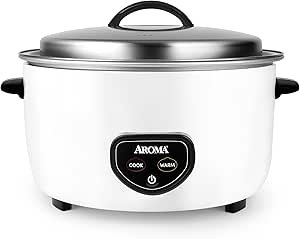
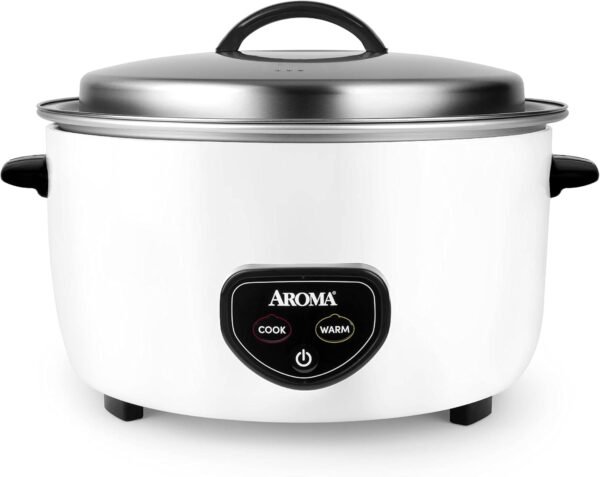
Aroma’s argument for this machine over other commercial cookers is that it is not a manual pot. The description states there are two modes with LED indicator lights, that temperature sensors detect the moment the rice is fully cooked, and that the machine then switches itself to warm and holds it there. Press the power button and walk away.
That matters more at this scale than at household scale. A domestic cook can stand next to a rice cooker. A kitchen serving sixty portions cannot spare anyone to watch one, and rice that sits at the wrong temperature after cooking either dries out or goes gluey. A machine that senses the transition and switches modes on its own is the difference between rice held properly for a service and rice that needs someone checking it.
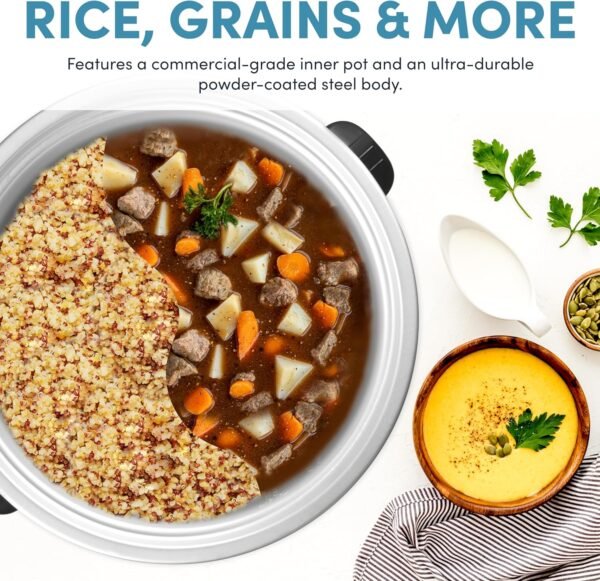
The trade against a household machine is menu range. This is a cook and hold appliance with two modes. It does not have separate cycles for sushi rice, brown rice, porridge and quinoa the way a domestic fuzzy logic cooker does. Aroma describes it as a rice and grain cooker, so other grains can be cooked in it, but you will be working out water ratios and timings yourself rather than pressing a labelled button.
What the construction tells you about how it is meant to be used
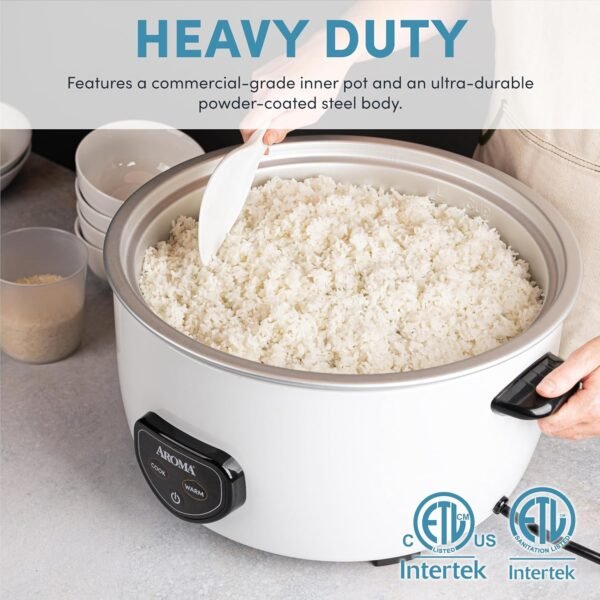
The build description is worth reading closely because it contains a small contradiction. The bullets describe a powder coated steel body with a heavy duty stainless steel lid and a thick inner pot with cool touch handles. The specification table then lists the material simply as stainless steel. Those are not the same claim: a powder coated steel body is painted steel, not stainless, and the stainless applies to the lid. If corrosion resistance on the exterior matters in your kitchen, that distinction is the one to confirm.
Two safety and hygiene points are stated clearly and are the reason this sits apart from a large household cooker. Aroma states ETL sanitization certification, which addresses cleanability for daily commercial use, and an advanced safety fuse providing thermal protection. It is worth noting that ETL sanitization is not the same as NSF certification, which is the standard many health departments and commercial kitchens specifically ask for. If you are buying for a regulated foodservice operation, check which certification your inspector requires before ordering.
The inner pot is stated as BPA free and lifts out for cleaning, which on a 14 quart pot is the only realistic way to wash it.
Living with it: power, refilling and the accessories that come with it
The electrical rating is 1550 watts at 120 volts, which works out to roughly 13 amps. That is most of a standard 15 amp circuit, so it should not share an outlet with another heating appliance. In a commercial kitchen that is routine. In a church hall or a rented venue it is worth checking, because a coffee urn and a rice cooker on the same circuit will trip a breaker at the worst moment.
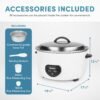
A note on the accessories. The description states the machine ships with both a standard 180 millilitre rice measuring cup and an oversized 900 millilitre cup, while the specification table’s included components field lists only a rice measuring cup and a serving spatula. Since the large cup is the one that makes filling a 14 quart pot practical, confirm both are in the box rather than assuming.
Cleaning at this size is the real daily cost. A 14 quart pot does not fit in a domestic sink, and it is heavy when wet. The removable pot and stainless lid are designed for it, but the routine is a two handed job at a large sink or a pot wash station, which is another reason this belongs in a working kitchen rather than a home one.
Keep warm is not infinite. Rice held for hours dries at the surface and develops a crust against the pot wall regardless of the machine. Planning batches to service times rather than cooking everything at nine in the morning is what gets good results out of any warmer.
When a different cooker is the right size
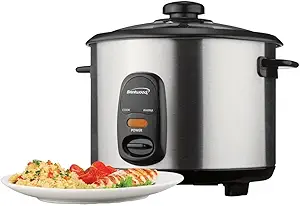
If this is for a home rather than a service, almost anything else in the category is a better fit. The Aroma ARC-914D review covers the same manufacturer’s household machine, and the Brentwood TS-10 five cup review covers the simplest end of the market.
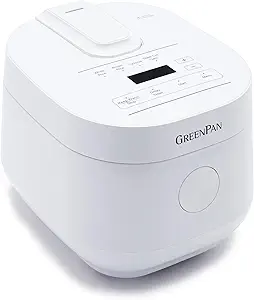
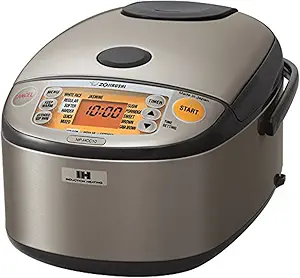
If precision matters more than volume, an induction machine controls the pan temperature rather than a plate, and the Zojirushi NP-HCC10XH induction review covers what that buys. If the priority is a compact machine with grain presets, the GreenPan ceramic nonstick rice cooker review covers that approach.
And if you are equipping a hall or a catering setup rather than a kitchen, the other machine that gets bought at the same time is usually a large coffee urn, which the West Bend 30 cup urn review covers. The rest of the range sits in the rice cookers category, with the hold and slow cook machines in the slow cookers category.
Who this is for and who should not buy it
It is for a restaurant, a canteen, a caterer, a large institution or anyone regularly serving rice to dozens of people. The automatic sensing and hold, the ETL sanitization rating, the thermal fuse and the removable pot are all specified for that setting, and the one touch operation means it does not need a trained operator.
It is not for a household, however large. Anyone in a regulated foodservice operation should confirm whether ETL sanitization satisfies their local requirement or whether NSF certification is needed. And anyone using it outside a commercial kitchen should check the circuit before plugging in 1550 watts. The listing shows 149 ratings averaging 4.3 stars, ranked 107th within rice cookers, from a machine first listed in September 2022.