



Description
How much rice does your household cook in a single sitting?
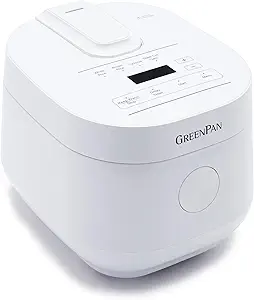
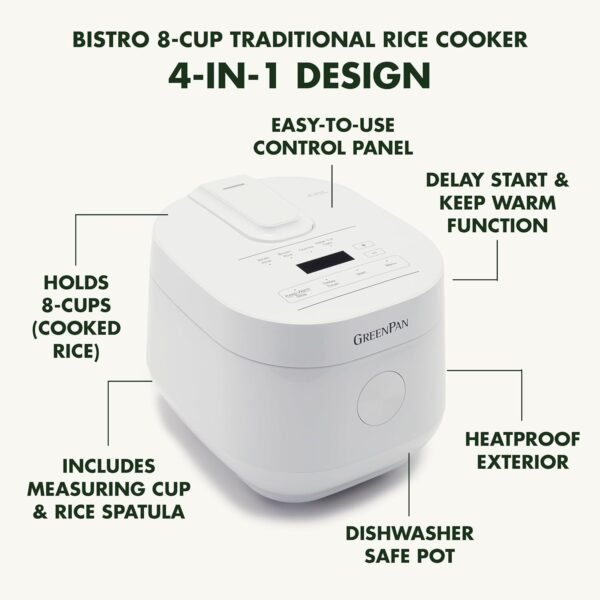
Rice cooker sizing is where most of these purchases go wrong, and it goes wrong because the industry measures capacity in two different units and rarely says which one it means. This listing does both, on the same page, without reconciling them. The specification table gives the capacity as 4 cups. The product title says 4 cups uncooked and 8 cups cooked. The description calls it the Bistro 8-Cup Traditional Rice Cooker. The included components list refers to an 8-Cup Rice Maker. All of those describe the same machine, but a shopper scanning the specification table alone would reasonably conclude it holds half as much as it does.
The usable answer is the cooked figure, because that is what lands on the plate. Eight cooked cups is roughly four to six side servings, or three to four servings when rice is the base of the meal rather than an accompaniment. For a couple that is a machine you never fill. For a family of four eating rice or grains several times a week it is well sized. For anyone batch cooking a week ahead, or feeding six, it will have to run twice.
The other half of the sizing question is where it lives. GreenPan lists dimensions of 6 inches deep by 6 inches wide by 8 inches high, which is genuinely small, small enough to leave out permanently in a tight kitchen rather than lifting it in and out of a cupboard. It is worth flagging that those dimensions are hard to reconcile with a 2 liter bowl plus insulation, a lid and a heating element, since a machine holding eight cooked cups is usually closer to nine or ten inches across. Treat the footprint as approximate and confirm it before planning a shelf around it.
The coating and the presets are what decide this cooker
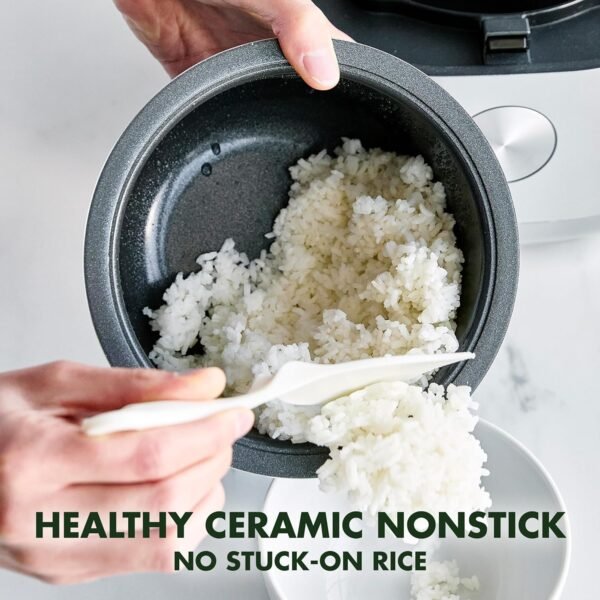
The reason to choose this machine over a cheaper one is the bowl. GreenPan uses its Thermolon Volt ceramic nonstick coating, which the company describes as diamond infused and formulated specifically for the sustained temperatures inside small appliances rather than the intermittent heat of a frying pan. GreenPan states the coating is free of PFAS, PFOA, lead and cadmium. That is the manufacturer’s claim about its own product, and since it is the central selling point, anyone buying for that reason should treat it as the thing to verify rather than the thing to assume.
The practical consequence of a ceramic coated bowl is release. Rice, and particularly the sticky layer at the bottom of a batch of brown rice or steel cut oats, is what makes rice cooker bowls unpleasant to clean. A coating that releases well turns a soak into a rinse. The trade is durability, since ceramic coatings are generally less tolerant of metal utensils and thermal shock than the alternatives, which is why the machine ships with its own spatula and ladle rather than expecting you to use your own.
What the fuzzy logic is actually adjusting
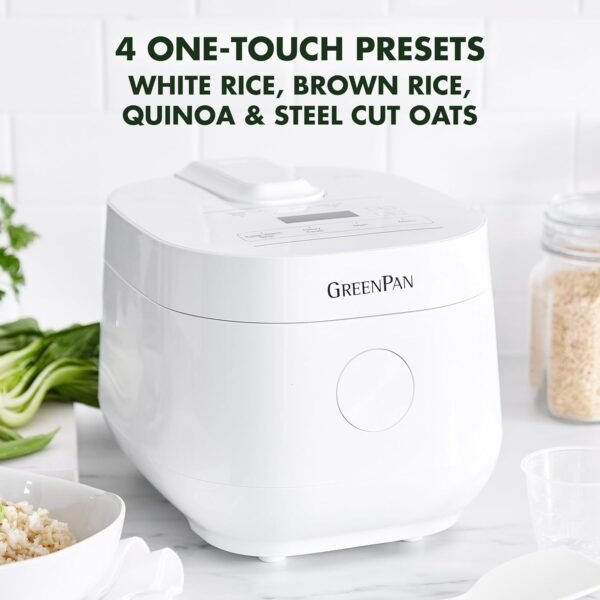
GreenPan calls the feature Smart Grain and describes it as fuzzy logic technology that automatically adjusts to make the rice better. In plain terms, a fuzzy logic cooker does not simply heat until the water is gone and then switch to warm. It reads temperature over time and adapts the heating curve, extending the soak, moderating the boil or lengthening the steam rest depending on how the batch is behaving. That is what allows one machine to handle white rice, brown rice, quinoa and steel cut oats from four separate presets rather than one setting and a lot of guesswork.
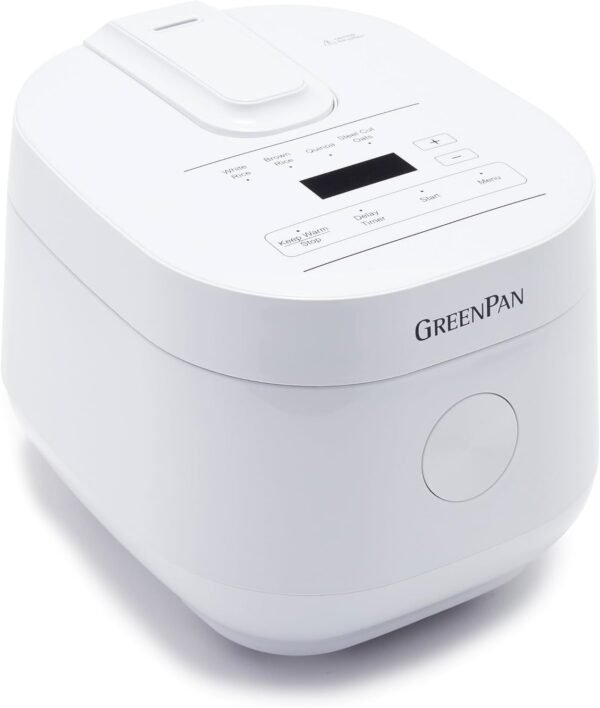
The four presets are named explicitly: white rice, brown rice, quinoa and steel cut oats, with a note that some oats need special instructions. There is also a delay timer with adjustable timing, a keep warm function, a steaming function, fill lines inside the removable bowl and an LED display. That is a well specified feature set for a compact machine, and the delay timer in particular is what makes overnight steel cut oats practical.
Living with it: cleaning, the cool touch shell and one voltage figure that does not fit
Cleaning is straightforward on paper. GreenPan states the bowl, measuring cup and rice spatula are dishwasher safe, and the description adds that removable parts are dishwasher safe. The care instruction field, however, lists both Dishwasher Safe Parts and Hand Wash without saying which applies to what. The safe reading is that removable items go in the machine and the body is wiped by hand, which is how nearly every rice cooker works, but the listing itself never says that cleanly.
The cool touch exterior is a meaningful feature in a small kitchen and in a household with children, because the outside of a working rice cooker is otherwise one of the hotter things on the counter. Steam still escapes at the vent, so cool touch applies to the shell rather than to everything the machine emits, and it should still be sited away from the edge of the counter and from anything that will be damaged by rising steam.
One specification does not fit the market. The listing gives the voltage as 220 volts alongside a 500 watt element. Household supply in the United States is nominally 120 volts. A 220 volt appliance will not work on a standard American outlet, so either the field is an import error, which is by far the most likely explanation, or the unit shipped is an international variant. Confirm the voltage with the seller before ordering, particularly if the machine is a gift. The 500 watt rating itself is modest and appropriate for the size, and it means the machine can share a circuit with other appliances without complaint.
Weight is listed at 9.33 pounds, which is heavier than the compact dimensions suggest and is another figure that sits awkwardly with the stated size.
When a different rice cooker suits you better
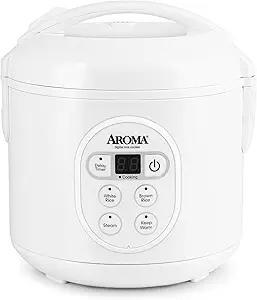
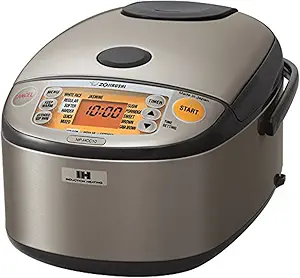
If you want more capacity in the same style of simple preset machine, the Aroma ARC-914D review covers a larger and more conventional option. If grain quality itself is what you care about most, the two Zojirushi machines are the reference points: the Zojirushi NS-ZCC10 Neuro Fuzzy review covers the classic fuzzy logic implementation, and the Zojirushi NP-HCC10XH induction heating review covers what induction adds over a plate element.
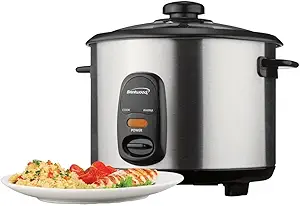
If the ceramic coating is not a priority and you would rather have a bare stainless bowl, the Brentwood TS-10 review covers that approach. The rest of the range sits in the rice cookers category, and because this machine also steams and holds, it overlaps with the multi cookers covered in the slow cookers category.
Who it fits and who it does not
It fits a small kitchen where counter space is the binding constraint, a household of two to four, and a cook who wants grains beyond white rice handled by a preset rather than by attention. It fits anyone who has chosen a ceramic coated bowl deliberately and wants a machine built around that decision.
It does not fit a large household or a batch cooking routine. It does not fit anyone who needs the specification table to be internally consistent, because this one calls the same machine 4 cups and 8 cups on the same page and lists a voltage that does not match the market it is sold in. The listing shows 44 ratings averaging 4.0 stars, ranked 428th within rice cookers, which is a small base of feedback for a product first listed in July 2022.