Description
Do you want rice, or do you want a rice program?
Rice cookers split cleanly into two philosophies and the price gap between them is large. One kind has a thermostat: it heats until the water is gone, the temperature rises past boiling, and a switch flips to warm. The other kind has a microprocessor that adjusts heat through the cook, with settings for white, brown, sushi and porridge, plus a timer.
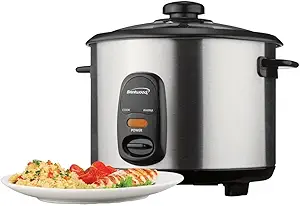
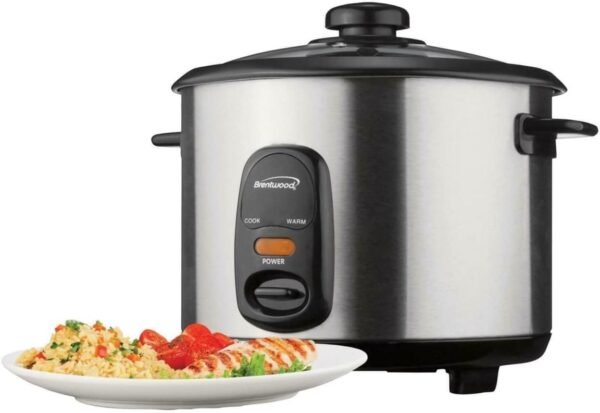
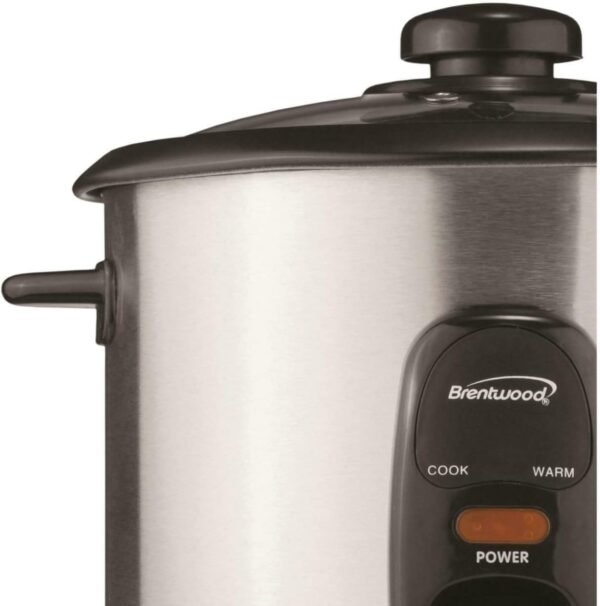
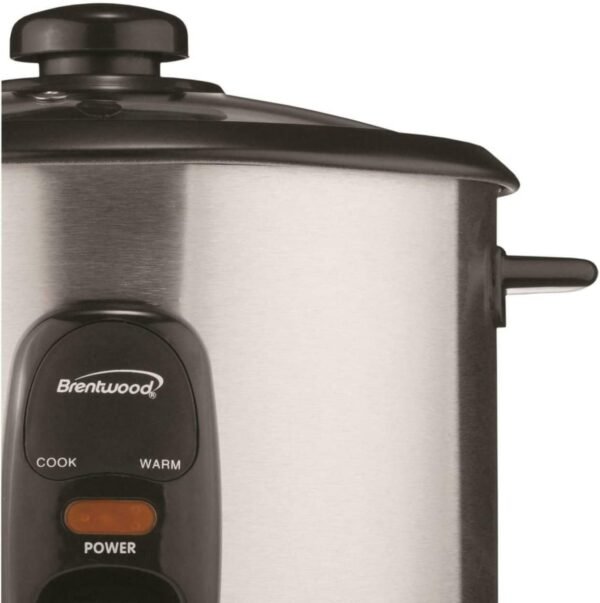
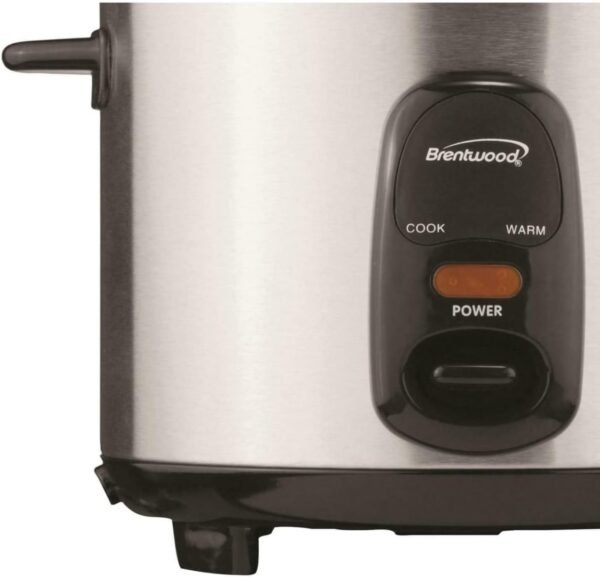
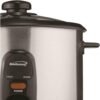
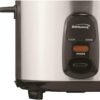
The Brentwood TS-10 is firmly the first kind, and it does not pretend otherwise. Brentwood describes it as hassle free one touch operation that switches to warming once food is cooked. There is one control. There is a power and warmer indicator light. That is the machine.
What you get in exchange is simplicity that does not break, a 4.4 pound appliance you can genuinely store in a cupboard, and a footprint of 10.75 by 8.5 by 9 inches that fits anywhere. For a student flat, a small kitchen, a second home or anyone who cooks plain white rice and nothing else, that is a complete answer.
Capacity is the number to get right
Brentwood rates it at 5 cups of uncooked rice. That is the figure to plan around, because uncooked rice roughly doubles, so five cups uncooked lands somewhere around ten cups cooked, which is four to six servings depending on how central rice is to the meal. For a couple it is generous. For a household of five it is a single meal with nothing left over.
The specification table gives the capacity as five cubic centimeters, which is an obvious data error. Five cubic centimeters is a teaspoon. Take the 5 cup figure from the product title and the feature bullets as the real one.
The 400 watt element is modest, which is appropriate for the size. It is also why this machine works on any outlet without thought, unlike the countertop appliances that draw ten times that.
What the one touch approach cannot do
It is worth being clear about the limits, because they are real. A single thermostat switch cooks white rice well because white rice absorbs water predictably and the switch fires when the water is gone. Brown rice needs longer and more water and benefits from a soak, and a machine with one setting will treat it the same as white. There is no timer, so you cannot set it in the morning for the evening. There is no keep warm duration control, only on and warm.
Brentwood does list a wider range of uses than rice: chili, soups, rice pudding, oats and quinoa. Those all work on the same principle, which is heat until the liquid is absorbed or reduced, and a thermostat cooker handles them at the same level it handles rice. Porridge and oats are genuinely convenient in one, because a machine that switches itself to warm cannot boil over the way a pan does if you turn your back.
Living with it
The removable pot is non stick, which is what makes cleanup manageable, since rice starch glues itself to bare metal. Treat it the way you treat any nonstick surface: no metal spoons, no abrasive pads, and the included serving paddle exists for exactly this reason.
The tempered glass lid is the other practical detail. Being able to see the surface of the rice without lifting the lid matters more in a cooker than in a pan, because lifting the lid releases the steam the cooking depends on.
Brentwood lists a measuring cup among the included items, and here is a point that confuses people every time: the cup supplied with a rice cooker is usually not a standard US cup. It is the measure the cooker’s capacity rating is based on. Use the supplied cup for both rice and water and the ratios work. Use a kitchen measuring cup for one and the supplied cup for the other and they do not.
There is a small inconsistency in the components list. The description says a measuring cup and a serving paddle are both included, while the specification field lists only a measuring cup, a glass lid and an instruction manual. Check the box for the paddle.
Two other listing artifacts are worth naming. The Material field says stainless steel while the pot is non stick coated and the lid is tempered glass, so stainless describes the outer body only. And the UPC field contains two separate numbers run together, which is a data error rather than anything about the product.
Rinsing is the habit that most changes results in a basic cooker and it costs nothing. Rinsing white rice until the water runs mostly clear removes surface starch, which is what makes rice gluey and what makes a nonstick pot harder to clean afterward. A thermostat cooker has no way to compensate for unrinsed rice, so the step matters more here than in a machine with a program that adjusts as it goes. The other habit is leaving the lid down for ten minutes after the switch flips to warm, which lets the steam redistribute through the grain. Both are free, and together they close most of the gap to a far more expensive cooker.
The ownership signal is reasonable for a simple appliance: 212 ratings at 4.2 stars, a rank of 424th in rice cookers, and an availability date of March 2010. Fifteen years on sale in essentially the same form is its own kind of endorsement.
What would send you elsewhere
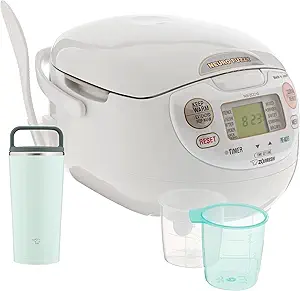
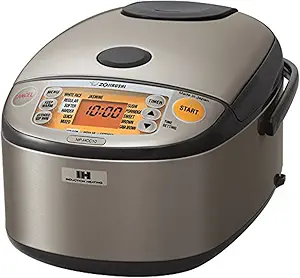
If rice is a daily staple and the variety matters, a microprocessor controlled cooker is a genuinely different appliance. The Zojirushi NS-ZCC10 and the Zojirushi NP-HCC10XH both add cooking programs and a timer, which is what you buy when brown rice and sushi rice need different treatment.
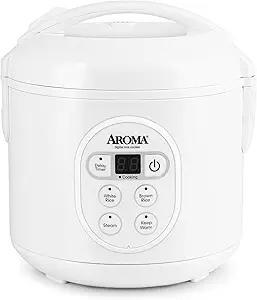
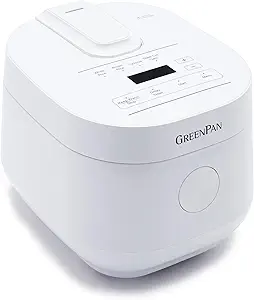
If you want a middle ground, the Aroma ARC-914D and the GreenPan rice cooker sit between the two philosophies. The rice cooker category lays them out by capacity and control type.
And if the appeal is really the set and forget aspect rather than rice specifically, a slow cooker covers a wider range of meals on the same principle. The slow cooker category is the place to look.
Who it fits and who should skip it
Buy it if you cook plain rice for one to four people, if the appliance needs to store in a cupboard between uses, and if one button is a feature rather than a limitation.
Skip it if brown rice is a regular part of your cooking, if you want to set a timer, or if you feed more than four. And use the cup that comes in the box rather than a kitchen measure, or the ratios will be wrong.