

Description
Can you control the light in the room?
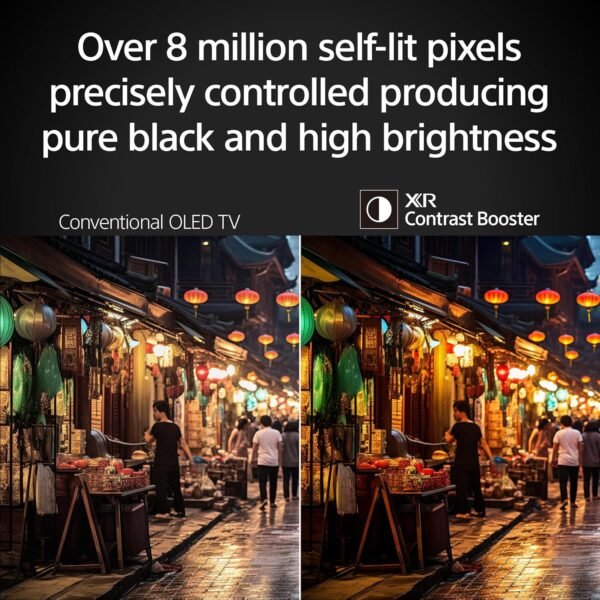
That is the OLED question and it comes before size, before processor and before price. OLED panels make light pixel by pixel, so black is genuinely black rather than a dimmed backlight, and Sony states this one has over 8 million self lit pixels under individual control. In a room you can darken, that produces an image an LCD cannot match. In a room with a window opposite the screen at four in the afternoon, a bright LED or QLED panel will look better, because raw brightness beats contrast when there is ambient light washing the screen.
So walk into the room at the time of day you actually watch and look at the wall. If you can close a blind, OLED is worth the money. If you cannot, spend it elsewhere.
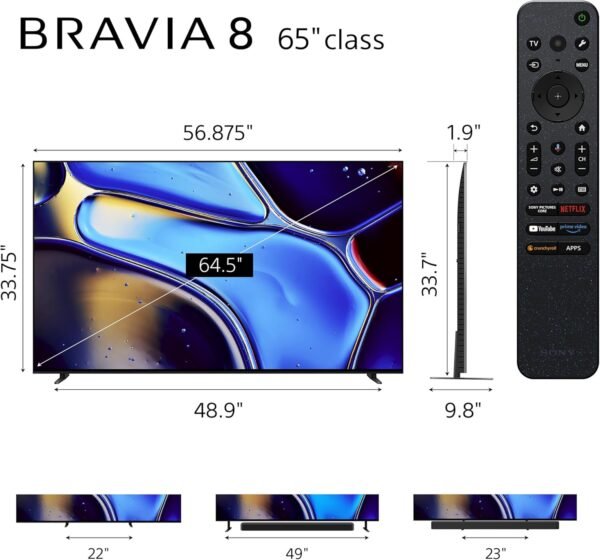
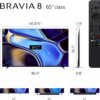
Assuming the room works, 65 inches is the size that fits most living rooms without dominating them. Sony gives the set as 56.88 inches wide, 33.75 inches high and 9.88 inches deep, at 51.2 pounds. Fifty seven inches is wider than most older media consoles, and 51 pounds is a two person lift. Comfortable seating distance at this diagonal is roughly eight to ten feet.
The processor and the panel are one decision
Sony’s XR Processor is the piece that separates its OLED sets from panels of similar specification. The company describes it as enhancing each scene in real time for color, contrast and clarity, working with XR Triluminos Pro for color volume, XR Clear Image for upscaling lower resolution content, and XR OLED Motion for fast movement. The upscaling matters more than the headline features on most evenings, because broadcast sport and older streaming content are not delivered at 4K.
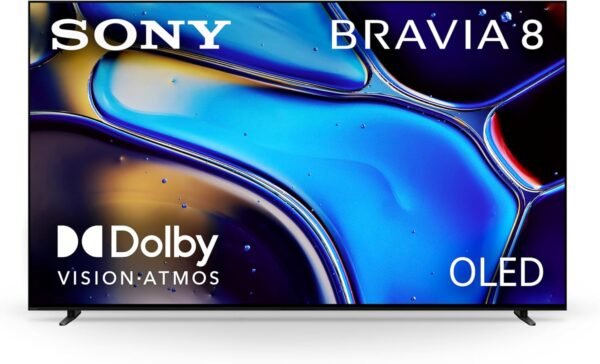
Format support is comprehensive: Dolby Vision, Dolby Atmos, IMAX Enhanced and DTS:X. That is a wider list than most sets carry, and DTS:X in particular is worth noting for anyone with a disc collection.
Studio calibrated modes, and what they actually do
Sony lists calibrated picture modes designed specifically for Prime Video, Netflix Adaptive and Sony Pictures CORE. These are not general picture presets. They are per service modes that switch the display into a configuration the content provider has signed off on, so the image matches what was approved in mastering rather than what the shop floor preset does. If you want the picture the production intended without learning a calibration menu, that is the shortest route to it.
Sony Pictures CORE, formerly BRAVIA CORE, is bundled with five credits for recent releases and a twelve month subscription to the back catalog. That is a time limited inclusion rather than a permanent feature of the set.
Living with an OLED
Acoustic Surface Audio Plus is the audio system, and it works by vibrating the panel itself to produce sound rather than firing from speakers below the screen. The practical result is that dialogue comes from the mouth on screen. It also means the panel needs freedom to move, so a flush wall mount is less straightforward here than on a conventional set.
The care instructions for OLED are real and simple. Static bright elements held for hours, such as a channel logo, a news ticker or a game heads up display, are the mechanism behind image retention. Sony builds in mitigations and the sensible household rule is to vary content and not leave a paused frame on screen for an afternoon. This is not a reason to avoid OLED, it is a reason to know how you use a television before buying one.
Gaming is covered through a Game Menu and PlayStation 5 specific features, Auto HDR Tone Mapping and Auto Genre Picture Mode, which configure the display for gaming and streaming automatically when a PS5 is connected. What the listing does not publish is a panel refresh rate or an HDMI version. If high frame rate console or PC gaming is the priority, get those figures from Sony rather than reading the PS5 features as an answer.
Two specification fields are corrupted in the source data and should not be read literally. The voltage appears as 1.1E and a power of two, which is scientific notation meaning 110 volts, on a set built for a nominal 120 volt supply. The wattage appears as 5E and a power of one, meaning 50, which is the audio amplifier output rather than the power draw of a 65 inch OLED. Neither figure is a specification you should plan around; take power and audio numbers from Sony’s own sheet.
Installation planning is worth doing before the delivery arrives. A 57 inch wide panel will span more than one wall stud, so the bracket position is set by the structure rather than by where you would like the screen centered, and that occasionally means moving furniture instead of moving the television. If it is going on a console instead, check the console width against 56.88 inches and the rating against 51.2 pounds, because the feet on a set this size sit near the outer edges rather than in the middle. Route power and HDMI before the panel goes up, since reaching behind a wall mounted 65 inch screen afterward is awkward at best.
The platform is Google TV with Google Assistant and AirPlay 2, which covers both major phone ecosystems for casting. The listing records 321 ratings at 4.3 stars, a rank of 15th in OLED televisions, and an availability date of May 2024. The remote takes two AAA batteries, included.
What would send you elsewhere
If the room is bright and cannot be darkened, a backlit panel is the right technology. The Hisense 65U6K and the Vizio M65Q6 cover the same diagonal with quantum dot backlighting, and the QLED category is where that comparison belongs.
If the room is large enough to justify going further, Sony’s own 83 inch A80L takes the same panel technology to a size that needs a dedicated room. The OLED category is small by design, because the technology sits at the top of the market.
Whichever way you go, a 51 pound panel belongs on a rated bracket. The Mounting Dream MD2380 is sized for this class, fixed into studs rather than into drywall.
Who it fits and who should skip it
Buy it if you can control the light in the room, if you watch films and want the calibrated modes to handle the picture for you, and if a PlayStation 5 is the console in the house.
Skip it if the room is bright and the window cannot be covered, if static content dominates your viewing, or if you need a published refresh rate before committing to high frame rate gaming. Ask Sony for the refresh rate and HDMI version, because the listing does not state either.