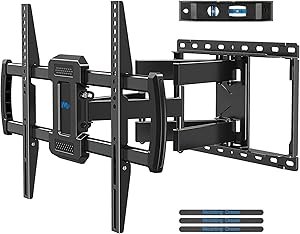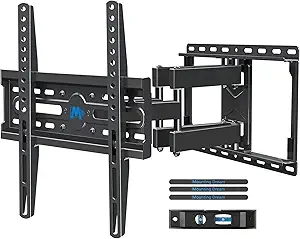
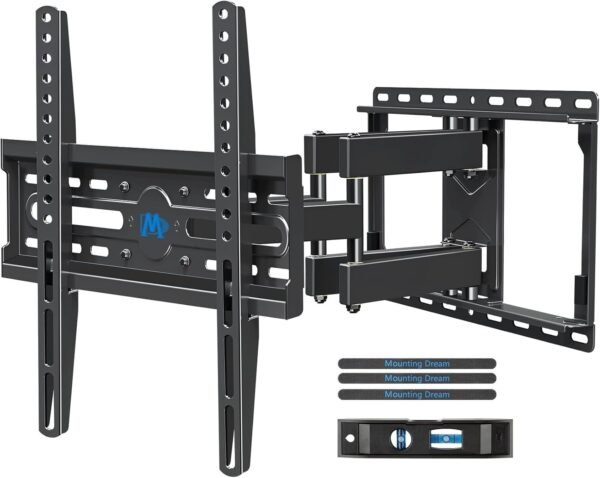
Description
What is behind your drywall, and how far apart is it?
Wall mount shopping starts at the wall, not at the television. Mounting Dream states this plainly and puts it in an unexpected place, at the end of a customer support bullet: these mounts are not for drywall installation. That single line is the most important thing on the listing. A full motion mount holding a television on extended arms produces a large leverage load on its fixings, and drywall anchors do not hold it. The bracket has to go into wood studs or into masonry with the correct anchors, and Mounting Dream notes that concrete anchors of 10 by 50 millimeters are available on request.
The second measurement is stud spacing. The MD2380 is built for 16 inch centers, which is the most common framing spacing in American homes but not the only one. Mounting Dream is direct about this too and names the alternative in the same bullet: if your studs are further apart, the MD2380-24K version handles 16, 18 and 24 inch spacings. Find a stud, find the next one, measure between the centers, and buy accordingly. Getting this wrong is not a mount that wobbles, it is a mount you cannot fit.
Only then does the television matter. This bracket is rated for 32 to 65 inch sets up to 99 pounds, with a maximum VESA pattern of 400 by 400 millimeters, which is 16 inches square. VESA is the bolt hole spacing on the back of the television, and it is published in every television manual even when the retail listing omits it. Check the pattern and the weight, both, because a 65-inch set can exceed the pattern limit even when it is well within the weight limit.
The specification that decides between mounts is the extension range
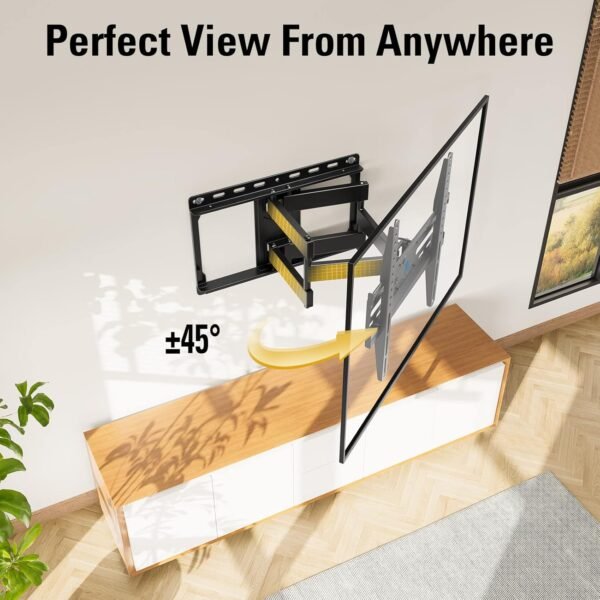
All wall mounts fall into three groups and they solve different problems. A fixed mount holds the television flat and close to the wall. A tilting mount adds downward angle for a set placed high. A full motion mount, which is what this is, adds arms that pull the television out from the wall and swivel it left or right.
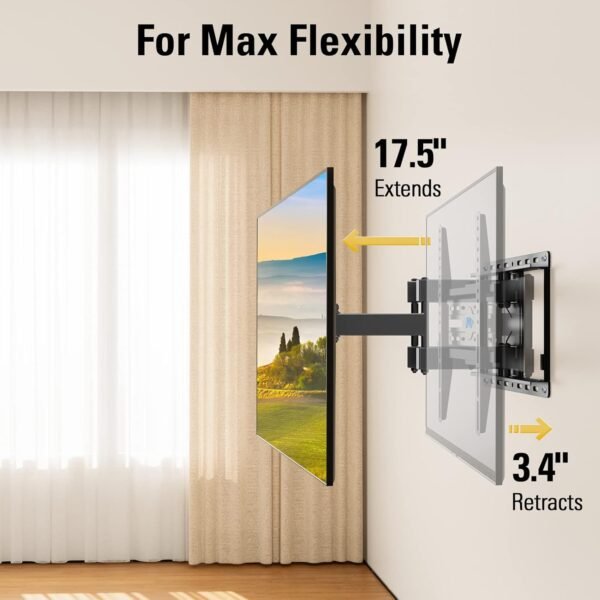
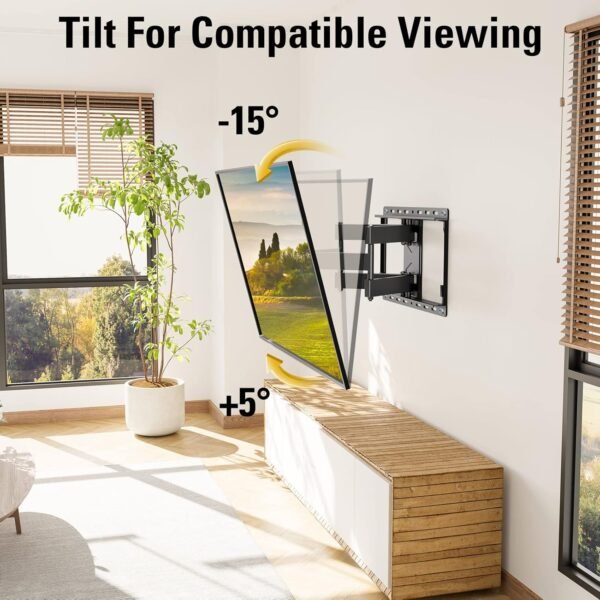
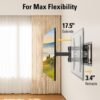
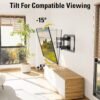
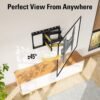
The numbers here are the ones to compare. This mount retracts to 3.4 inches from the wall and extends to 17.5 inches. It tilts up 5 degrees and down 15 degrees. Those figures decide whether it solves your particular problem. Retracted at 3.4 inches, the television sits close enough to look deliberate rather than propped away from the wall. Extended at 17.5 inches, it can be pulled clear of a corner or an alcove and turned toward a kitchen, a dining table or a second seating area. If your room only needs the set to face one direction, you are paying for arms you will never move and a fixed or tilting mount will sit flatter.
Why the tilt range is asymmetric, and why that is correct
Five degrees up and fifteen degrees down looks lopsided until you think about where televisions get mounted. Sets go above eye level far more often than below it, over a fireplace or high on a wall, and the correction needed is downward. Fifteen degrees of down tilt is enough to square a screen mounted a couple of feet above seated eye level. The five degrees of up tilt exists mainly for fine correction and for the rare low mount.
Tilt also does something less obvious, which the listing mentions: it reduces glare. A window or a light behind the viewer reflects off the screen at a predictable angle, and a few degrees of tilt moves that reflection off the picture. It is a cheaper fix than moving the furniture.
Mounting Dream also lists a plus or minus 3 degree post installation adjustment, which is the feature installers care about most. No wall is perfectly plumb and no bracket goes on perfectly level, and being able to correct a slight tilt after the television is hanging is the difference between a job that looks right and one that nags at you.
Living with it: the install, the hardware and the wear points
The listing describes the installation aids in some detail, and they are the things that make a two hour job into a one hour one: a paper template for marking the holes, hardware supplied in pre labeled bags, and storage on the bracket itself for the Allen key. That last one sounds trivial and is not, because the key is what you need in two years when you want to adjust something and the box is long gone.
Construction is described as robot welded with six articulating arms. There is a small inconsistency worth naming: the product title calls it a dual arm bracket while a feature bullet calls it six articulating arms. Both describe the same thing from different angles, since a dual arm design is built from multiple linked segments, but the listing states it two ways without explaining.
The bracket itself weighs 11.16 pounds and ships in a 17.13 by 9.17 by 3.19 inch box. On a full motion mount, the parts that wear are the pivot joints and the friction that holds a position. A mount that is moved daily will loosen over years in a way a fixed mount never does, which is another reason to buy full motion only if you will use the motion.
Cable management is the step most people skip. On an extending mount the cables have to have enough slack to reach full extension and enough tidiness not to sag when retracted, and that has to be planned before the television goes on, not afterwards.
When a different bracket is the right answer
If your studs are not on 16 inch centers, this is not the model, and the listing names its own alternative. If your television is larger than 65 inches or heavier than 99 pounds, look at a heavier bracket, and check the VESA pattern too, since large sets frequently use 600 by 400 millimeters. The Mounting Dream MD2296 full motion mount review covers the sibling model in this range.
It is worth checking the mount against the set you actually own. The TCL 55S421 review and the Hisense 55-inch A6 Series review sit comfortably inside the 32 to 65 inch and 99 pound envelope, as does the VIZIO M-Series Quantum 55-inch review. At the top of the range the LG 65-inch UQ7570 review is the size where the VESA pattern needs checking rather than assumed.
The rest of the brackets are in the TV wall and ceiling mounts category, and the sets they carry are in the LED and LCD televisions category.
Who should buy it and who should not
It suits a wood framed wall on 16 inch centers, a television between 32 and 65 inches and under 99 pounds with a VESA pattern of 400 by 400 millimeters or smaller, and a room where the screen genuinely needs to swivel or pull out. The post installation levelling adjustment, the template and the labelled hardware make it a reasonable first mount for someone who has not fitted one before. The listing shows 43,624 ratings averaging 4.8 stars, ranked first within TV wall and ceiling mounts and 32nd across electronics, which is an unusually deep base of owner feedback for a bracket that has been listed since January 2015.
It does not suit a drywall only wall, studs at anything other than 16 inch spacing, a set over 65 inches or over 99 pounds, or a room where the television only ever faces one way. In that last case a fixed or tilting bracket costs less, sits flatter against the wall, and has nothing to loosen.