Description
What are you actually trying to move, and how far?
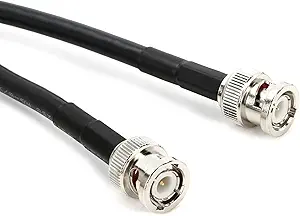
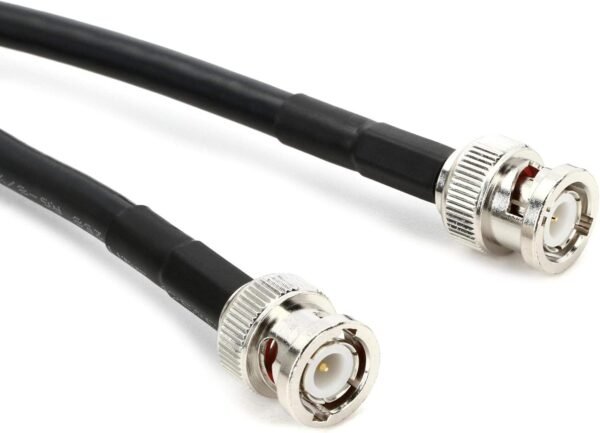
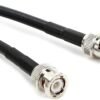
This is not a television antenna cable and buying it for a television will not work. The Shure UA825 is a 25 foot BNC to BNC coaxial jumper made to move the receiving antennas of a professional wireless microphone system away from the equipment rack. Shure lists the compatible hardware explicitly: the P9T and P10T transmitters and the QLXD4, BLX4R, SLX4, SLXD and ULXD receiver series. If your equipment is not on that list, or if the connector on your gear is a threaded F type or a push on coaxial connector rather than a bayonet BNC, this cable does not fit it.
The problem it solves is specific and common in live sound. Wireless receivers get racked, and racks get put behind a wall, under a stage or in a closet. Metal, bodies and building structure all attenuate the signal, so the antennas need to be somewhere with a clear line to the performers while the receivers stay in the rack. Twenty five feet of cable is what gets them there.
So the decision is not really about the cable. It is about how far you need to move the antennas and what that distance costs you in signal. Every foot of coax loses some of the signal you are trying to protect, and at UHF frequencies that loss is not trivial.
The specification that decides it: RG8X at 25 feet
Shure gives the cable type as RG8X/U, which is a thinner and more flexible coax than full size RG8. That flexibility is the reason it is used for patching around a rack, and the cost is higher loss per foot than a thicker cable would have.
Here is the honest limit of what this listing supports: it publishes no insertion loss figure at any frequency. None. Nor does it state the characteristic impedance, though BNC coaxial jumpers of this type in wireless microphone systems are conventionally 50 ohm. If your system design depends on a loss budget, get the specification sheet from Shure rather than relying on the retail listing, because running long antenna cable without accounting for loss is how a wireless system that worked at soundcheck fails during a show. In many systems, an inline antenna amplifier is what makes a long run viable, and that is a separate purchase.
Connectors, weight and build
The connectors are BNC male on both ends, a bayonet type that twists and locks rather than screwing or pushing on. That locking action is the reason BNC is standard in professional video and RF work: it does not fall out when someone walks past the rack. The outer jacket is polyethylene and the whole cable weighs 1.01 pounds. The listing gives product dimensions of 7.5 by 7 by 1 inches, which describes the coiled package rather than the cable.
Shure records the indoor and outdoor usage field as outdoor, which is worth reading carefully. A polyethylene jacket handles being outside for a show; that is not the same as being suitable for a permanent buried or exposed installation, and the listing does not claim it is.
Living with an antenna cable
There is very little to say about maintenance and that is the point. There are no consumables and nothing to power. What fails on antenna jumpers is the connector, either from being yanked at an angle or from moisture getting into the joint, and both are handled by strain relief and by not leaving a connection exposed to weather.
Routing is the part worth thinking about. Antenna coax should not run alongside mains power for long parallel distances, and it should not be coiled tightly into a small loop, because tight bends change the cable geometry and therefore its behavior. Twenty five feet is enough to reach across a stage front, which also means it is enough to become a trip hazard if it is not taped or trunked.
Two things on this listing are simply wrong and are worth naming rather than repeating. The specification table has a field labeled Compatible Phone Models, which then lists Shure wireless microphone transmitters and receivers. These are not phones, and the field label is an import artifact rather than anything about the product. The table also gives Number of Pins as 2 for a coaxial connector, which does not describe how a BNC connector works. Treat both as data errors in the same family as the rest of the import problems on this catalog.
Antenna placement is worth a sentence because it determines whether the cable buys you anything. Moving a receiver’s antennas twenty five feet is only useful if the new position has a clearer path to the performers than the old one. Height helps, line of sight helps, and putting the antennas in front of the metal that was blocking them helps most of all. Moving them twenty five feet into a different corner of the same closet achieves nothing except adding cable loss, which is a real way to make a system worse while believing you have improved it.
It is also fair to say plainly that this product sits oddly in a category of television and radio receiving antennas. It is professional audio hardware. If you arrived here looking for something to improve television reception, none of it applies.
The listing shows 26 ratings at 4.9 stars, a rank of 1,397th in radio antennas, and an availability date of December 2004. A very high average on a small sample usually means a simple product doing exactly what buyers expected.
What would send you elsewhere
If your goal is receiving broadcast television, this is the wrong shelf entirely. Start with an actual receiving antenna such as the Antennas Direct 91XG or the Winegard FL5500A, and browse the television antenna category from there.
If you are working on radio rather than audio production, the antennas in the radio antenna category are the relevant hardware, including mobile designs such as the Diamond X30A dual band and the Comet CA 2x4SRNMO. Note that those use different connector standards, so a BNC jumper will not mate with them without an adapter.
Who it fits and who should skip it
Buy it if you run one of the Shure wireless systems Shure lists, if your receivers are racked away from clear line of sight, and if 25 feet is the distance that gets the antennas where they need to be.
Skip it if your connectors are not BNC, if you are trying to improve television reception, or if your run is long enough that signal loss needs calculating. Get the loss figures from Shure before committing to a long antenna run, because this listing does not publish them.