
Description
Do you have somewhere to put a 17 foot mast, and a license to use it?
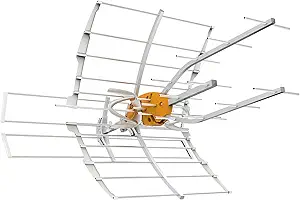
Both questions have to be answered yes before the Tram 1481 makes any sense. This is a base station antenna for the amateur radio bands, covering 144 to 148 MHz and 430 to 450 MHz. In the United States those are the two meter and seventy centimeter amateur allocations, and transmitting on them requires an amateur radio license. Receiving does not, but this antenna is rated for 200 watts of transmit power and it is built for people who transmit. Anyone who arrived here expecting a television antenna is in the wrong category, and this will not receive broadcast television.
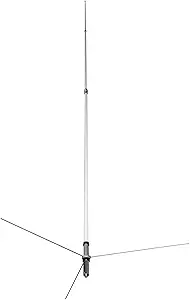
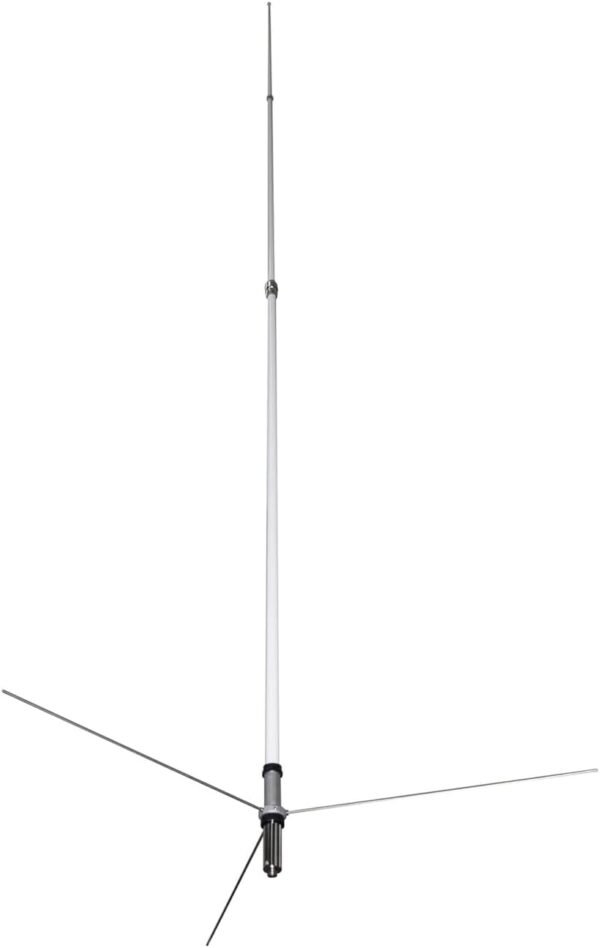
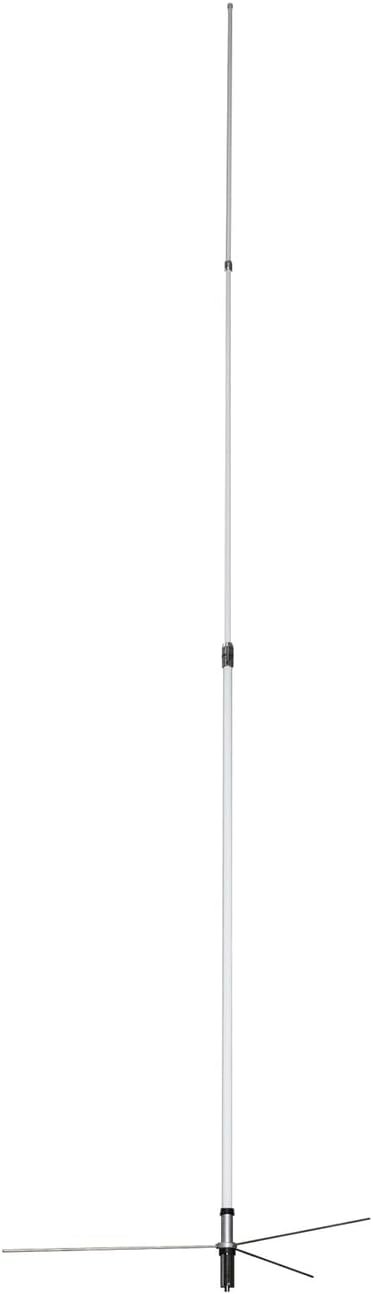
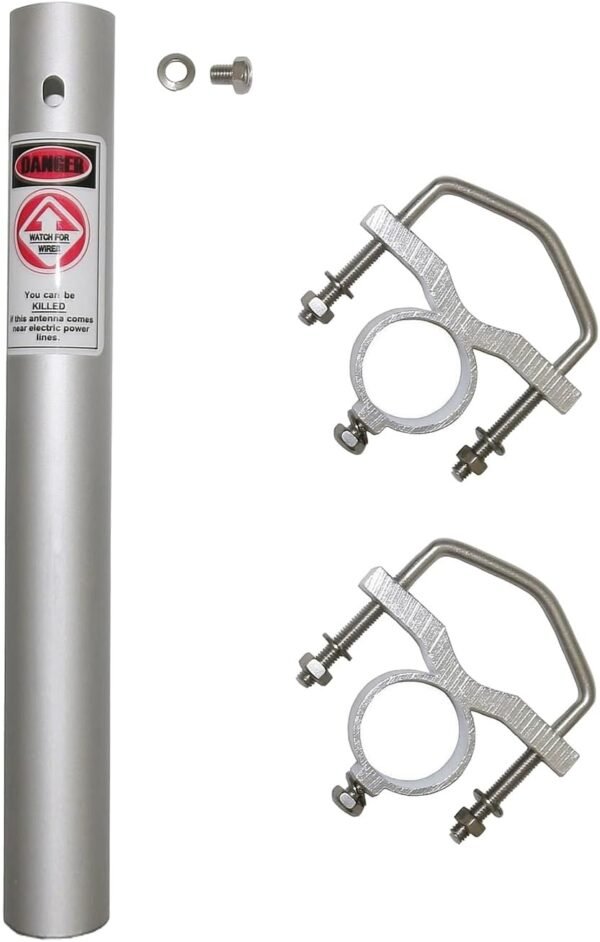
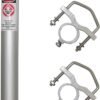
The physical question is just as binding. Tram states the antenna is 17 feet tall in three sections. That is a mast the height of a two story building, mounted to a bracket that accepts a pole between 1 and 3/16 inches and 2 and 7/16 inches in diameter. It needs a chimney, a roof tripod, a wall bracket or a ground mounted post, and it needs to be somewhere it can fall without hitting anything that matters. Height is the whole point of a base antenna, since VHF and UHF propagation is largely line of sight, but height is also the whole risk.
Note that the listed product dimensions of 70.5 by 5.25 by 3.25 inches describe the shipping carton with the three sections nested, not the assembled antenna. The assembled height is the 17 feet quoted in the title. Do not plan a mount around the smaller figure.
The specifications that decide it: gain figures on both bands
Tram publishes gain separately for each band, which is the right way to do it: 8.3 dBd across the 144 to 148 MHz range with a 4 MHz bandwidth, and 11.7 dBd across 430 to 450 MHz with a 20 MHz bandwidth. Those are stated in dBd, referenced to a dipole, rather than the dBi figure that makes numbers look larger, which is worth noticing when comparing against another manufacturer’s claims.
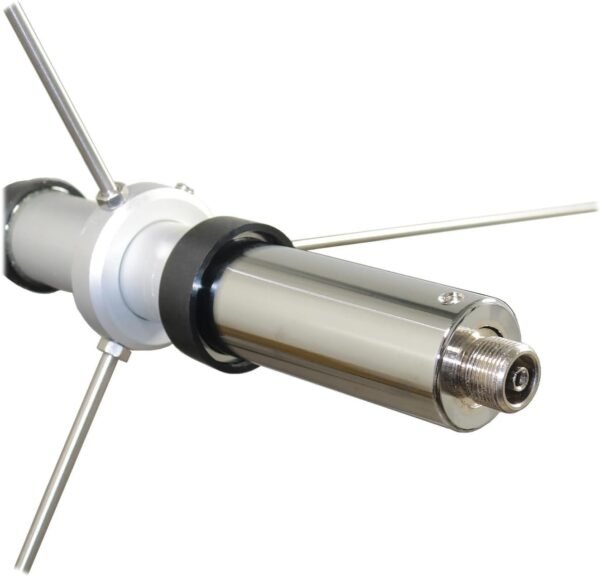
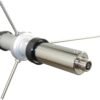
High gain on a vertical antenna is achieved by flattening the radiation pattern toward the horizon rather than by creating energy. That is exactly what you want for reaching distant repeaters and stations at ground level, and exactly what you do not want if the intended contacts are satellites or aircraft overhead. The design is described as a 5/8 wave three element arrangement on one band and an eight element c-load on the other, with 20 and a half inch radials at the base.
The connector and the impedance
The feedpoint is a UHF SO-239 socket at 50 ohms, which is the standard for amateur equipment and means a PL-259 terminated coaxial cable connects directly. The 50 ohm figure appears in the specification table as well as the description, so there is no ambiguity there. Radio equipment expecting 75 ohms will not match this properly, which is another reason it is not a television antenna.
Living with it: weather, static, and the safety side of a 17 foot mast
Tram states the radiator and coil are hermetically sealed inside fiberglass tubing, and that the joints between sections are designed so each retains the strength of a single piece. Water ingress at a joint is the usual failure mode on multi section fiberglass antennas, and it shows up as rising standing wave ratio rather than as an obvious break. Sealing the connector at the base with proper self amalgamating tape after installation is a maintenance step the listing does not mention and every installation needs.
The wind rating is stated at a maximum of 90 miles per hour. That is a figure for the antenna, not for whatever it is bolted to, and a 17 foot lever arm exerts substantial force on a bracket in a storm. The mount and its fixings are the part that decides whether the installation survives, and they are not included beyond the supplied bracket with three stainless radials.
The construction is described as DC grounded, which allows static charge to bleed away rather than accumulate. That reduces receive noise and is a real electrical property. It is not a substitute for a proper station ground and lightning protection system, and any antenna installed at height should be bonded and protected according to local electrical code and the relevant national standard. The listing describes static dissipation and lightning protection in the same sentence, and those are related but not the same thing. Treat grounding as a job to plan properly rather than a feature that comes in the box.
The most important safety consideration is not in the listing at all. Raising a 17 foot conductive mast means keeping well clear of overhead power lines, in every direction the antenna could fall during the raising. That is not an abstract precaution and it is the single thing to plan around before anything else. Two people, a clear area and a check overhead.
The antenna weighs 5.39 pounds, is finished in white, has been available since December 2013 and shows 303 ratings at an average of 4.3.
When a different antenna fits the situation
If the station is mobile rather than fixed, a base antenna of this height is the wrong object entirely and a mobile whip is what you want. The Comet CA-2x4SRNMO covers the same two bands from a vehicle mount, and the Tram 1180 is another option from the same manufacturer.
If you want a base antenna but with a different mechanical design or gain profile, the Diamond X30A is the direct comparison and is shorter, which matters if the mounting point is constrained. For citizens band rather than amateur bands, the Stryker SR-A10 serves a different service entirely. The rest sit under radio antennas, and if broadcast television is actually what you need, that is the TV antenna category instead.
Who should buy it and who should not
Buy it if you hold an amateur license, work the two meter and seventy centimeter bands from a fixed location, and have a mounting point that can carry a 17 foot fiberglass mast safely. Published gain figures on both bands in dBd, a sealed fiberglass radiator, a DC grounded design and a 50 ohm SO-239 feedpoint make it a straightforward station antenna.
Skip it if there is nowhere safe to mount it, if the interest is receiving broadcast television, or if the operating is done from a vehicle. Before ordering, plan the mast, the mount fixings, the coaxial run and the grounding as one job, and check what is overhead at the raising site. The listed carton dimensions are not the assembled height.