Description
How far are you from the transmitters, and what stands between you and them?
Antenna shopping is the one part of home entertainment where the product matters less than the address. Two houses on the same street get different results from the same antenna depending on which way the windows face, what the walls are made of, and whether a hill sits in the path. So before any specification matters, find out where your local transmitters are, which direction they lie in from your home, and whether they broadcast on UHF or high VHF. Public reception maps and several free tools will tell you that in a couple of minutes, and the answer decides whether an indoor antenna is realistic at all.
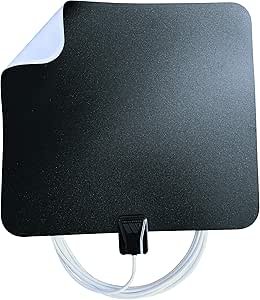
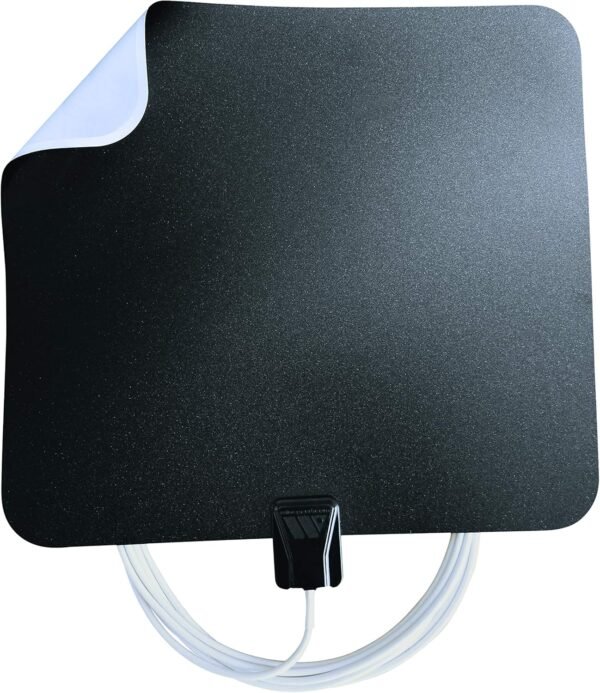
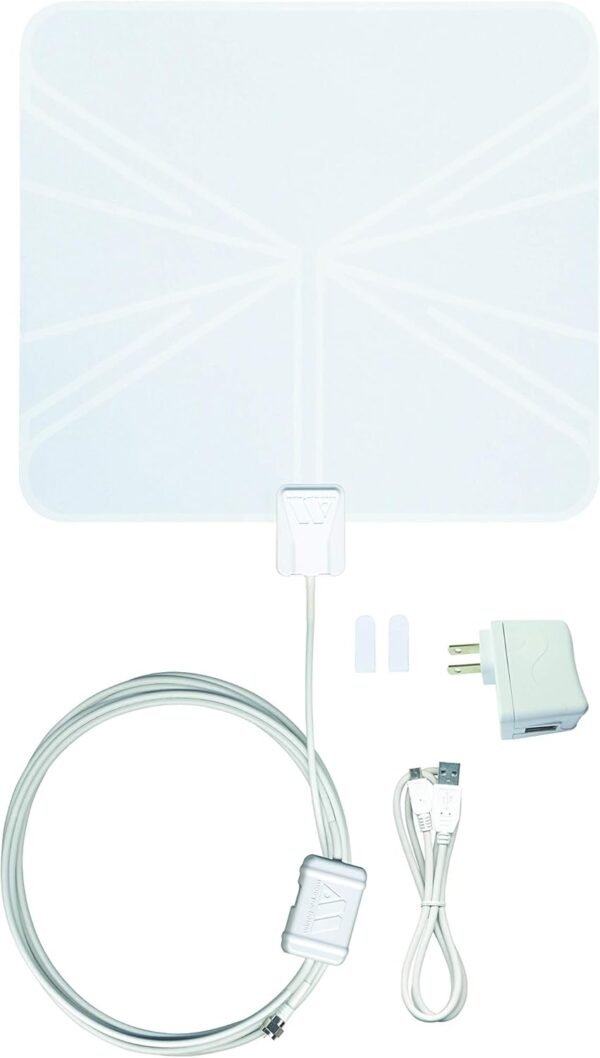
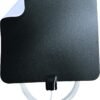
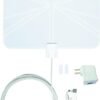
The FL5500A is a flat indoor panel, roughly 13 inches by 12 inches by 0.6 inches, designed to be stuck to a wall or a window with the two 3M Command strips Winegard includes. That form factor is the point, since it disappears behind a curtain or beside a window frame. It is also the limitation, since an indoor antenna works through your building’s walls, and the same antenna in an attic or outdoors would do better.
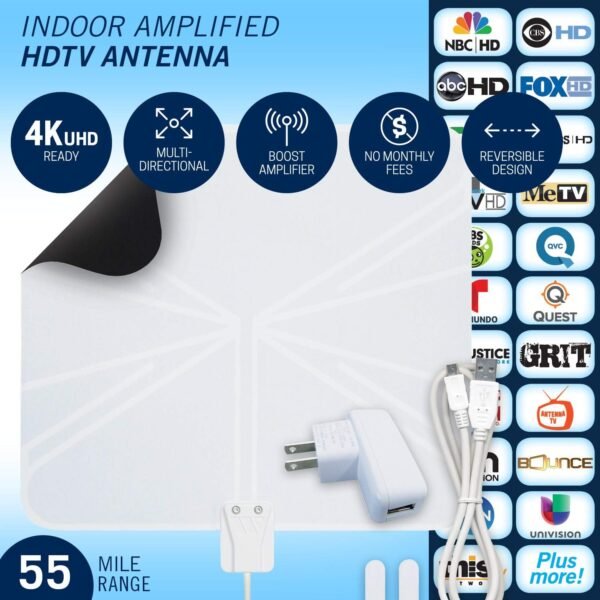
Winegard describes it as multi-directional, which means it does not have to be aimed precisely at one tower. That is useful where local stations broadcast from more than one site. It is not the same as omnidirectional, so there is still a better and a worse orientation.
Amplification and band coverage are what decide this one
Two things separate this model from Winegard’s unamplified FlatWave. The first is the embedded amplifier. Winegard calls it Clear Circuit Technology and states a noise figure of 1.0 dB, compared with 3 dB or more from other preamplifiers. The second is where that amplifier sits: embedded at the antenna elements rather than partway down the cable.
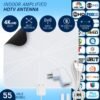
The band coverage needs reading carefully. The product title says high VHF and UHF. High VHF is broadcast channels 7 through 13. Low VHF, channels 2 through 6, is not covered, and several feature bullets describe the antenna simply as dual band VHF and UHF without drawing that distinction. If any station you need still occupies a low VHF channel, this antenna is not designed to receive it. Winegard also lists the antenna as NextGen TV compatible, which is the consumer name for ATSC 3.0, and since ATSC 3.0 uses the same frequencies as the current standard, that claim amounts to saying the antenna does not stand in the way rather than that it adds a capability.
What a 1 dB noise figure at the antenna is worth
Amplifier placement is one of the few points where the marketing and the engineering agree. In any receiving chain the noise figure of the first stage dominates the noise figure of everything after it. Signal that has already travelled down 18 feet of coax has picked up loss, and amplifying it at the television end amplifies the noise along with it. Putting a low noise amplifier directly at the elements means the weakest signals are boosted before that loss happens, which is why a 1 dB figure at the antenna is worth more than a larger gain figure at the other end of the cable.
What amplification cannot do is create signal that is not there. In a strong signal area an amplifier can actually make reception worse by overloading the tuner front end, which shows up as channels that break up at close range and work fine further away. If you live within a few miles of the transmitters, the unamplified version of this antenna is often the better buy.
Living with it: placement, the cable you actually get, and the rescan habit
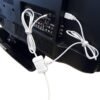
Placement is the whole game with an indoor antenna. Highest practical point, on or near a window, on the side of the building facing the transmitters, away from metal window screens, foil backed insulation and large appliances. Winegard’s Command strips make repositioning cheap, so try three or four spots and run a channel scan at each. Two feet of movement can change the channel count noticeably.
The cable is where the listing contradicts itself, and the difference is practical rather than cosmetic. The product title says a 6 foot cable. The description and two feature bullets say an 18.5 foot mini coax cable attached to the antenna. Eighteen and a half feet lets you put the antenna at a window and the television across the room. Six feet does not. Since the cable is attached, this is not something you can correct afterwards with a longer lead, so confirm the length with Winegard before ordering if the run is long.
The weight is given two ways as well: 5.4 ounces in the specification table and 0.6 pounds, which is 9.6 ounces, in the description. Neither is heavy enough to matter for the adhesive strips, but it is another sign that the fields were never checked against each other. The stated impedance of 74.99 ohms is simply the standard 75 ohm coaxial figure carrying a rounding artifact.
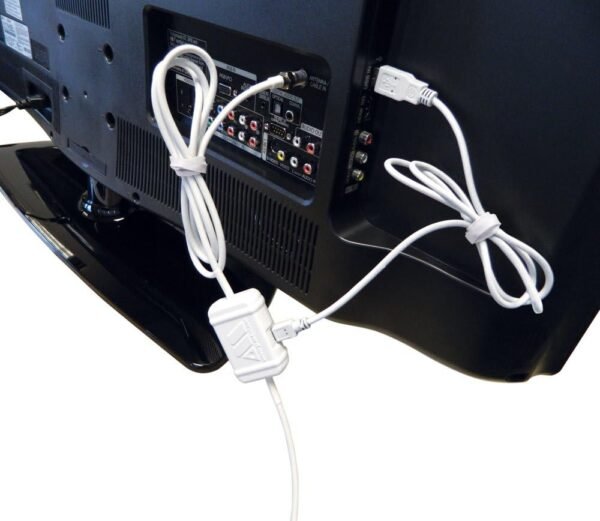
Power comes from a 3 foot USB cable with a 110 volt adapter, and an LED confirms the amplifier is running. If your television has a spare USB port you can skip the wall adapter. Finally, build the rescan habit. Winegard is right to press this point: broadcasters change frequencies more often than viewers expect, and running a channel scan monthly and after any repositioning is what keeps the lineup complete.
When a different antenna is the right answer
The mile range figure on this listing is itself inconsistent, a useful reminder of how little those numbers mean. The title, the description and four bullets say 60 miles, while a fifth says 50 miles. Range claims depend on transmitter power, terrain and antenna height, none of which the manufacturer controls, so treat any such figure as marketing shorthand rather than a specification.
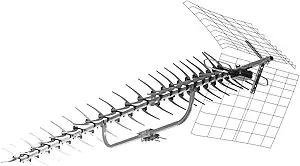
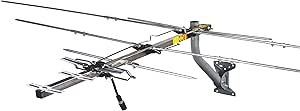
If you are far from the transmitters, or the stations you want are in one direction and weak, an outdoor directional antenna will outperform any flat indoor panel. The Antennas Direct 91XG outdoor UHF antenna review covers a high gain directional option, and the Winegard YA7000C review covers Winegard’s own outdoor VHF answer for the channels a UHF only antenna misses. If you want outdoor performance in a less conspicuous package, the Televes Ellipse Mix review covers a compact outdoor unit.
It is also worth confirming the television at the other end of the cable is doing its part, since tuner sensitivity varies between sets. The TCL 32S327 review and the VIZIO 50-inch V-Series review both cover sets with built in tuners and RF inputs. The rest of the range sits in the TV antennas category, and the sets themselves are in the LED and LCD television category.
Who it suits and who should not bother
It suits an apartment or a house within reasonable reach of the transmitters, where the stations you want sit on UHF or high VHF, and where an outdoor installation is either not allowed or not wanted. The low noise amplifier placed at the elements is a real design advantage for marginal signals, and the flat panel is easy to hide. With 8,903 ratings averaging 4.0 stars and a rank of 94th within TV antennas, it carries a deep history of owner feedback.
It is the wrong choice if you are very close to the transmitters, where an unamplified antenna likely behaves better, or if you need low VHF channels, or if you are far enough out that only an outdoor antenna will do. And if the cable really is 6 feet rather than 18.5, check that against your room layout before ordering, because the lead is attached and cannot be swapped.