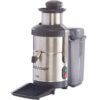

Description
How many juices do you make before ten in the morning?
That question sorts this machine from every home juicer on the market. A domestic centrifugal juicer is designed for a few glasses a day, with a pause between them and a sink nearby. The Robot Coupe J80 Ultra is designed for a service window: a juice bar at breakfast, a cafe running a menu of fresh juices, a hotel buffet, a restaurant prepping mixers. If you make one glass in the morning, everything below is more machine than the job needs.
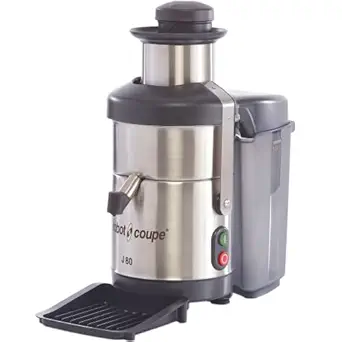
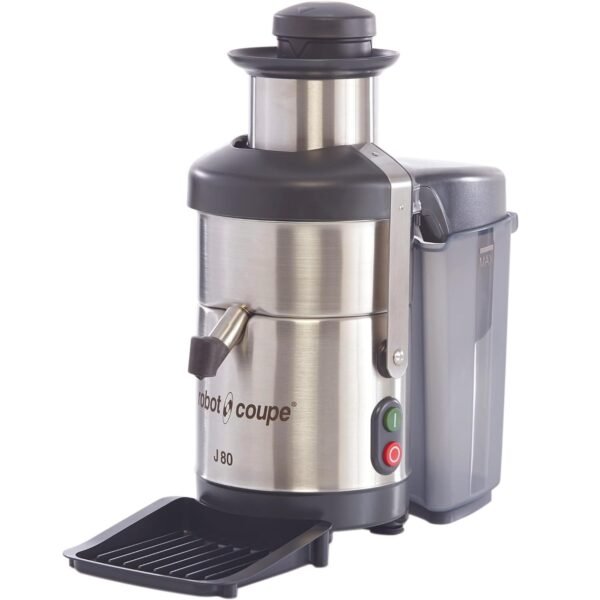
The evidence for that is in the design rather than the marketing. Robot Coupe lists a 1.25 horsepower motor turning at 3,000 rpm, an automatic feed with pulp ejection, and a 6.5 quart waste container. That last figure is the one that gives the game away. A home juicer holds pulp in a small bin that fills after two or three fruits and interrupts you. Six and a half quarts is sized so that nobody has to stop and empty anything during a rush.
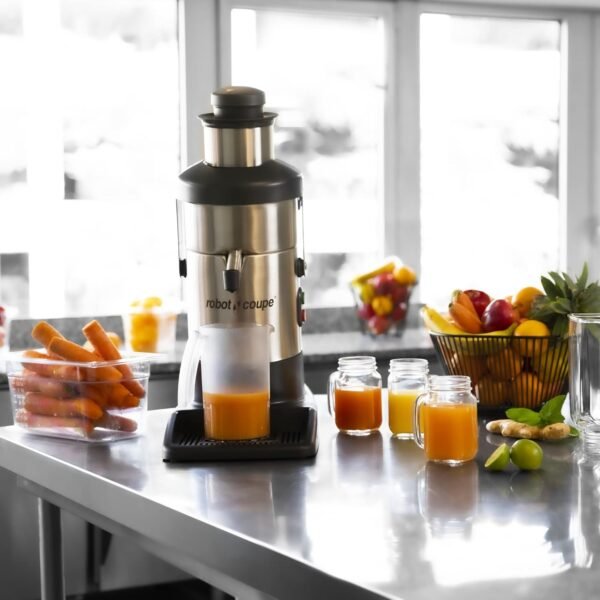
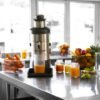
The listed dimensions are 21 by 9.25 by 19.75 inches. Note the height. At just under 20 inches this will not fit beneath standard 18 inch wall cabinets, so it wants an open bench, a prep table or a service counter, which is exactly where equipment of this kind normally lives.
The mechanism that decides it: continuous feed and pulp ejection
Centrifugal juicing works by grating fruit against a spinning disc and throwing the juice out through a mesh basket by centrifugal force. Robot Coupe lists a 2.5 millimeter grating disc and a fine mesh filter basket for this model. The grating disc size sets how finely produce is broken down before the spin, and the mesh determines how much fine pulp ends up in the glass.
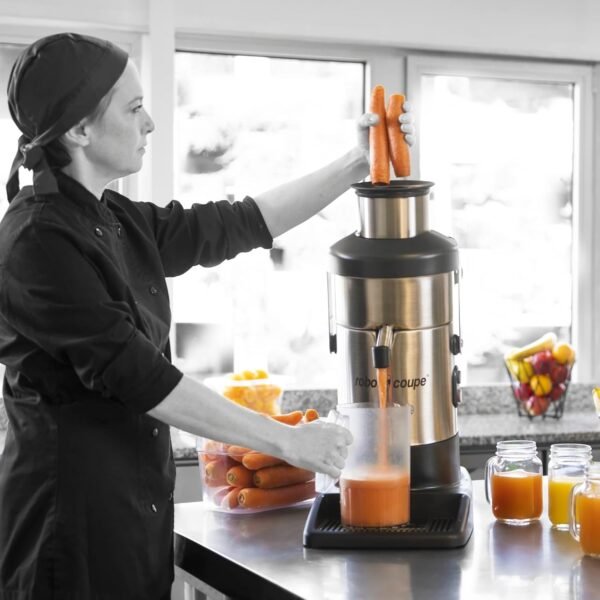
The part that separates commercial from domestic is pulp ejection. On a machine without it, the basket fills with fiber, extraction efficiency drops, and you stop to disassemble and clean it out. With automatic ejection the pulp is thrown clear into the waste container continuously, so the machine holds its output over a long run. Combined with the auto feed, this is designed to be loaded and left rather than fed one apple at a time.
Speed, and what it costs you
Three thousand rpm is fast, and fast has a trade off worth understanding before you buy. Centrifugal juicers introduce air and some heat into the juice, which is why the result is best served immediately and why it separates in the glass sooner than juice from a slow press. A commercial operation serving to order does not care, because the juice never sits. A household making a jug for the day probably does care, and should look at masticating machines instead. That is not a defect in this juicer. It is a consequence of choosing throughput.
Living with commercial equipment
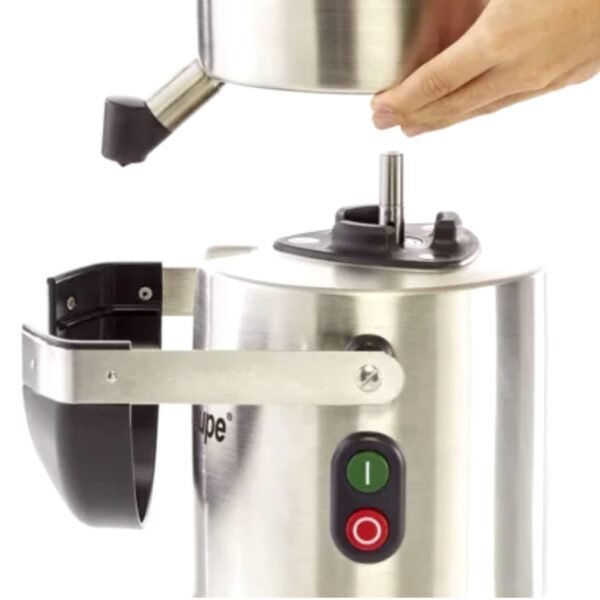
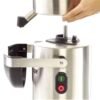
Construction is a stainless steel motor base with an anti drip spout, and the spout is a more meaningful detail than it sounds. In service, a juicer that dribbles between glasses turns a clean station into a sticky one within an hour, and sticky attracts fruit flies. An anti drip spout is a sanitation feature dressed as a convenience.
Cleaning is the honest running cost of any centrifugal juicer. The filter basket and grating disc need brushing out after service, because dried pulp in a fine mesh is far harder to remove than wet pulp. Nothing about the mechanism changes that. What varies between machines is how quickly the parts come apart, and the listing does not publish a teardown time or a dishwasher rating, so ask the seller which components are rated for a commercial dish machine.
Power is 120 volts, which means it plugs into a standard outlet rather than needing a dedicated commercial supply. The listing gives the weight as 16 pounds, which is light for a stainless bodied commercial juicer and reads more like a component or shipping figure than the assembled machine. If bench loading or portability matters, confirm the assembled weight with Robot Coupe rather than relying on that number.
Noise is worth planning for in a customer facing space. A 3,000 rpm motor grating hard produce is loud by the standards of a quiet cafe, and unlike an espresso grinder it runs for as long as the fruit keeps coming. If the juicer sits on a front counter rather than in a back prep area, that noise becomes part of the room. Placement also affects splatter: centrifugal machines throw a fine mist that settles on nearby surfaces, so the space around the unit needs to be wipeable rather than porous.
The listing has a genuine data hole worth naming. The Customer Reviews field, which should carry a star rating and a count, instead contains the sales rank text repeated from another field. There is no star rating or review count on this page at all, while a separate rating field shows a bare 4 with nothing behind it. The description field is also empty, so the only substantive product information is in the feature bullets. It has been listed since January 2010 and shows a rank of 164th in centrifugal juicers. Do your verification through a foodservice dealer rather than through retail reviews for this one.
What would send you somewhere else
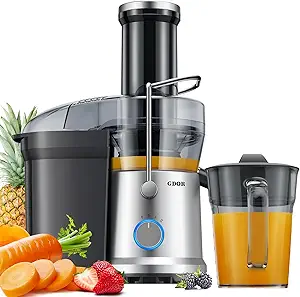
For a home kitchen, a smaller centrifugal machine is the right shape of purchase. The Gdor JE2106 covers the same extraction method at domestic scale, and the wider centrifugal juicer category is where that comparison sits.
If the goal is juice that keeps for a day rather than juice served immediately, a slow press is the mechanism you want. The Kuvings AUTO10W cold press and the Hurom H400 both run at a fraction of these speeds, both run at a fraction of these speeds. The masticating juicer category collects the slow press options together, and they are a different bargain: slower to feed, slower to clean, and a juice that separates less in the glass.
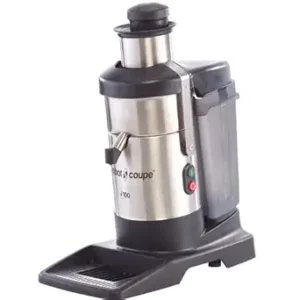
If you are outfitting a commercial kitchen rather than a home, the same maker’s Robot Coupe R2 Dice food processor is built to the same duty expectations and the same equipment class, and the larger Robot Coupe J100 steps up in capacity.
Who it fits and who should skip it
Buy it if you are juicing to order in volume, if you have open bench height and a routine that includes brushing out a filter basket after every service, and if the 6.5 quart waste container solves a problem you currently have.
Skip it if this is for a home kitchen, if it needs to fit under a cabinet, or if you want juice that holds overnight. And because this listing publishes no review data and no description at all, verify the current specification and warranty with a foodservice dealer before ordering.