
Description
How many mornings will you stand there feeding a chute?
The reason most juicers end up in a cupboard is not the juice. It is the ten minutes of standing at the counter pushing pieces of apple down a tube one at a time, having already spent ten minutes chopping them small enough to fit. Slow juicers make better juice and they make it slowly, and the feeding is the part people quietly stop doing.
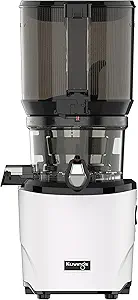
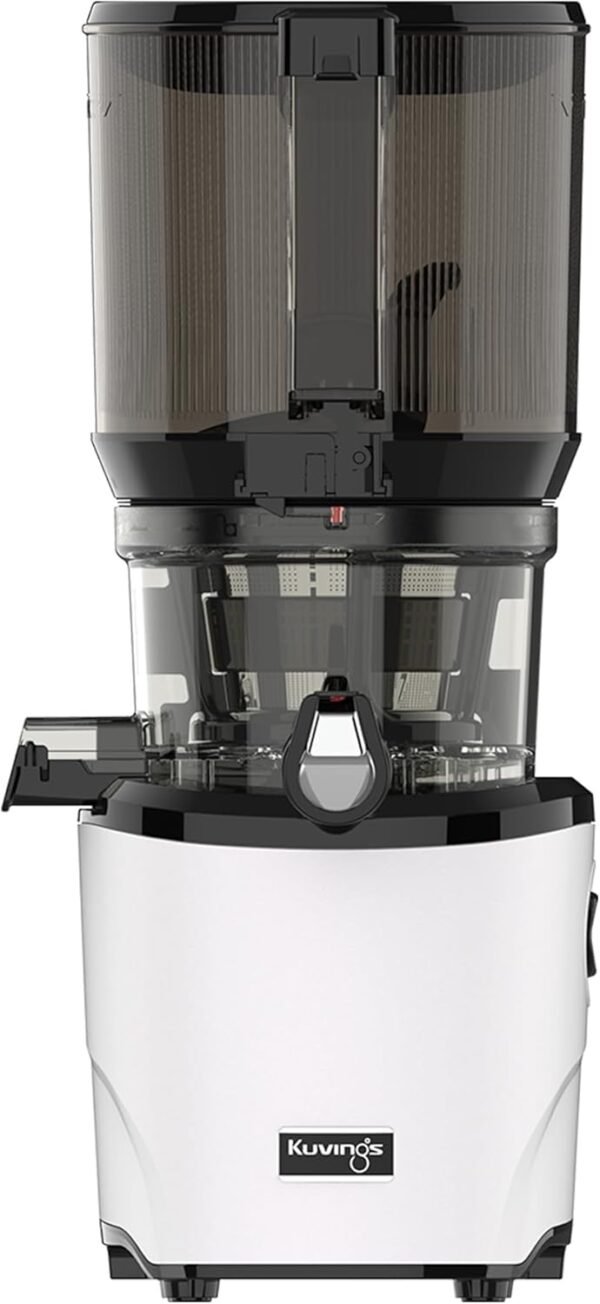
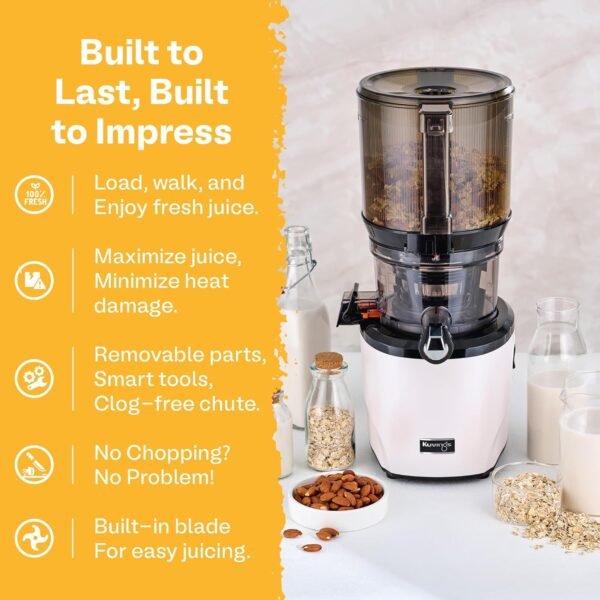
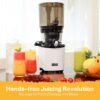
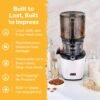
The Kuvings AUTO10 is aimed squarely at that. It has a 3 liter hopper, roughly 100 ounces, with an auto cutting blade. Kuvings describes the workflow as loading whole fruits and vegetables, closing the lid and walking away while the machine cuts and feeds itself. If your objection to cold press juicing has been the labor rather than the result, that is the specification that matters and everything else is secondary.
The practical question is where it lives, and here the numbers are demanding. The unit is 18.07 inches tall, 10 inches wide and 8.15 inches deep, and weighs 23.8 pounds. Eighteen inches will not fit under standard wall cabinets, and you need clearance above that to open the hopper lid and drop produce in. At almost 24 pounds this is not a machine that gets lifted out for weekend use. It needs a permanent home on open counter.
What a 240 watt slow motor is doing
The motor is rated at 240 watts, which looks small next to a centrifugal juicer drawing several times that. That comparison is misleading. A masticating juicer works by crushing and pressing produce slowly against a screen rather than shredding it at high speed, so it needs torque rather than raw speed, and it does its work over a longer period.
Kuvings states the motor handles hard produce including kale, beets, carrots and pineapples, and that it runs 45 continuous minutes for large batches. That continuous run figure is the one to note, because slow juicers commonly have a duty cycle limit and hitting it mid batch means waiting for the motor to cool.
The trade of slow pressing against fast spinning is worth understanding rather than taking on faith. Slow juicing introduces less air and less heat, which is why the juice separates more slowly in the glass and keeps better in the refrigerator. Fast centrifugal juicing is quicker to do and quicker to clean, and the juice is best drunk immediately. Neither is universally better; they suit different habits.
Screens, and what else it makes
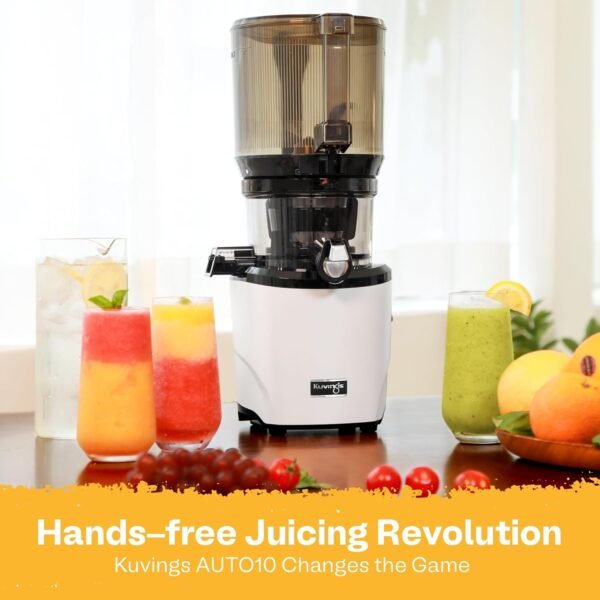
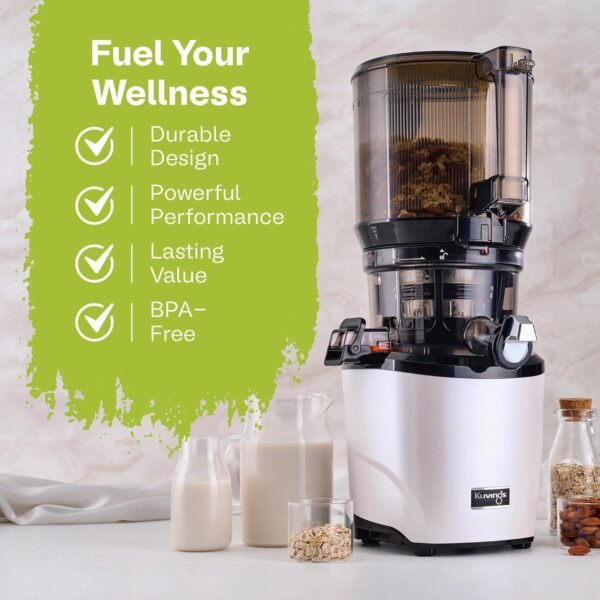
Three screens are included: juice, smoothie and sorbet. Changing the screen changes what the machine produces from the same mechanism, because the screen determines how much pulp passes through. That is what turns a juicer into a machine that also makes smoothies, frozen fruit sorbet and nut milk, and it is a meaningful widening of what a single appliance covers.
Living with it
Cleaning is the honest running cost of every masticating juicer, and Kuvings has clearly worked on it. The parts come apart, a dedicated cleaning tool is supplied, the pulp chute is redesigned to reduce clogging, and the Smart Cap detaches so the outlet can be cleaned properly rather than left to build up. That last detail matters more than it sounds, because a juice outlet that cannot be reached is where residue accumulates.
None of that removes the fundamental task. A slow juicer has a screen with thousands of small holes and fibrous pulp gets into them. It needs brushing out after each session, and it needs doing before the pulp dries, because dried pulp in a fine screen is a genuinely tedious job. Budget five to ten minutes after each use and the machine stays in service.
The product title describes the machine as quiet, and the listing publishes no decibel figure to support that. Slow juicers are inherently quieter than centrifugal machines because they run at a fraction of the speed, so the claim is plausible in kind, but treat the specific word as marketing rather than a measurement. The description field on this listing is empty entirely, so the feature bullets and the specification table are all there is.
Kuvings states a 15 year assurance on the product and 40 years in business. A long assurance period on a juicer is worth checking the terms of, because these normally cover the motor rather than the wearing parts. The screens and the auger are the components that age, and those are consumables over a long ownership.
The hopper changes how you shop as well as how you juice, which is the part worth thinking through before buying. A machine designed around batches encourages buying produce in quantity and juicing once every few days rather than every morning, and that only works if you have refrigerator space for both the produce going in and the juice coming out. Three liters of hopper is a lot of fruit and vegetables to have on hand at once. If your household buys small amounts fresh, the hopper advantage largely disappears and you are carrying the extra height and weight for nothing. There is also the pulp to deal with, and a batch machine produces it in batch quantities. Slow juicers eject a dry, dense pulp that is genuinely useful in soups, stocks, baking and compost, but it has to go somewhere within a day or it turns.
The listing shows 93 ratings at 4.5 stars, a rank of 54th in masticating juicers, and an availability date of June 2024. That is a decent early signal on a recent product.
What would send you elsewhere
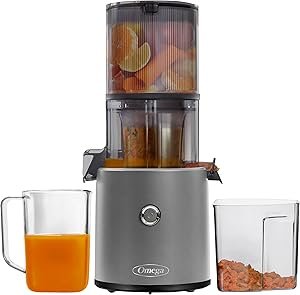
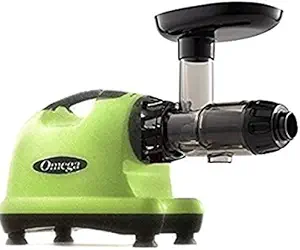
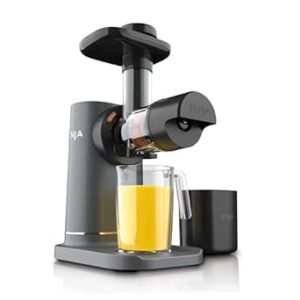
If you juice one glass at a time and do not mind feeding a chute, a conventional masticating juicer is smaller, lighter and cheaper. The Hurom H400 is the closest alternative on the self feeding idea, and the Omega JC2022 and Ninja JC151 are more compact takes on the same mechanism. The masticating juicer category lines them up.
If speed matters more than shelf life, a centrifugal machine gets juice into a glass in a fraction of the time and cleans faster, at the cost of juice that separates sooner. The centrifugal juicer category covers that route, and the Gdor JE2106 is the domestic version of it.
Who it fits and who should skip it
Buy it if you juice in batches rather than by the glass, if the hands free hopper is what would actually keep you using a juicer, and if you have 18 inches of open counter height for it.
Skip it if the machine has to fit under a cabinet or go away between uses, if you juice one glass a day, or if a five to ten minute cleaning routine after each session is not something you will keep up. Check what the 15 year assurance covers, since screens and augers wear.