


Description
Do you want juice quickly, or juice slowly?
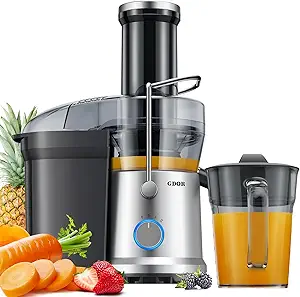
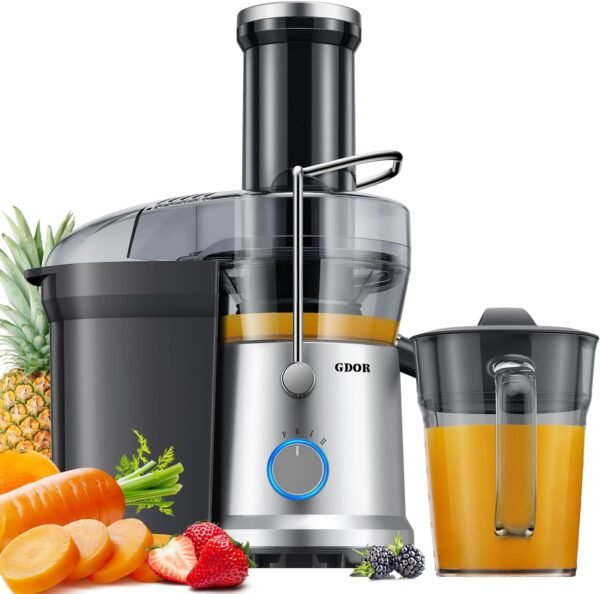
This is the fork in the road for every juicer purchase, and it decides more than any specification on the page. A centrifugal machine like the GDOR JE2106 spins a shredding disc at high speed and flings the pulp outward through a mesh basket. It is fast, it takes whole fruit, and it makes a lot of juice in a short time. A masticating machine crushes produce slowly with an auger. It is quieter, it handles leafy greens better, and it takes longer at both ends.
The tradeoffs are real and they run in both directions. High speed introduces air, which is why centrifugal juice foams and why it separates in the glass within minutes rather than hours. It also generates some heat at the cutting surface. Against that, a centrifugal machine will do a bag of apples and carrots in the time a slow juicer takes to do three, and for a household making a large jug in one go that speed is the entire point.
So the honest question is what your routine looks like. Weekend batch juicing for a family, or carrots and apples for a crowd, favors this machine. A single green juice every morning made from kale and celery favors a slow juicer such as the Ninja JC151, and the masticating juicers category covers that side.
The specifications that matter, and the ones that contradict each other
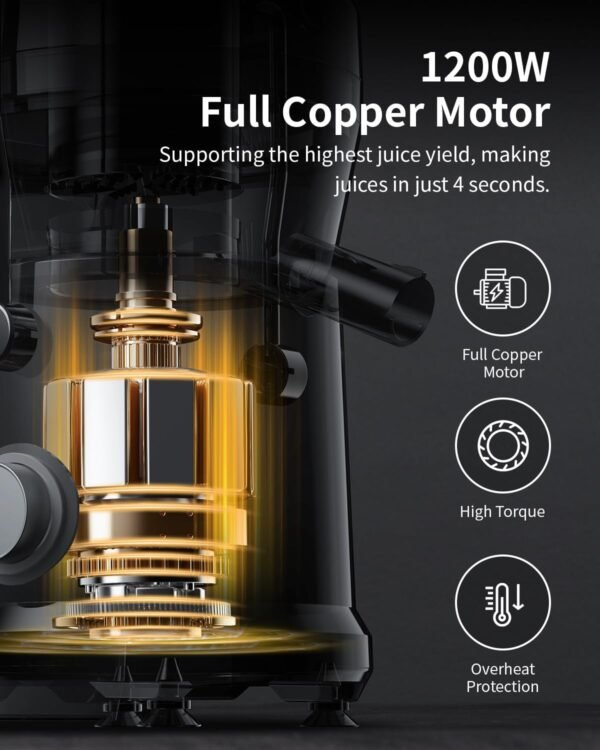
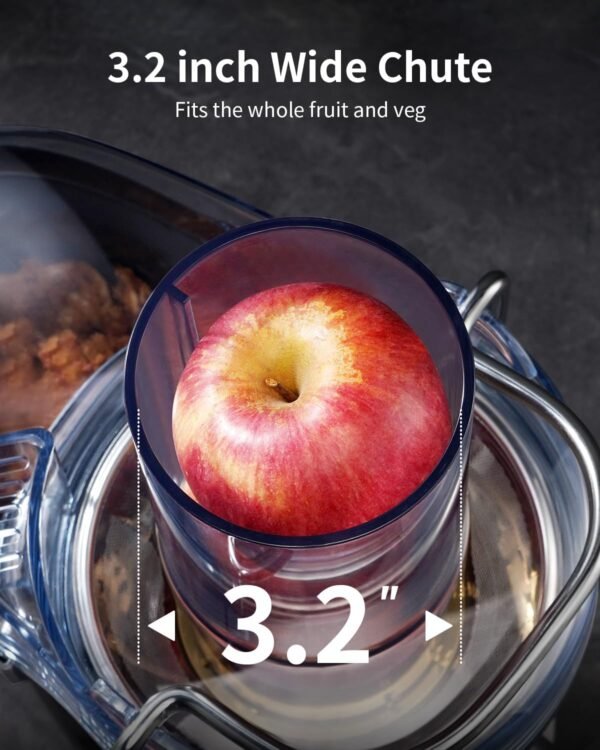
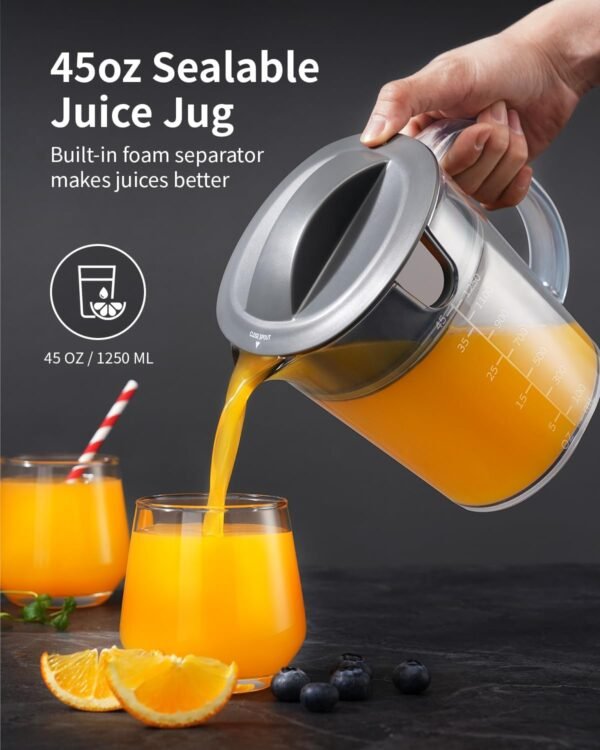
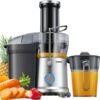
Three figures do real work here. The motor is quoted at 1200 watts maximum power on 120 volts, described as full copper, with overheat protection listed as a feature. The feed chute is 3.2 inches wide, which takes a whole apple and cuts prep time substantially. And the containers are generous: a 45 ounce juice jug with a sealable lid and a built in foam separator, plus a 70 ounce pulp bin. That pulp capacity is what determines how long you can run before stopping to empty it, and 70 ounces is large for a domestic machine.
The speed control is where the listing argues with itself. The product title says Dual Speeds. The attribute table says Number of Speeds: 3. The feature bullets describe three positions: a low setting for soft produce such as oranges and tomatoes, a fast setting for hard produce such as apples, celery, carrot and kale, and a P position described as the highest speed, reached after release, which reads as a momentary pulse rather than a continuous speed. The most consistent reading is two running speeds plus a pulse, but the listing states it three different ways and you should confirm it.
Cleaning instructions that cancel each other out
The Product Care Instructions field reads, in a single line: Hand Wash Only, Dishwasher Safe. Those cannot both be true, and the separate Is Dishwasher Safe field simply says Yes. The feature bullets give the usable version: some detachable parts are dishwasher safe on the top shelf only, and a cleaning brush is included. Take the bullet as the operative instruction and hand wash anything you are unsure about, especially the fine mesh basket, which is the part a dishwasher cycle is least likely to actually clean.
Two other fields do not survive scrutiny. Capacity is listed as 2.8 pounds, which is not a capacity of anything on a juicer. And the product dimensions of 11 inches deep by 15 inches wide by 6 inches high cannot describe a machine with a vertical feed chute and a jug standing underneath the spout. Plan on a taller footprint and confirm the real height before deciding where it lives.
Living with a centrifugal juicer
Two things dominate ownership, and neither is the juicing. The first is noise. A 1200 watt motor spinning a disc at high speed is loud, closer to a vacuum cleaner than a blender, and it runs for as long as you are feeding it. That is a genuine consideration in an apartment or an early morning household, and it is the main reason people move to slow juicers.
The second is the mesh basket. It is the part that separates juice from pulp, it clogs steadily during a session, and it is a fiddly thing to clean because pulp dries into the mesh within minutes. The included brush is not an accessory, it is required equipment, and the rule is to rinse immediately rather than leaving parts in the sink. A machine cleaned straight away takes about five minutes; the same machine left for an hour takes considerably longer.
The foam separator in the jug lid is a small feature that addresses a real annoyance, since centrifugal juice arrives with a head of foam that you would otherwise spoon off. The sealable lid lets the jug go into the refrigerator, though juice made this way is best drunk soon rather than stored, whatever the listing says about sealing in freshness.
Produce preparation still exists even with a 3.2 inch chute. Whole apples go in, but stone fruit needs pitting, citrus needs peeling because the pith turns the juice bitter, and anything with a hard core is better quartered than forced. The chute saves the chopping, not the sorting.
The listing records 172 customer ratings averaging 4.3 stars, a manufacture year of 2024, a first availability date of October 2024, and a rank of 50th in centrifugal juicers. That is a good category position on a young listing with a moderate sample.
What would send you to a different machine
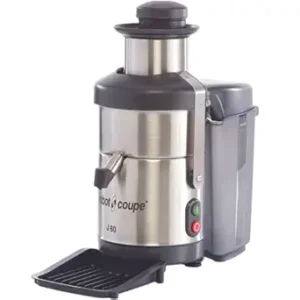
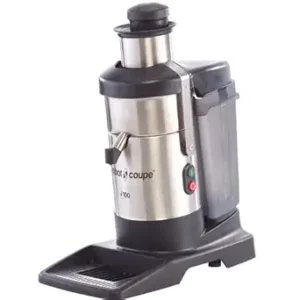
If the volume you are juicing is commercial rather than domestic, a household motor will not survive it. The Robot Coupe J80 Ultra and the larger Robot Coupe J100 are built for continuous service in a juice bar, with the duty cycle and the price that implies. The centrifugal juicers category shows the gap between the two tiers.
If noise or leafy greens are the sticking point, a slow juicer is the answer rather than a better centrifugal one. The Aeitto cold press juicer is the wide chute version of that idea, which keeps the prep saving while giving up the speed.
Who should buy the JE2106
Buy it if you juice in batches, mostly hard produce such as apples, carrots and celery, want to skip most of the chopping, and can live with the noise. The 3.2 inch chute, the 70 ounce pulp bin and the 45 ounce sealable jug are the three things that make a large session practical, and they are the reason to choose this over a smaller machine.
Do not buy it for daily green juice, do not plan the counter position from the published dimensions, and do not put parts in a dishwasher on the strength of a specification field that says both hand wash only and dishwasher safe in the same line. Confirm the speed count and the true height before ordering.