

Description
Is the room bright, and is there a console that takes 66 inches?
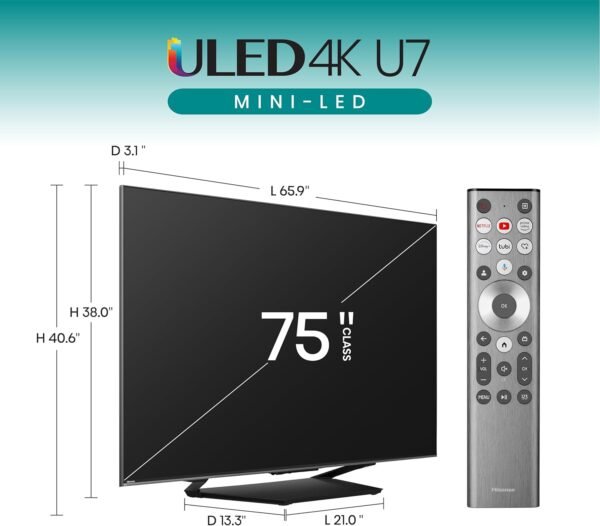
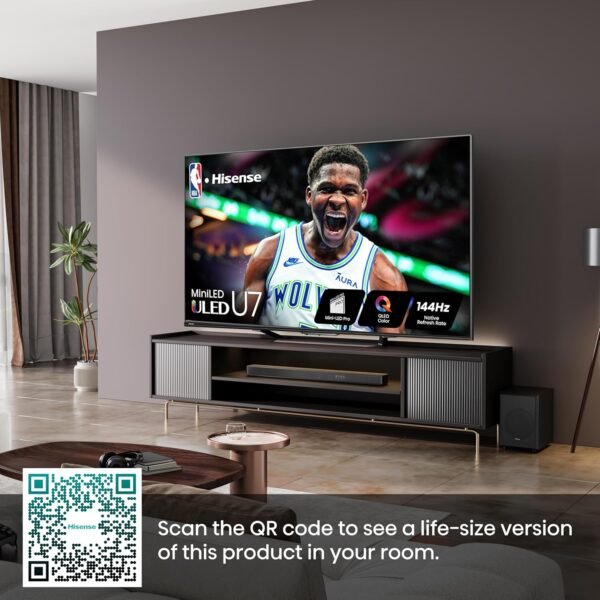
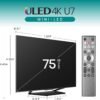
Two constraints decide this purchase before any specification does. Hisense lists the 75U7N cabinet at 3.1 by 65.9 by 38 inches and the weight at 88.8 pounds. That is a set five and a half feet wide and just under ninety pounds, which puts it beyond a one person install and beyond a light wall bracket. Measure the console. Check that the bracket is rated well above 88.8 pounds and that it is going into studs.
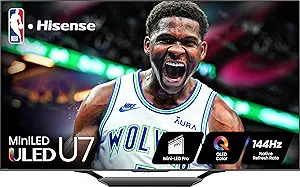
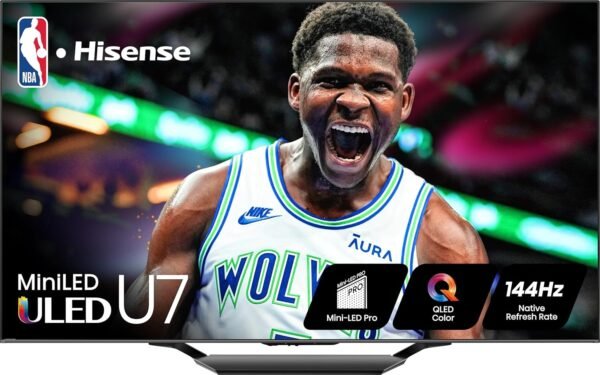
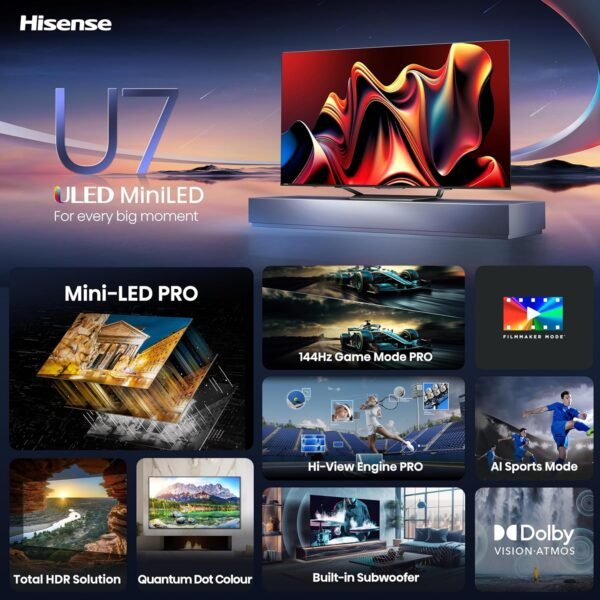
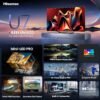
The room brightness question is the one that decides whether this is the right technology rather than just the right size. This model is built on a mini LED backlight with full array local dimming and a quantum dot color layer. That combination is aimed squarely at rooms with daylight. Hisense states peak brightness reaching up to 1,500 nits, which is a real figure rather than a marketing name, and it is roughly two to three times what a conventional LED LCD manages. In a living room with windows, that is the difference between a picture that holds up in the afternoon and one that does not.
Seating distance follows. A 75 inch 4K panel suits a viewing position roughly eight to twelve feet back. Closer than that and the size becomes tiring. Further and the resolution stops paying for itself.
The specifications that decide it: mini LED dimming and a native 144Hz panel
Mini LED means the backlight uses a large number of very small LEDs rather than a few large ones, which allows the full array local dimming to work in finer zones. Finer zones means less halo around bright objects on dark backgrounds, which is the visible weakness of conventional local dimming. Hisense does not publish a zone count, which is the number that would let you compare this against another mini LED set, so the technology is stated but not quantified.
The gaming specification is stated clearly and consistently, which is more than most listings in this category manage. Hisense gives a native 144Hz panel with a variable refresh range of 48Hz to 144Hz, AMD FreeSync Premium Pro certification and low latency motion handling. A stated VRR window with both ends named is genuinely useful, because it tells you the range within which the panel will match a console or PC frame rate rather than just quoting a ceiling. There is also an on screen game bar operable from the television remote rather than the controller.
Sound, and what a 2.1 system in a television means
Hisense specifies a three speaker arrangement with a built in subwoofer and 40 watts of maximum power, with Dolby Atmos decoding. Forty watts across three drivers with a dedicated low frequency unit is above average for a flat panel, and the built in subwoofer is the part that matters, because it is the missing element in almost every thin television. It will not replace a soundbar with a separate sub, but it means the set is usable out of the box for ordinary viewing.
Living with it: power, the tuner, warranty and one copy error
Hisense states 120 volts and 300 watts. Three hundred watts is meaningful on a set this size and it is honest to publish it, since many listings omit power draw entirely. It also means the set should be on a normal circuit without concern, unlike a countertop cooking appliance.
One feature deserves more attention than it usually gets: the NEXTGEN TV ATSC 3.0 tuner. That is the newer North American broadcast standard, carrying 4K and improved audio over the air, and a set without it can only receive the older ATSC 1.0 signals. If free over the air television is part of how the household watches, that tuner is a reason to prefer this set, and it pairs with a decent antenna rather than replacing the need for one.
Connectivity includes Wi-Fi 6E, which adds the 6GHz band and matters most in congested wireless environments. Google TV is the platform, with Alexa compatibility. IMAX Enhanced and Filmmaker Mode are both certification programs rather than processing tricks, and Filmmaker Mode in particular is worth knowing about because it switches off motion interpolation and other processing to show content at its original frame rate and aspect ratio.
Hisense states a two year warranty on its ULED sets, which is longer than the usual one year and is worth factoring into the comparison.
One error in the published listing is worth naming rather than passing over. The product description promotes the U7 series and then says the tuner makes the U8 future proof. This is a U7 listing. That is text carried over from a different model’s description, and it is a reminder that the marketing copy on these records is not always written for the product it is attached to. The specification table itself is consistent and appears to describe the 75U7N correctly. The listing also carries a rating field of 5 alongside a customer review summary of 4.4 stars across 890 ratings.
When a different set is the better answer
If the room is dark and film watching dominates, the argument for a bright mini LED panel weakens and an OLED will give deeper blacks. Within the same brand and family, the Hisense 75U7K is the previous generation at the same size and worth comparing on price, and the Hisense 65U6K is the step down in both size and backlight sophistication.
If the household is invested in a PlayStation and wants the console specific features, the Sony X85K is the same size with a different set of gaming integrations. If 75 inches is more than the room can take, the VIZIO M65Q6-L4 covers similar ground at 65 inches. Mounting a set of this weight is its own decision and belongs in the wall and ceiling mount category. The rest of the quantum dot options sit under QLED televisions.
Who should buy it and who should not
Buy it if the room gets daylight, the console or wall can carry 88.8 pounds across 65.9 inches, and either gaming or over the air broadcast is part of how the set will be used. The 1,500 nit peak, mini LED local dimming, a native 144Hz panel with a stated 48 to 144Hz VRR window, an ATSC 3.0 tuner and a two year warranty is an unusually complete specification.
Skip it if the viewing is mostly in a dark room where contrast beats brightness, or if the physical constraints do not work. Before ordering, ask Hisense for the local dimming zone count, which is not published, and disregard the sentence in the product description that refers to the U8, because it belongs to a different model.