

Description
How many oranges are you getting through in a week?
Citrus juicers are a category where more machine is usually the wrong answer. A big masticating juicer will handle oranges, but it costs several times as much, occupies a permanent block of counter, takes ten minutes to clean, and does a job that a dedicated reamer does faster. Meanwhile a hand held squeezer costs almost nothing and works fine until you are doing four grapefruit before breakfast.
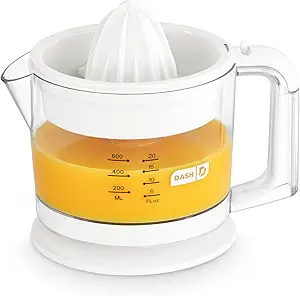
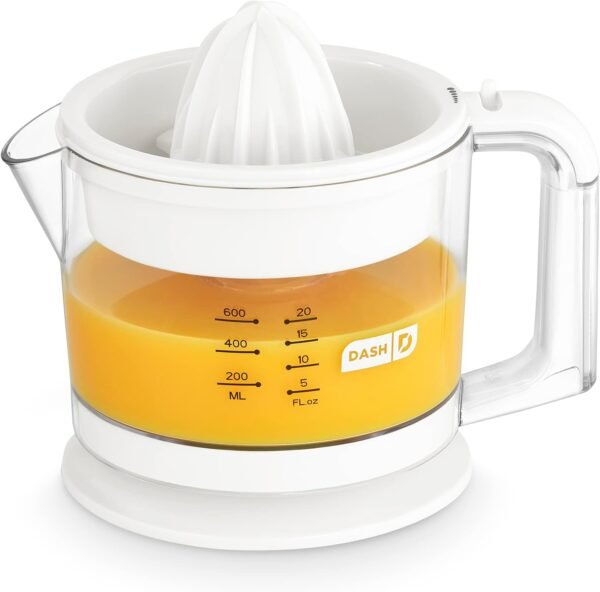
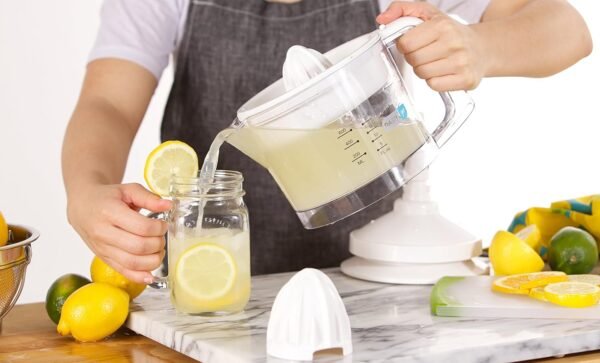
The Dash sits in the gap between those two. It is an electric reamer: a motorized cone that spins under a half of fruit while you press down, with the juice draining into a container below. That is the entire mechanism, and for citrus specifically it is the right one, because a reamer separates juice from pith and membrane without shredding them into the glass.
The size is the reason to look at it. Dash gives the unit as 8.8 inches wide, 7.8 inches high and 6.4 inches deep, and the specification table records the weight as 1.9 pounds. That is a footprint smaller than most kettles and light enough to lift with one hand, which is why the company points it at first apartments, small kitchens, dorm rooms and campers. If a juicer has to live in a cupboard between uses, this is the shape that survives that arrangement.
The two features that separate it from a plain reamer
The first is the auto reversing action. The cone spins one way then the other as you press, which matters because a cone turning in a single direction tends to drag the fruit around with it rather than tearing the flesh open. Reversing keeps the fruit under control with less grip needed from you, and it extracts more from each half.
Two cones are supplied, one large and one small, which is the difference between a machine that handles a lime and a machine that handles a grapefruit. Using a small cone on a large fruit leaves juice in the shell; using a large cone on a lime is awkward and messy. Having both is the reason this is called a dual juicer.
The second feature is adjustable pulp control. A filter setting decides how much pulp passes into the container, so the same machine produces smooth juice for someone who dislikes it and pulpy juice for someone who wants it. On a shared kitchen appliance that is more useful than it sounds.
The container
Juice collects in a 20 ounce container with a pouring spout and a lid, and Dash notes it is refrigerator friendly, so the vessel you juice into is the vessel you store in. That removes a decanting step and a second thing to wash. Twenty ounces is roughly two large glasses, which lines up with the size of the machine.
Operation is as simple as it gets: plug it in, press down on the reamer to start, release to stop. There is no switch and no timer. That is the correct design for something used for ninety seconds at a time.
Living with it, and two things the listing gets wrong
Cleaning is where this listing contradicts itself and it matters, because it is the single question that decides whether a juicer stays in weekly use. The Product Care Instructions field says Hand Wash Only. A feature bullet says all non electric parts are dishwasher safe. Those cannot both be true. Given that the cones, the filter and the container are simple plastic parts, the dishwasher claim is plausible, but confirm it with Dash before you build a routine around it.
The weight is given two ways as well. The specification table says 1.9 pounds and a feature bullet says the juicer weighs just one pound. Neither figure changes the buying decision, but it is a reminder that the numbers on this page are not consistent. The capacity field compounds it by listing 1.3 pounds, which is not a capacity measurement at all; the container is 20 ounces.
One feature bullet is also truncated, beginning mid word with a fragment about the cones and the container. The intended text is presumably a list of what is in the box, which appears to be the two cones, the 20 ounce container with lid and a recipe book with recipe database access.
The practical limits are worth stating. Citrus only. This will not juice apples, carrots, celery or leafy greens, and nothing about a reamer is designed to. The plastic build keeps it light and cheap, and it also means this is not a machine for a juice bar. Rind oils and citric acid are hard on plastic over years, so rinsing promptly rather than leaving it to sit is what keeps it looking new.
Yield is worth setting expectations about, because it determines how often the machine comes out. A medium orange gives roughly a quarter cup of juice, so a 20 ounce container is somewhere between eight and twelve oranges depending on size and ripeness. That is a bag of fruit for two glasses, which is the arithmetic behind why fresh squeezed juice is expensive to make at home and why a reamer that extracts efficiently is worth more than a cheap one that does not. Room temperature fruit gives up more juice than fruit straight from the refrigerator, and rolling it firmly on a counter before cutting breaks the internal membranes and helps further.
Ownership signals are good for a small appliance: 886 ratings at 4.3 stars, a rank of 16th in citrus juicers, and an availability date of July 2013. Over a decade on sale is its own kind of evidence.
What would send you elsewhere
If you want to juice anything other than citrus, this is the wrong machine entirely and no accessory changes that. For hard produce like carrots, beets and apples, a centrifugal machine is the fast route, and the Gdor JE2106 sits in the centrifugal juicer category as the domestic version of that.
If you want juice that keeps rather than juice drunk immediately, a slow press is the mechanism. The Kuvings AUTO10 handles whole fruit without pre chopping, and the Ninja JC151 is the more compact take on it. The masticating juicer category covers that ground.
And if the volume is genuinely commercial, a machine built for service is a different class again, such as the Robot Coupe J80 Ultra, which is designed to run through a breakfast rush rather than through a breakfast.
Who it fits and who should skip it
Buy it if you juice citrus and only citrus, if the machine needs to be small and light enough to store, and if two cone sizes and pulp control cover what your household wants.
Skip it if you want to juice vegetables or hard fruit, or if you need a settled answer on dishwasher safety, since the listing gives that both ways. Confirm the cleaning instructions with Dash before you buy.