Description
Is the system you are feeding a television, or a stereo?
This is the question to settle before anything else, because the Bluesound Node ICON is filed alongside television streaming boxes and it is not one. It has no video output at all. It is a network audio source with digital to analog conversion, balanced XLR outputs and headphone amplification, designed to sit in a hi-fi rack and feed an amplifier or a pair of active speakers. If what you want is Netflix on a television, this will not do it and a video player is the correct purchase.
What it is for is a system that already has good speakers and no modern source. A great many households own an amplifier and speakers bought a decade or two ago, with a CD player and nothing else, and no way to play a streaming service through them. A network streamer is the box that fixes that, and the argument for a serious one rather than a cheap dongle is entirely about the quality of the conversion from digital to analog.
The physical fit is straightforward. Bluesound lists 8.7 by 7.6 by 3.3 inches and 6.61 pounds, which is a half width component that sits on a shelf or next to an amplifier rather than in a full rack slot. Note that the listing publishes no ventilation guidance and no power consumption figure, so allow air around it as you would any class of audio component.
The specifications that decide it: dual mono conversion and balanced outputs
Bluesound builds this around two ESS SABRE ES9039Q2M converter chips in what it calls a dual mono arrangement, meaning one converter per channel rather than one chip handling both. Separating the channels removes crosstalk between them at the conversion stage. That is the specification that justifies this sitting above a basic streamer, and it is a real architectural difference rather than a marketing name. Bluesound adds QRONO d2a timing correction from MQA Labs, described as correcting timing errors during conversion, and an ES9826 analog to digital converter for the input side, plus stated DSD playback support.
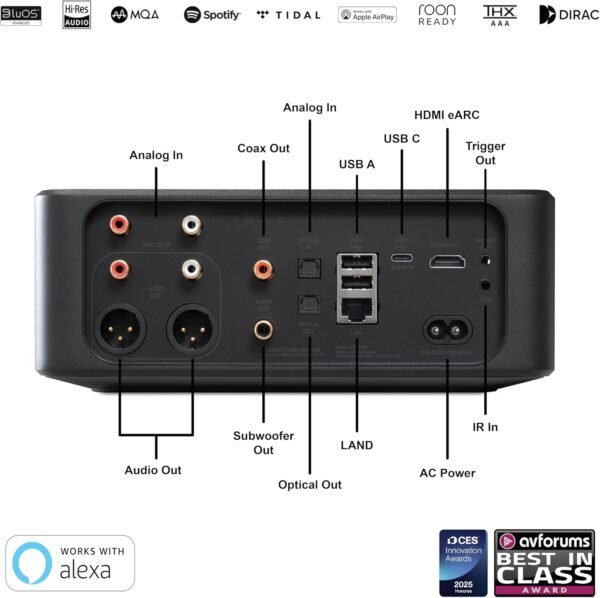
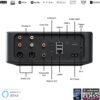
Balanced XLR outputs are the second specification that matters, and they are the one that decides whether this is the right box for your particular amplifier. Balanced connections reject noise picked up along the cable and are the standard in professional audio, but they are only useful if the amplifier has balanced inputs. If your amplifier has only RCA sockets, the XLR outputs are capability you have paid for and cannot use. Check the back of your amplifier before ordering.
The headphone stage, and what THX AAA describes
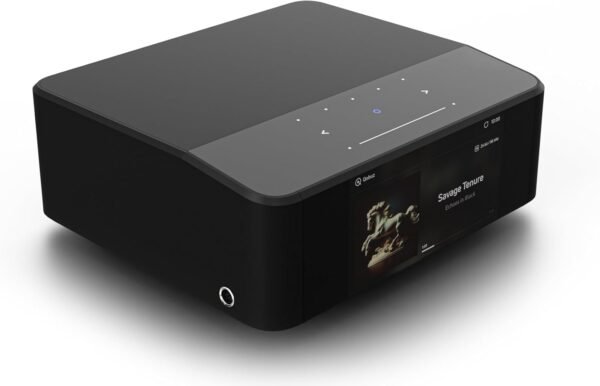
Two full sized quarter inch headphone jacks are fitted, driven by a THX AAA amplifier stage. THX AAA is a feed forward error correction topology, and Bluesound describes it in terms of low noise and distortion. Two jacks rather than one is an unusual and practical inclusion, since it means two people can listen to the same source. Quarter inch rather than 3.5mm signals that this is aimed at full sized headphones rather than earbuds, and an adapter will be needed for anything with a small plug.
Living with it: connections, the app, and the upgrades that cost more
Connectivity is broad. Bluesound lists dual band Wi-Fi, AirPlay 2, aptX Adaptive Bluetooth and HDMI eARC. The HDMI eARC port is the most interesting of those for a household with a television, because it lets the television send its audio back down one cable into this unit and out to a proper stereo system. That is a genuinely useful bridge between the two worlds, and it is the only respect in which this box has anything to do with a television at all.
The multi room function runs on BluOS, Bluesound’s own platform, controlled from a phone, tablet or desktop. Multi room systems live or die by their software, and committing to one means committing to that ecosystem for any additional speakers, since BluOS units group with other BluOS units. That is worth understanding as a long term decision rather than a feature.
Room correction needs a plain warning about cost. Bluesound states the unit is ready for Dirac Live, and then states that Dirac Live is available as an upgrade purchased directly from Dirac, and that a calibration kit with a high sensitivity microphone is also required and available from Bluesound with additional purchase. So the room correction that appears in the feature list is two further purchases away. That is disclosed in the listing, which is to its credit, but it is easy to read past.
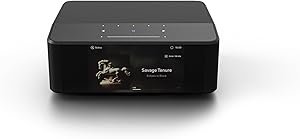
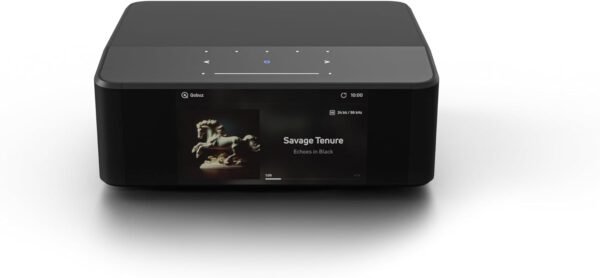
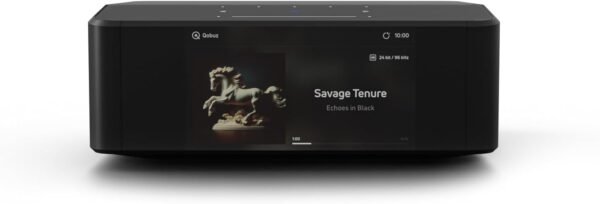
There is a 5 inch full color display on the front and an aluminum chassis in gloss black. The listing publishes no description text at all beyond the feature bullets, and shows 38 ratings at an average of 4.4, which is a small sample for a component in this class. It first became available in September 2024.
When a different box is the right one
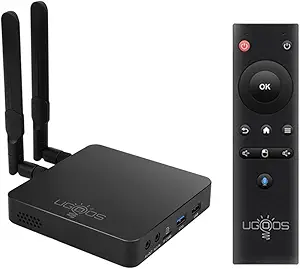
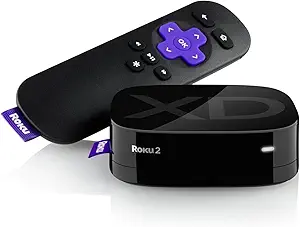
If the goal is video, none of this applies and a television player is what you want. The Roku streaming player is the simplest version, the Ugoos AM6B Plus is the Android option, and the BrightSign XT244 is the commercial signage alternative. Those all sit in the streaming media player category alongside this unit, which is why the classification is worth pointing out.
If the problem is getting an existing source into a modern system rather than streaming a new one, that is a conversion job, and the INOGENI 4K2USB3 and the rest of the video converter category cover that side.
Who should buy it and who should not
Buy it if you own an amplifier and speakers worth feeding properly, you want streaming services and local libraries through that system rather than through a television, and you will use either the balanced outputs or the headphone stage. Dual mono conversion, XLR outputs, HDMI eARC and two quarter inch headphone jacks make it a coherent hi-fi source component.
Skip it if you were looking for a video streaming box, because this has no video output, or if your amplifier has only unbalanced inputs and you have no headphones, in which case much of what you are paying for goes unused. Before ordering, check your amplifier’s input sockets, and budget separately for Dirac Live and its calibration microphone if room correction is part of the appeal, because neither is included.