


Description
Can the room, the wall and the doorway take a hundred inches?
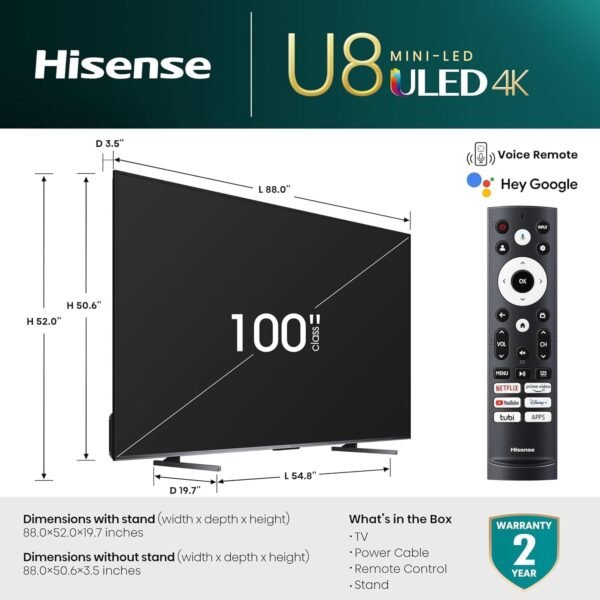
At this size the practical questions come before the picture. Hisense gives the panel as 88 inches wide and 50.6 inches tall, at 3.5 inches deep and 162 pounds. Eighty eight inches is over seven feet across. That does not go through a standard interior door in its carton, it does not turn on a staircase landing, and it is not a job for two people with good intentions.
Then the mounting. A hundred and sixty two pounds needs a bracket rated well above that, fixed into structural framing across more than two studs, and if it is going on furniture instead, the media unit has to be rated for the load rather than merely look sturdy. Both routes should be settled before delivery day, not on it.
Then the room itself. A 100-inch panel wants a viewing distance of roughly eleven to sixteen feet for 4K content. Any closer and you are scanning the screen with your eyes rather than taking it in, and structure becomes visible on anything that is not native 4K. If your sofa sits nine feet away, a smaller and better specified set will look better in that room, and that is a size decision no picture setting can undo.
Mini-LED backlighting and a 144 hertz panel are what this set is built around
The two specifications that justify the U8 series are the backlight and the refresh rate, and Hisense publishes both clearly.
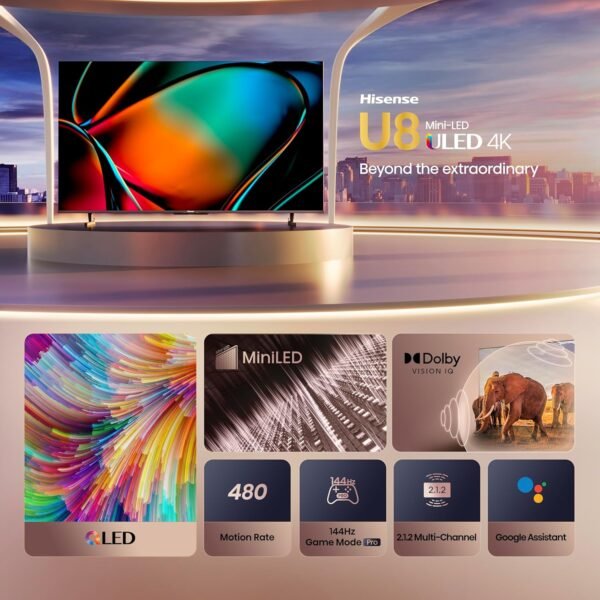
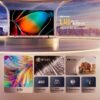
The backlight is Mini-LED with what Hisense calls Full Array Local Dimming Pro. Smaller LEDs mean more of them and therefore more independently controlled dimming zones, which is what allows a bright object to sit on a dark background without the area around it lifting to grey. Hisense states a peak brightness figure of 1500, which in context means nits, and describes more than double the dimming zones of the previous generation. That comparison is the weak point: the listing never gives an absolute zone count, only a relative one, so there is no way to compare it with another manufacturer’s set from this page.
The panel is stated as a native 144 hertz refresh rate, and this is one of the rare listings that handles the motion numbers honestly. It quotes a 480 motion rate and then explains in its own bullet that the native 144 hertz refresh is the foundation for that 480 figure. Motion rate numbers are interpolation indices rather than panel specifications, and a listing that says so is being straight with you. What matters for gaming is the 144 hertz native figure, and it comes with HDMI 2.1 inputs, automatic low latency mode, variable refresh rate and FreeSync Premium Pro.
The tuner that most large television listings do not mention
One line in the description deserves more attention than it usually gets. This set includes a NextGen TV tuner, which is the consumer name for ATSC 3.0, the newer American broadcast standard.
That matters because ATSC 3.0 carries 4K broadcast, high dynamic range and better audio over the air, free, with an antenna and no subscription. Most televisions sold today still ship with the older ATSC 1.0 tuner only, and a set without the newer tuner cannot receive those broadcasts at all without an external box. On a television this large, where over the air sport in 4K is one of the genuinely compelling uses, having the tuner built in is a real advantage.
Getting it working needs an antenna, and an outdoor directional antenna is usually what a 4K broadcast signal wants rather than a flat panel behind a curtain. The Winegard YA7000C yagi antenna review covers that side of the setup, including the band coverage question that decides which stations you can actually receive.
Living with it: power, sound and copy that belongs to a different television
Hisense publishes a power consumption figure of 350 watts at 120 volts, which is unusually forthcoming and is a real number to plan around. A 100-inch Mini-LED panel running bright is a meaningful continuous load and it puts heat into the room, and 350 watts is roughly three times what a mid sized television draws.
Audio is where the listing contradicts itself. The description and a feature bullet both describe a 50 watt 2.1.2 multi channel system driving five speakers including rear firing drivers and a built in subwoofer. The specification table then gives an output wattage of 60 watts. Fifty and sixty cannot both be right, and the page never reconciles them. Either way, a 2.1.2 arrangement with a built in subwoofer and Dolby Atmos decoding is a genuinely better starting point than the two thin drivers most large sets carry, and on a screen this size it may be enough to postpone a soundbar.
The listing also carries copy written for a different product. The description ends by noting that the U8H is now available in an 85 inch screen size, which refers to the previous generation and has nothing to do with a 100 inch U8K. That is series wide marketing text pasted onto a specific model listing, and it is a good reminder that not every sentence on these pages was written about the product you are looking at. The same description makes an absolute claim about brightness and calls the set future proof, both of which are the manufacturer’s marketing rather than findings.
The platform is Google TV with hands free voice control, WiFi 6E compatibility is stated, and the panel carries a low reflection treatment, which matters more at this size because a screen this large catches every window in the room.
When a different television is the better call
At this size the comparisons worth making are against the other very large panels rather than against 65 inch sets. The Hisense 100QD7N review covers the same size from the same manufacturer at a different position in the range, and the TCL 98-inch Q65 review and the Samsung QN98QN90A review cover 98 inch alternatives, which is a marginally easier delivery and mount.
If eleven feet of viewing distance is not available, stepping down is the better engineering decision rather than a compromise, and the Hisense 85-inch U6 Mini-LED review covers a size that still fills a large room while remaining a normal installation.
The rest of the range sits in the QLED televisions category, and the antennas that feed the built in tuner are in the TV antennas category.
Who this suits and who should not attempt it
It suits a large dedicated room with eleven feet or more of seating distance, a wall or floor that can carry 162 pounds, and a household that games as well as watches, since the 144 hertz native panel with HDMI 2.1 and variable refresh rate is a genuine gaming specification rather than a badge. The ATSC 3.0 tuner and the 2.1.2 audio system are the two features that separate it from a large panel with nothing behind it. The listing shows 727 ratings averaging 4.2 stars, ranked 147th within QLED televisions.
It does not suit a normal living room, an upstairs room reached by a turning staircase, or a household that has not planned installation and delivery in advance. Anyone comparing on dimming performance should also note that the zone count is given only as a comparison with last year’s model, never as a number.