


Description
Eighty five inches is a room decision, not a screen decision
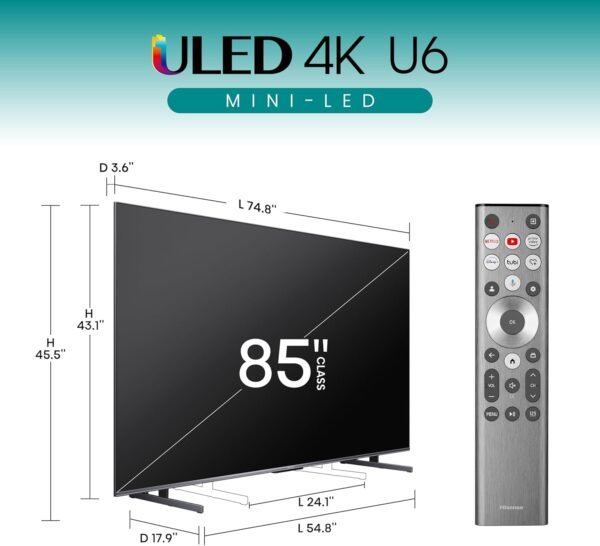
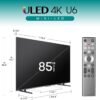
At this size the television stops being furniture and starts being architecture. An 85 inch panel needs roughly six and a half feet of clear wall, a seating position around ten to twelve feet back, and a delivery route that a carton wider than a doorway can actually negotiate. Measure the wall, then measure the stairwell, then measure the sofa distance. If any of the three fails, a 75 inch set is the better purchase and it is not a compromise.
This listing has a specific problem that makes those measurements harder than they should be: the specification table is completely empty. There is no weight, no dimensions, no wattage, no voltage, no model number field, no review count and no star rating. The description field is empty too. Everything below comes from the feature bullets.
For an 85 inch television that is a serious gap. Panels at this size weigh somewhere over 100 pounds and need a bracket rated well above that, fixed into studs. Nobody should be ordering a set this large without a published weight, so get the dimensions and the weight from Hisense before the delivery is booked, and give them to whoever is doing the installation.
The backlight is what you are paying for
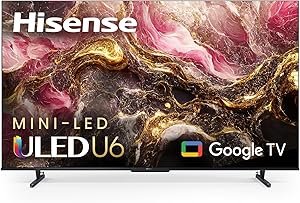
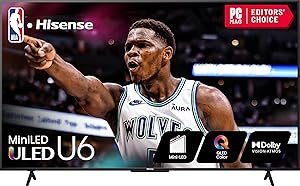
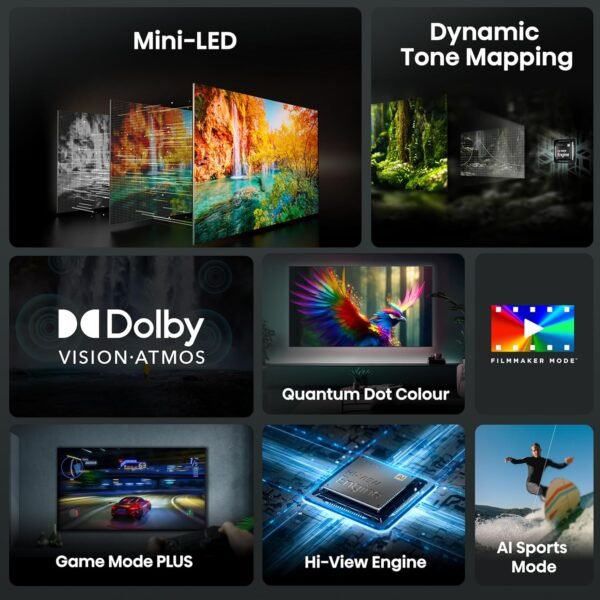
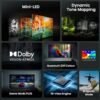
The U6N pairs Mini-LED backlighting with what Hisense calls Full Array Local Dimming Pro. That combination is the single most important thing on the specification. Mini-LED means the backlight is built from far smaller and far more numerous LEDs than a conventional array, which allows many more independently controlled dimming zones. More zones means a bright object on a dark background can be lit without lifting the black around it.
On a screen this large that matters more than it does on a small one, because any unevenness in a backlight is spread across a bigger area and becomes correspondingly easier to see. An 85 inch edge lit panel is a compromise; an 85 inch Mini-LED panel is the technology matching the size.
Color comes from QLED quantum dot, and the format support covers Dolby Vision and HDR10+ alongside Dolby Atmos audio. Supporting both major dynamic high dynamic range formats means whatever a streaming service sends, the set has the matching pipeline.
The processing chipset
Hisense names the Hi-View Engine as the chipset, describing Dynamic Tone Mapping Pro, face detection, AI HDR enhancement and AI detail enhancement. Tone mapping is the one that does real work on a bright panel: it decides how to fit the brightness range of the content into the brightness range the display can produce, and a dynamic version does that scene by scene rather than once for the whole film.
Gaming and connectivity
Game Mode Plus covers variable refresh rate, auto low latency mode and AMD FreeSync compatibility. Hisense states Game Booster 120, meaning variable refresh up to 120Hz. Note that Motion Rate 240 appears alongside it and is a different kind of number entirely: it is a motion clarity index tied to MEMC frame insertion, not a refresh rate. The panel figure to work with is 120.
Connectivity is one of the more useful specifications here. Four HDMI inputs with eARC, which Hisense points out directly against sets that ship with three. On a large living room television with a console, a soundbar, a disc player and a streaming device, running out of HDMI is a real and irritating problem, and eARC is what lets the soundbar receive full quality audio back from the television. WiFi 6 handles the network side, with the platform being Google TV and Alexa compatibility listed.
Living with a screen this size
Placement and light are the things that decide satisfaction. Mini-LED with local dimming is a good technology for a room that cannot be darkened, which is fortunate, because a room large enough for 85 inches is rarely a room you can black out. What to avoid is a window directly opposite, since a screen this large reflects an entire window rather than a patch of one.
Sound will need help. Whatever the built in speakers do, a slim panel in a room sized for an 85 inch television is outmatched, and the eARC support exists precisely so that a soundbar or receiver can take over. Budget for that at the same time rather than later.
Power draw is not published here, but a large Mini-LED panel is among the more demanding televisions to run, and that is the cost of a bright backlight. Expect it to be noticeable if the set runs several hours a night.
Local dimming has a visible side effect worth expecting rather than being surprised by. Where a small bright element sits on a dark field, such as subtitles on a night scene, the zone behind it lifts slightly and produces a faint halo. More zones means smaller halos, which is what Mini-LED buys over a conventional array, but it does not remove the effect entirely. If a completely halo free picture is the requirement, that argues for a self emissive panel rather than a different backlit one, at the cost of the brightness this set is chosen for.
One more note on the range. Hisense sells several closely related U series models at overlapping sizes, and the model codes differ by one or two characters. Check the exact code you are ordering against the specification you think you are buying, because the differences between series are real even when the marketing language is nearly identical.
What would send you elsewhere
Within the same family, the Hisense 75U7K is a size down in the higher U7 series with a published 1,000 nit figure and a native 144Hz panel, which is a genuinely different specification rather than just a smaller screen. The Hisense 65U6K is the same series two sizes down.
If you want to go larger still, the TCL 98Q651G and the Hisense 100U8K push past 90 inches, with all the delivery and wall considerations that implies. The QLED category is where to compare panel width against wall width.
Whatever you choose at this scale, the bracket matters more than usual. Options in the wall and ceiling mount category should be matched to the manufacturer’s published weight, which is exactly the figure this listing does not provide.
Who it fits and who should skip it
Buy it if you have the wall, the seating distance and the delivery route, if the room is bright enough to want a Mini-LED backlight, and if four HDMI inputs with eARC solve a connection problem you already have.
Skip it if the room is smaller than the screen, or if you are unwilling to order an 85 inch television without a published weight. Get the dimensions and weight from Hisense before booking installation, because this listing carries neither.