






Description
Are you buying a television, or a wall you have to look at all day?
The Frame exists to answer a specific complaint: in an open plan room, a large black rectangle dominates the wall for the twenty two hours a day nobody is watching it. Everything distinctive about this Samsung follows from that. Art Mode uses a built in motion sensor to switch the panel to a picture when the room is occupied and the television is off. The matte display film gives the screen the reflectance of paper rather than glass. The Slim Fit Wall Mount holds it flush against the wall instead of standing it off. The bezel is magnetic so it can be changed to match a room.
If that problem is not your problem, none of it is worth paying for and a conventional set will give you more picture for the money. If it is your problem, no conventional set solves it, because the flush mount and the matte film cannot be added afterwards. That is the whole decision, and it is unusually clean for a television.
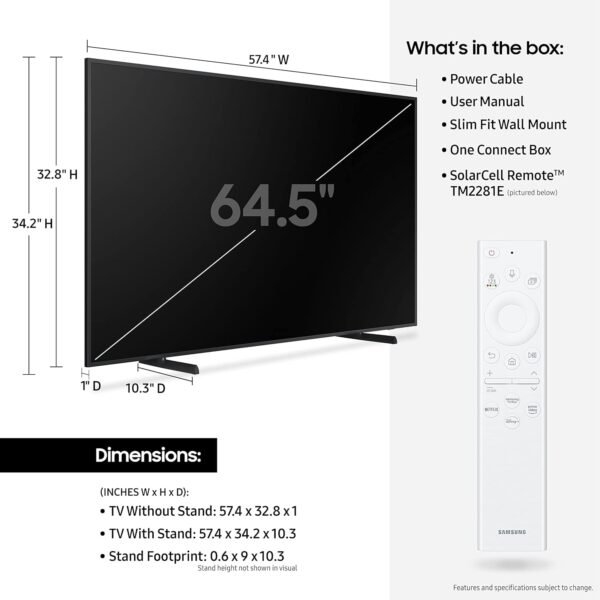
At 65 inches this sits in the size most living rooms want, and the mounting approach means it should be planned as a piece of wall rather than as an object on furniture. Samsung routes everything through a single thin cable to a separate One Connect box, which is what makes a flush install look finished: one wire to hide rather than five. That box has to live somewhere, usually in a cabinet or a recess, and where it goes is a question to settle before the mount goes up.
Two features do the work here: the matte film and Art Mode
Matte finish on a television is a genuine engineering trade rather than a styling choice. A glossy panel reflects room light as sharp bright images, which is distracting but leaves black levels looking deep when the room is dark. A matte film scatters that reflected light instead, so reflections become a soft haze rather than a mirror. The result is a screen that stays readable in a bright room and a picture that looks slightly less inky in a dark one. On The Frame the reason for the choice is obvious: printed art viewed under daylight is exactly the case a glossy screen handles worst.
Art Mode is the other half. Samsung states the panel uses a built in motion sensor so the display comes on when someone is in the room and goes off when nobody is, which is what keeps it from being an always on power draw. The artwork itself comes from two places: your own photographs and images, which cost nothing, or Samsung’s Art Store, which the listing describes as a library of over 1,400 works and which requires a subscription. That subscription is an ongoing commitment attached to a feature that is a major reason for buying the product, and anyone weighing this set should decide up front whether they intend to pay it or to use their own images.
What the listing tells you about the panel, and what it does not
Samsung describes this as a QLED 4K panel with Quantum Dot technology and 100 percent color volume, plus Quantum HDR for expanded contrast. Sound output is given as 40 watts RMS, Bluetooth as version 5.2, and standby power consumption as 0.5 watts.
Beyond that the page is close to empty. The specifications section of this listing is literally blank: no dimensions, no weight, no VESA pattern, no HDMI count, no brightness figure, no panel technology detail. A single feature bullet states a frequency of 60 hz, and that figure appears nowhere else on the page and is not corroborated by any specification table, so it should be confirmed with Samsung rather than relied on. For a set where the mount, the weight and the cable routing all have to be planned in advance, having no published dimensions at all is a significant gap. Get the specification sheet for the exact model code before you drill anything.
One more thing worth naming: the first feature bullet on this listing is not from Samsung. It begins with a retailer’s own recommendation badge before listing the Bluetooth version and sound output. Retailer marketing appearing inside the manufacturer’s feature bullets is a good reminder that these pages are assembled from several sources.
Living with it: mounting, the One Connect box and what you give up
The Slim Fit Wall Mount is included, which is unusual and is part of the value. It is also the reason installation needs planning. A flush mount leaves no room behind the panel for cables, which is why the single connection cable to the One Connect box exists, and why the tidiest installs run that cable inside the wall. That is a job to think about before the television arrives, and in a rented home it may not be possible at all, in which case the flush look is lost and much of the point with it.
The customizable bezel is magnetic and snaps on over the standard frame, and Samsung positions it as a way to match a room. Bezels are sold separately, and the listing does not say which, if any, is included.
Two practical points about art on a screen. First, a panel showing a static image for many hours a day is doing the thing that historically caused image retention, and while modern sets include mitigations, it is a reasonable question to ask about long term use. Second, Art Mode consumes power whenever it is displaying, and the 0.5 watt figure in the bullets is standby consumption rather than Art Mode consumption. The listing does not publish the latter.
If the wall or the tenancy rules out a flush install, an articulating bracket is the alternative, and the Mounting Dream MD2296 full motion mount review covers what that adds and costs in depth from the wall.
When a different set is the better call
If you want the same idea at a smaller size, the Samsung The Frame LS03B 55-inch review covers the same series one size down, which is a meaningful difference in how much wall it occupies. If you want the newer generation of the same concept, the Samsung The Frame LS03D review covers what changed.
If the art function is not the point and you simply want picture quality at 65 inches, the money buys more elsewhere. The Hisense 65U6K Mini-LED review covers a backlight technology built for contrast rather than for wall presence, and the Sony BRAVIA 8 65-inch OLED review covers the self emissive alternative, which gives true black at the cost of peak brightness in a sunlit room.
The rest of the range sits in the QLED televisions category, and the brackets are in the TV wall and ceiling mounts category.
Who should buy it and who should not
It suits a room where the television is on a prominent wall and is off most of the time, where a flush installation is possible, and where the household will actually use Art Mode rather than treating it as a novelty for a fortnight. The matte film also makes it a sensible choice for a bright room with windows opposite the screen, which is the situation glossy panels handle worst.
It does not suit a dedicated dark room home cinema, where a matte film works against you and an OLED would do more. It does not suit a rental where the cable cannot be hidden. And it does not suit anyone unwilling to either pay for the Art Store subscription or curate their own images, because without artwork on it, this is a television with an unusual finish and a thin mount.