
Description
Start with your wall, not with your television
Almost everyone shopping for a full motion mount starts by checking the TV size and stops there. That is the wrong order. Mounting Dream states in two separate places on this listing that the MD2296 is NOT FOR DRYWALL INSTALLATION, and that single line eliminates more buyers than any specification on the page. This bracket is rated to hang up to 100 pounds of television on an articulated arm, and that load has to end up in structural timber or masonry, never in plasterboard anchors.
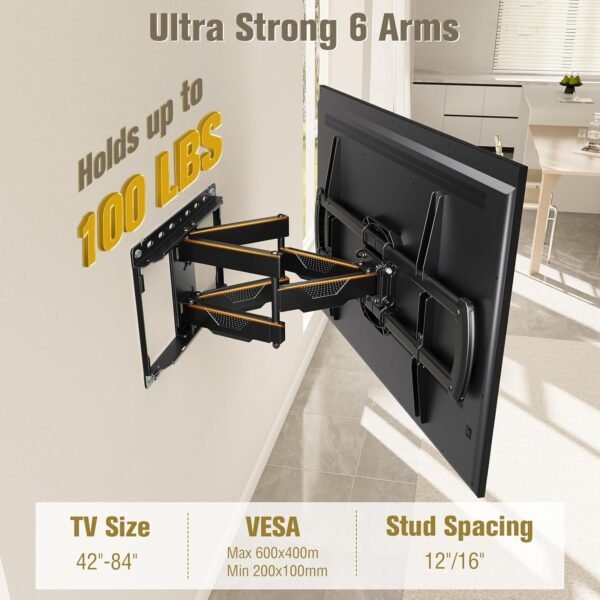
So the first thing to establish is what is behind the surface you intend to drill. The mount is specified to fit 16 inch wood stud spacing, which is the standard interval in most North American framing. If your studs sit at 24 inch centers, if the wall is a metal stud partition, or if you are mounting to brick or concrete, the packaged hardware is not the hardware you need. The listing notes that concrete anchors sized 10 by 50 mm are available from Mounting Dream customer service rather than being supplied in the box. Establish that before you order, not on a Saturday afternoon with the TV already off its stand.
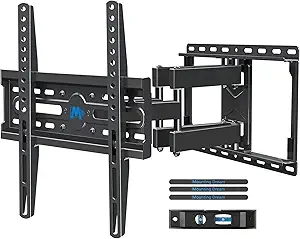
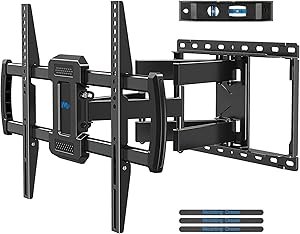
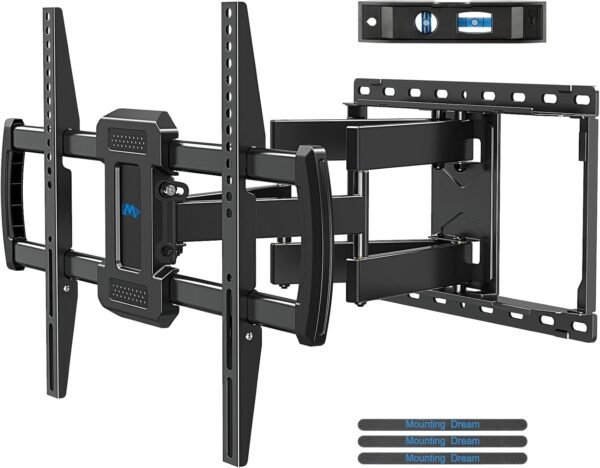
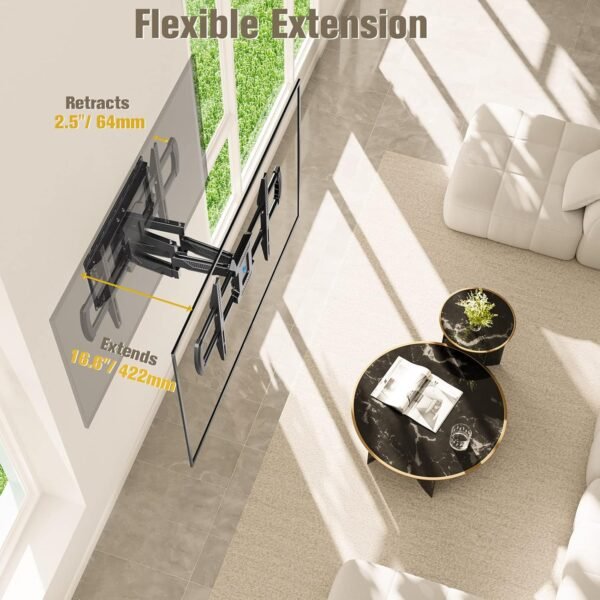
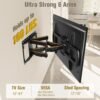
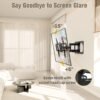
The second question is how far the screen needs to travel. This is a dual arm design with six articulating joints, and the listing gives the extension range as up to 16.6 inches from the wall, retracting to 2.5 inches. That range is the whole reason to buy an articulating mount instead of a fixed plate. If your TV will sit centered on a wall and never move, you are paying for movement you will not use.
The numbers that decide compatibility
Three figures gate whether this mount will work with your television. Screen size is quoted as 42 to 84 inches. Weight capacity is quoted as 100 pounds. The mounting pattern is quoted as a maximum VESA of 600 by 400 mm, which the listing also expresses as roughly 24 by 16 inches.
Of those three, VESA is the one people get wrong. Screen size is a diagonal measurement and tells you very little about the bolt pattern on the back panel. A large but light television can carry a small VESA pattern, and a smaller commercial panel can carry a large one. Measure the horizontal and vertical distance between the four threaded holes on the back of your set and compare that to 600 by 400 mm before anything else. A set with a 600 by 400 pattern is at the limit of this bracket, and anything beyond it needs a different mount or an adapter plate.
The movement figures, read carefully
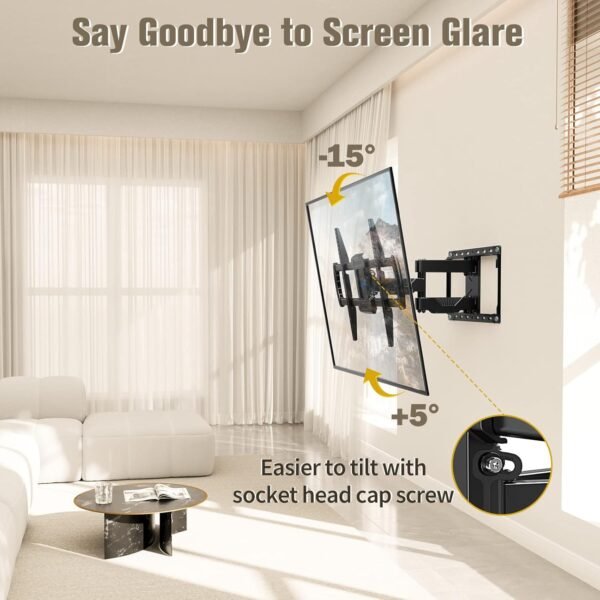
The listing specifies tilt of 5 degrees up and 15 degrees down, swivel of 45 degrees, and 4 degrees of level adjustment after installation. The tilt asymmetry is deliberate, because mounts of this kind are usually installed above eye level and need to angle down toward a seated viewer. The 4 degrees of post installation leveling is the feature that rescues an install that came out slightly crooked, since it lets you correct the horizontal without pulling the wall plate off the studs.
The swivel figure is the one to treat with care. The listing gives 45 degrees without stating whether that is 45 degrees in total or 45 degrees to each side, and the achievable swivel on any articulating mount also depends on how wide your television is, because a wider panel fouls the wall sooner. Confirm the intended reading with the manufacturer if the exact angle is what your room depends on.
Installation and living with it
The listing describes a package that is better equipped than most: clear instructions, a paper template for marking the wall, a level, pre labeled bags of screws and spacers, and velcro strips for cord management. The paper template matters more than it sounds, because the common failure on a full motion mount is drilling the wall plate slightly out of true and only discovering it once the television is hanging. The wall plate also carries an EVA pad, described as a cushioning layer, and the listing credits robotic welding for the joints.
The bracket itself weighs 13.46 pounds and its folded dimensions are 11.75 by 11.44 by 3 inches. That folded figure is the parked bracket, not the span of the wall plate, so do not use it to plan how much wall the mount will cover.
What you live with afterward is cable slack. A mount that extends 16.6 inches and swivels needs enough cable behind the panel to travel that far without tugging, and the velcro strips in the box only manage the slack, they do not create it. Plan for longer HDMI and power runs than a fixed mount needs. If you have not chosen the television yet, the practical order is to pick the panel, confirm its VESA pattern and weight, then come back to the mount. The LED and LCD television category is the place to work that out.
When a different mount is the right call
If your television is under 65 inches and you want to spend less on hardware, the Mounting Dream MD2380 is the same manufacturer covering the 32 to 65 inch range, and there is no advantage in buying capacity you will not use. If you are at the other end and hanging something like the Sharp 75 inch AQUOS commercial panel or the Hisense 85 inch U6 Series, check the panel weight and VESA pattern against the 100 pound and 600 by 400 mm limits carefully, because 84 inches is the quoted ceiling for this bracket and an 85 inch set is past it.
A mid sized set such as the Sony 75 inch X85K sits comfortably inside the range, which is the situation this mount was designed around. The rest of the TV wall and ceiling mounts category covers the fixed and tilting alternatives if full motion turns out to be more than your room needs.
Two notes on the listing data itself. The description field is completely empty, so every specification here comes from the feature bullets and the attribute table rather than from a manufacturer narrative. And the attribute table publishes no VESA field at all; the 600 by 400 mm figure appears only inside a bullet. If VESA compatibility is what your purchase turns on, verify it on the live product page rather than from a specification summary.
Who this mount is for
It is for someone hanging a 42 to 84 inch television under 100 pounds on a wood stud or masonry wall, who genuinely needs the screen to pull out, swivel and tilt. The listing records 15,428 customer ratings averaging 4.8 stars, a first availability date of June 2014, country of origin Vietnam, and a rank of 90th in TV wall and ceiling mounts, which is a long track record rather than a new entry.
It is not for a drywall only installation, and Mounting Dream says so plainly rather than leaving it in the small print. It is not for panels over 84 inches or over 100 pounds, and it is not for a VESA pattern larger than 600 by 400 mm. If any of those describe your situation, a different bracket is the answer and no amount of careful installation substitutes for the right load rating.