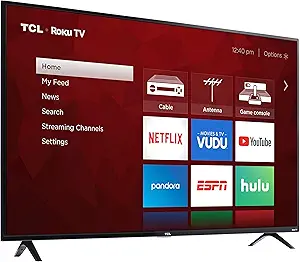
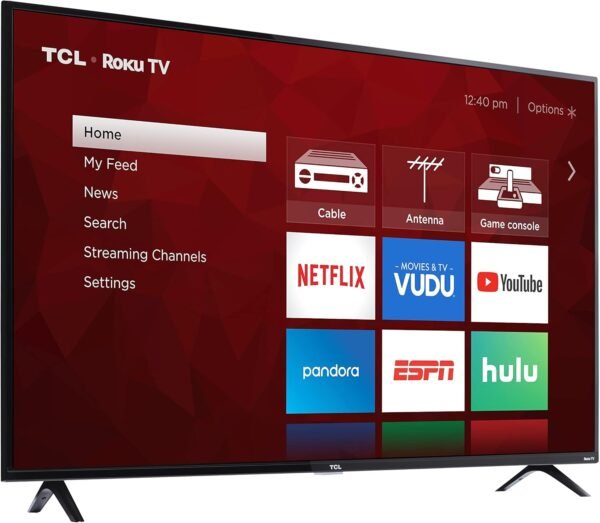
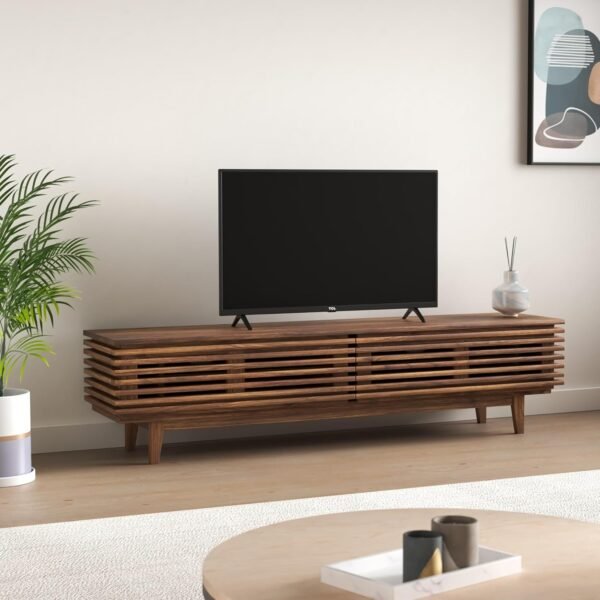
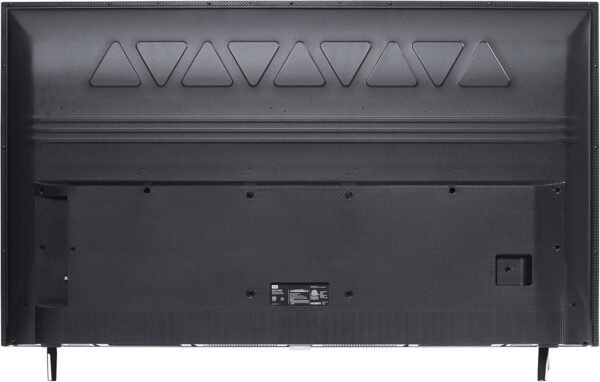
Description
Is 55 inches the size your room is asking for?
Before anything else about this television matters, work out whether 55 inches is the right diagonal for the seat you watch from. The rule of thumb that holds up for 4K content is that the screen wants to fill somewhere between 30 and 40 degrees of your field of view, which for a 55-inch panel puts the sofa roughly six to nine feet back. Closer than that and you start resolving structure in upscaled content. Further back and you are paying for resolution you cannot see.
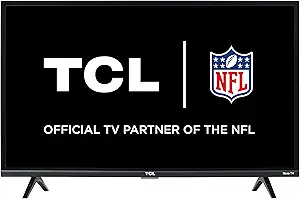
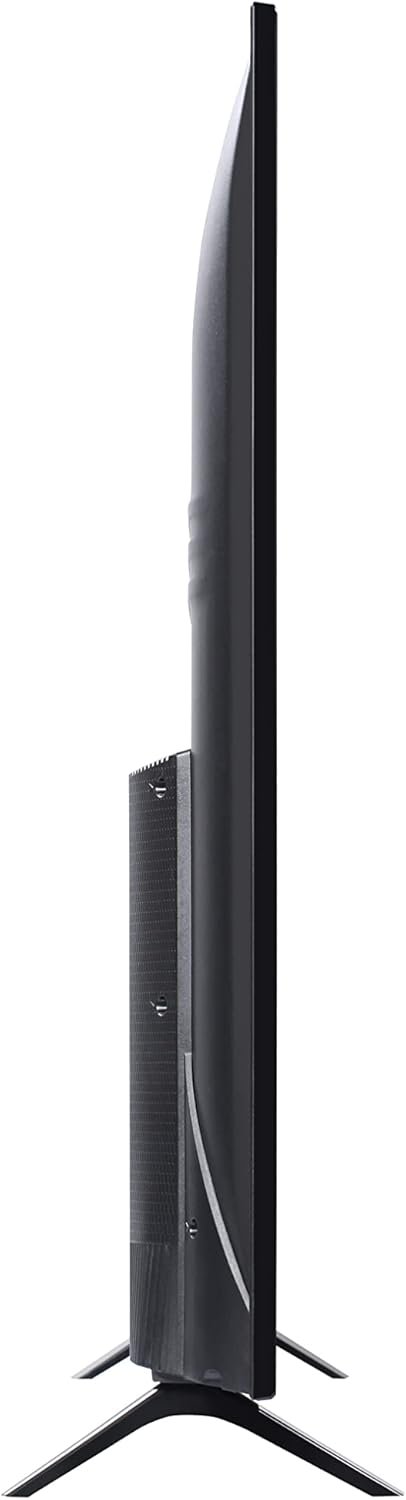
Then check the wall. A 55-inch 16:9 panel is a little under 48 inches wide, and the only dimensions this listing publishes are package dimensions of 55 by 34 by 6 inches. That is the carton, not the television, so it tells you what has to come through your front door and nothing about what fits on your media unit. Measure your furniture against roughly 48 inches of width and around 28 inches of height including the stand, then confirm against TCL’s own manual rather than this listing.
The third part of the fit question is what you will feed it. This is a 4K set with a Roku platform built in, so streaming is handled without an extra box. If most of your viewing is broadcast television or older HD sources, the upscaling engine is doing more work than the panel is, and that changes which specification you should care about.
The specifications that decide this set are mostly the ones the listing leaves blank
TCL publishes the resolution, the presence of high dynamic range and the platform. It does not publish the refresh rate, the peak brightness, the HDR format, the number of HDMI inputs, or whether there is any local dimming. On a television those omissions are not trivia. They are the difference between a set that copes with a bright room and one that does not, and between a set a console can drive at high frame rates and one that cannot.
What the listing does say is that the set carries HDR and TCL’s 4K Creative Pro upscaling engine. HDR without a named format means you cannot tell from the page whether Dolby Vision, HDR10+ or plain HDR10 is on board. The 4-Series has historically been an HDR10 set on a 60 hertz panel, and nothing in this listing contradicts that, but nothing in it confirms it either. If HDR handling is your reason for buying, that is the question to settle with TCL before ordering.
What the upscaling engine is doing to your HD channels
TCL describes 4K Creative Pro as allowing HD content to be viewed in near 4K quality. What upscaling actually does is interpolate. It takes a 1920 by 1080 image, estimates the missing pixels needed to fill a 3840 by 2160 panel, then sharpens edges so the result does not look soft. Good upscaling is largely invisible. Poor upscaling adds halos around high contrast edges and turns film grain into a shimmer. Since most cable, broadcast and older streaming content is still 1080p or lower, the upscaler runs on the majority of what you watch, which makes it more consequential day to day than the 4K badge on the box.
The listing also carries a striking gap. It publishes no feature bullets at all, so every detail comes from one description paragraph or from the specification table. That is unusual for a television at this level, and it is a reason to read TCL’s own product page for this model number rather than relying on this page alone.
Living with it: weight, mounting and the numbers that do not add up
The listed item weight is 59.4 pounds. A 55-inch 4-Series panel does not weigh 59 pounds. Sets in that class are typically in the twenties without a stand. Given that the only dimensions published are for the carton, 59.4 pounds is far more likely to be shipping weight including packaging and accessories. That matters practically, because if you plan the wall mount around a 59 pound load you will overspecify, and if you plan the carry into the house around 25 pounds you will be surprised. The listing gives the weight one way and the dimensions another, and it never reconciles them.
The wattage field reads 16 watts. That is not the power consumption of a 55-inch LED television, which typically sits between 60 and 120 watts in normal viewing. Sixteen watts is a plausible figure for total audio output or for standby behavior, and it has landed in the power field during import. Use the yellow energy guide label shipped with the set rather than this number.
For mounting, the listing does not publish a VESA pattern, so buy the bracket after you have the manual, not before. A bracket rated across the 32 to 65 inch range, such as the one covered in the Mounting Dream MD2380 review, will handle the size and weight comfortably, but the bolt spacing still has to match. Sound is the usual compromise on a slim set at this position, and a soundbar is the normal remedy, so plan the cable run before the television goes on the wall.
When another television answers the question better
The most direct comparisons are inside TCL’s own range. The TCL 55S446 Google TV review covers the same size on a different platform, which matters if you already live inside the Google ecosystem or want a different app store. The TCL 55S455 review covers the closest sibling in the 4-Series and is the fairest like for like comparison on generation.
If 55 inches turns out to be too large for the wall, stepping down to 50 inches changes more than the four inch difference in diagonal suggests, and the VIZIO 50-inch V-Series review covers that size on a different platform again. If the Roku interface is the specific thing you want and the television you already own is otherwise fine, adding a separate player costs far less than replacing a set, and the Roku 2 XD player review covers the standalone approach. The full range of sizes sits in the LED and LCD television category.
Who should buy this and who should not
This set suits a household that wants a straightforward 55-inch 4K panel running an interface most people already understand, in a room with controlled lighting, watching mostly streamed content. The 135 ratings on file average 4.1 stars, and it ranks 598th within LED and LCD televisions and 154,497th across electronics, which is a modest but not negligible base of feedback for a set first listed in March 2023.
It is a poor fit if you are buying for a bright room, since no brightness figure is published, or for a games console, where refresh rate and variable refresh support decide the experience and neither is stated. It is also a poor fit for anyone who wants to compare HDR formats before buying, because this listing never names one.