

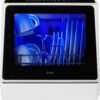


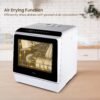
Description
Where does the water come from, and where does it go?
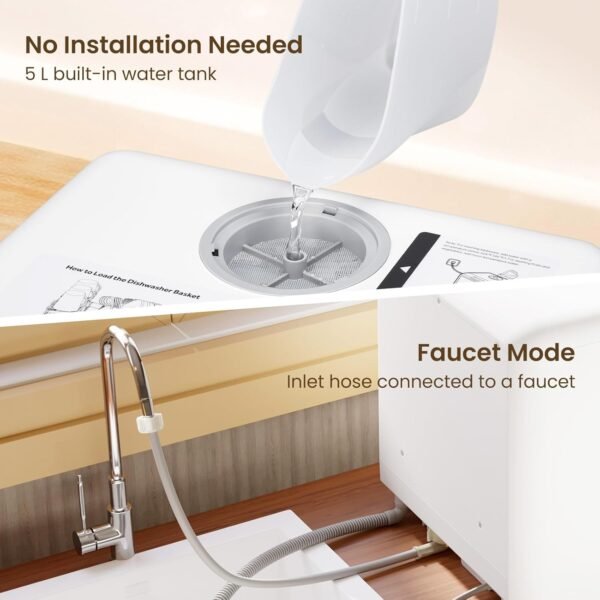
Every countertop dishwasher decision comes down to plumbing, and this one is bought specifically by people who do not have any. The HAVA TDQR carries a 5 liter tank inside the machine, which you fill by hand, so it can run on a counter with nothing but a power outlet and somewhere to put the drain hose. That is what makes it viable in a rented apartment, a dorm, a boat, a camper or a kitchen where the sink has no spare connection.
The alternative supply mode is a hose to the faucet, and HAVA includes it. The inlet and outlet hoses are both listed at 61 inches, which is a little over five feet, and that number quietly sets your layout. The machine has to sit within five feet of the tap and within five feet of a drain, and the drain hose has to end lower than the machine or it will not empty. If your only sink is across the room, the tank mode is what you will actually use.
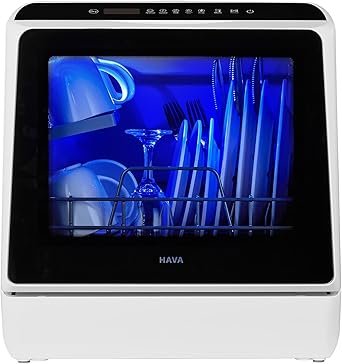
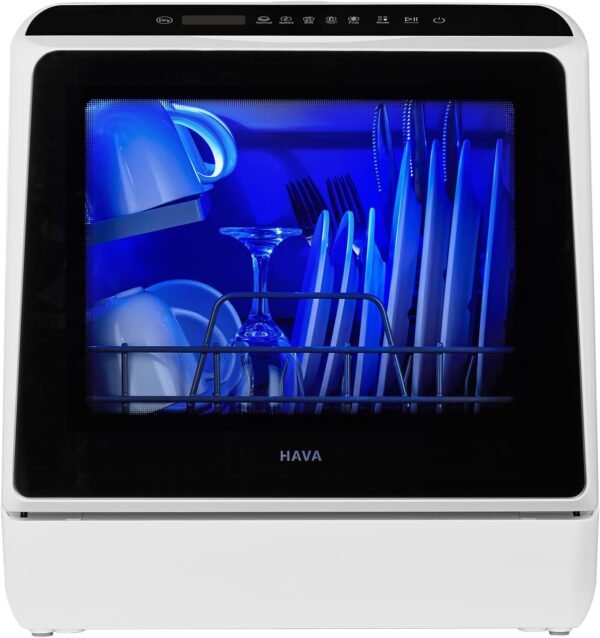
The footprint is 16.8 by 16.9 by 18.1 inches. That is a large object on a counter, roughly the size of a big microwave, and it needs the lid or door clearance on top of that. Anyone buying this for a small kitchen should measure the counter before deciding, because the machine that saves you from washing up by hand also permanently occupies the space you were using to do it.
Capacity and the tank size are what decide whether this works for you
HAVA rates the interior at up to four full place settings, more than 30 pieces of kitchenware, and dishes up to 11 inches loaded at an angle. Four place settings is the honest number to plan around. For one or two people that is a full day of dishes in one load, or a single meal’s worth for a family of four. It is not a machine you load after cooking for six.
The 11 inch plate limit matters more than people expect. Standard American dinner plates run 10 to 12 inches, so some of your plates will fit and some will not, and they only fit at an angle. Large mixing bowls, sheet pans and stock pots are outside this machine’s world entirely. Check your own plates against 11 inches before ordering.
What the 5 liter figure means in daily use
Water consumption is listed at 5 liters per cycle, and the built in tank is also 5 liters. Those two numbers being identical is the design: one tank fill equals one wash. It also means there is no reserve, so if a cycle needs more water than expected, or if you start a cycle on a partly filled tank, it will not complete. HAVA states that 5 liters is about a quarter of what handwashing the same load uses, a 75 percent reduction. That is the manufacturer’s own comparison and it depends heavily on how you wash up by hand, but the direction is right, since a running tap uses several liters a minute.
HAVA also specifies the detergent rules clearly, which is worth following. Dishwasher specific detergent only, in pod, liquid or powder form, at roughly 0.2 to 0.3 ounces per cycle. Ordinary dish soap in a dishwasher produces foam that overflows the machine, and on a countertop unit that means water on your counter and possibly into the electronics.
Living with it: the programs, the drying cycle, and several contradictory fields
The listing describes six programs, and then describes them twice with different names. The manufacturer bullet lists Normal, Speed, Soft, Heavy or Baby Care, Fruit and Dry. The specification table’s cycle options field lists Speed, Intensive, Heated Dry, Normal and Rapid, which is five names and only partly overlaps. Both places agree there are six settings. Which six they are is something to confirm from the manual rather than from this page.
The two most distinctive programs are worth understanding. Heavy, which HAVA also calls Baby Care, runs at 167 degrees Fahrenheit, and that temperature is the point: hot water is what cuts through oil and what sanitizes bottles and cups. The Fruit program with the included basket is a rinse cycle for produce rather than a wash, and whether you use it is a matter of habit. Drying is 60 minutes of hot air followed by 72 hours of automatic ventilation, which is HAVA’s answer to the closed box smell that small dishwashers develop.
Three fields on this page do not hold up. The voltage is listed as 220 volts on a machine whose own title targets apartments and RVs in a 120 volt market, which is either an import error or a different regional variant, and it is worth confirming before ordering because an RV owner cannot simply try it and see. The energy consumption field reads “950 Watt Hours” when 950 watts is a power rating rather than an energy quantity; the annual figure of 150 kilowatt hours per year is the one that means something. And the model is called TDQR in the title and the specification table but “HAVA R01 Mini Dishwasher” inside a feature bullet, so two model names describe one machine.
There is also an unusual disclosure in the listing itself. HAVA states that each unit undergoes factory testing and that a small amount of residual water inside on arrival is normal. That is the manufacturer telling you in advance that the machine will not arrive bone dry, which is honest, and it is worth knowing so it is not mistaken for a leak.
When a different machine is the right answer
If you have a kitchen with plumbing and a 24 inch gap, a built in dishwasher does two to three times the work per cycle, runs quieter and never needs filling by hand. The Bosch SHE53B75UC review covers what that step up buys, and for most permanent kitchens it is the better answer.
If the constraint is the same one that brought you here, a small space with no room to spare, the rest of the kitchen usually has the same problem. The Galanz convertible refrigerator freezer review covers cold storage at that scale, the Chefman 2 quart mini air fryer review covers cooking in a kettle sized footprint, and the Ninja Fit personal blender review covers blending without a full size jug on the counter.
The two dishwasher ranges sit in the countertop dishwashers category and the built-in dishwashers category.
Who it suits and who should skip it
It suits one or two people in a home with no dishwasher connection and no prospect of getting one, who wash up daily rather than in large batches, and who have a clear 17 inch square of counter to give up. The tank mode is a genuine capability rather than a marketing line, and the hot Baby Care cycle is a real reason to choose it over handwashing for bottles and oily dishes. The listing shows 787 ratings averaging 4.5 stars, ranked eighth within countertop dishwashers, which is a solid base of feedback.
It does not suit a household of four or more, a kitchen with large plates and pans, or anyone who cannot spare the counter space. And anyone buying for an RV should settle the voltage question with the seller first, because the specification table and the intended market disagree.