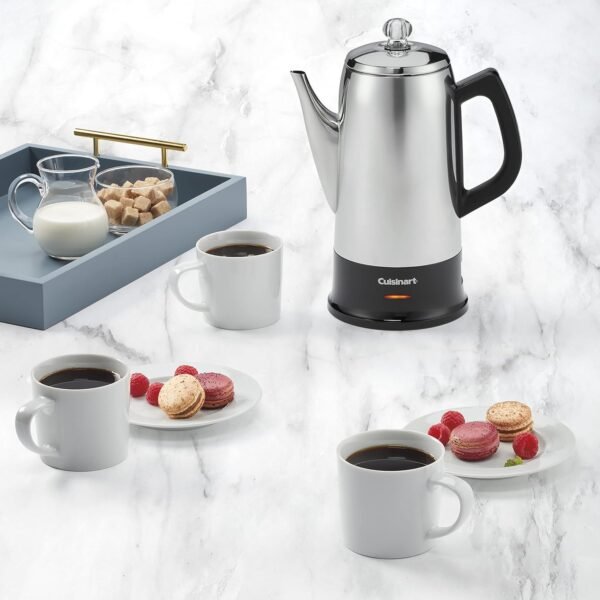
Description
Are you buying a brewing method or a memory?
Percolators occupy an odd place in coffee. They were the standard American method for decades, they were largely replaced by drip machines, and they came back because a certain kind of coffee drinker prefers what they produce and a certain kind of household likes the sound. Both are legitimate reasons and it is worth knowing which one is yours before spending anything.
The mechanism explains the difference. A percolator boils water at the base and pushes it up a tube, where it falls over the grounds and drains back down to be heated and pushed up again. The same water passes through the coffee repeatedly. That produces a stronger, heavier cup than drip brewing, and it also means the coffee can be over extracted if the cycle runs too long. A drip machine passes water through the grounds once and stops.
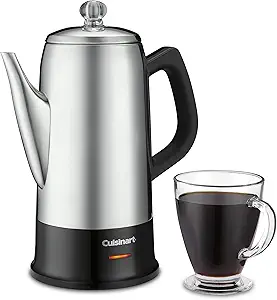
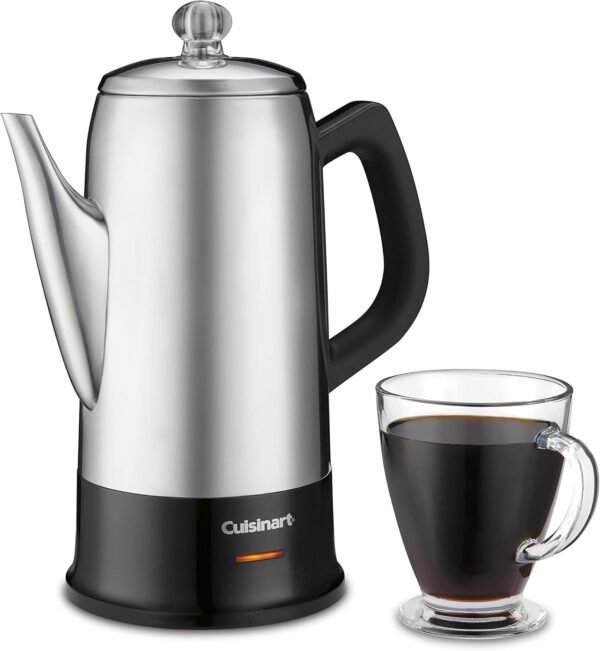
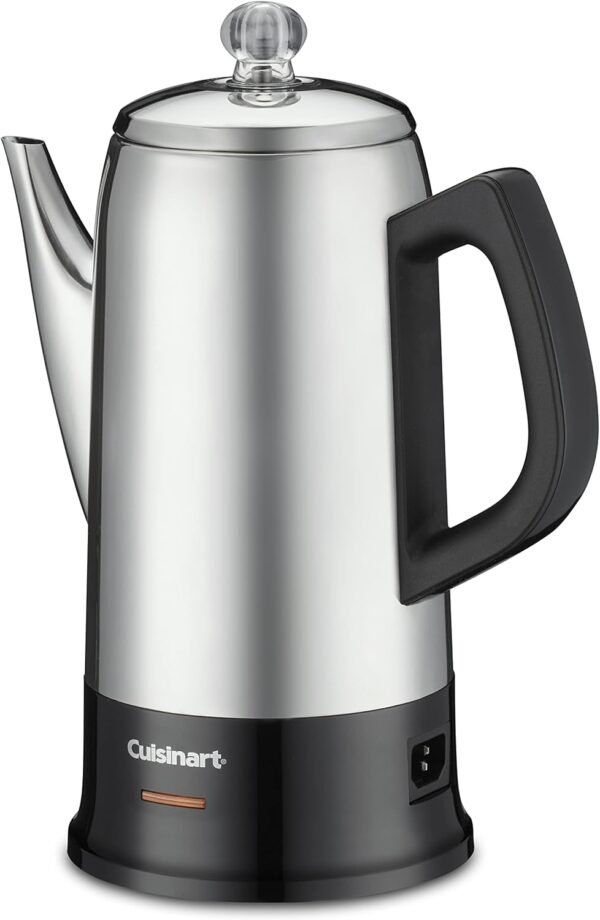
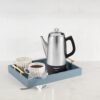
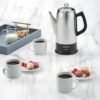
Cuisinart leans into the theater of it. The PRC-12N pushes the coffee up into a transparent knob on top of the lid, so you can watch the brew color deepen and hear the familiar percolating sound. That is not an engineering feature and Cuisinart does not pretend it is. It is the reason a lot of people buy one.
Capacity and the details that matter in use
The capacity range is 4 to 12 cups, and the range is more useful than the maximum. Percolators are inefficient at very small volumes because the tube needs enough water to circulate, so a machine with a stated minimum of four cups is telling you where the floor is. Twelve cups at the top makes this a machine for a gathering rather than for one person.
The stainless steel basket is removable and has measurement markings inside, so you are dosing grounds against a scale rather than guessing. The filter is reusable, meaning no paper cost and no paper to run out of, with the usual consequence that more oils and some fine sediment reach the cup. For percolated coffee that is consistent with the style rather than a flaw.
Three pouring details are named and they are the ones that separate a good jug from an annoying one: an ergonomic handle, a knuckle guard so your hand does not meet the hot body, and a long tapered no drip spout. On a 12 cup stainless jug full of boiling coffee, a spout that dribbles down the side is not a minor irritation.
Size and weight
The unit measures 12.25 inches high, 9.25 inches wide and 6.25 inches deep, and weighs 3 pounds empty. That height clears standard wall cabinets, and 3 pounds means it stores easily. Unlike a drip machine there is no separate carafe, no warming plate and no water reservoir to fill separately: the jug is the machine.
Living with a percolator
The main technique point is timing. Because the water recirculates, the longer it runs the stronger and more bitter the result gets. Percolators of this type stop themselves and switch to a keep warm state, but the strength you get is a function of the cycle rather than something you dial in, so if the coffee is too strong the answer is less coffee in the basket rather than a shorter brew.
Cleaning is straightforward and the stainless construction helps. There is no plastic reservoir to grow anything in, and the basket and tube come out. What does need attention is the tube and the underside of the lid knob, where coffee oils accumulate and turn stale, and the base, where mineral scale forms exactly as it does in a kettle. Descale it on the same schedule you would descale a kettle for your water hardness.
Two things on the specification table need naming rather than repeating. The voltage is recorded as 2.3E and a power of two, which is scientific notation meaning 230 volts, on a product sold into a 120 volt market. That is almost certainly an import error, but confirm the supply voltage with the seller before buying. And the operation mode field says Manual while another field says the interface is buttons and the product is an electric percolator; the machine is electric and it runs its own cycle.
The listing publishes no wattage at all, which for a heating appliance is a genuine gap. If you are planning circuits or taking it to a location with limited supply, get that figure from Cuisinart.
Grind size is the other variable and percolators want a coarse one. Fine grounds pass through the basket perforations into the pot, producing sediment in the cup and a bitter finish, because those fines keep extracting through every cycle. Coffee ground for a drip machine is usually too fine here. If your grinder has a setting for a press, that is the right neighborhood, and it is the single change that most improves percolated coffee.
One more practical note about the format. Because the jug is the machine, there is no separate carafe to break and no hot plate to leave switched on, but there is also nowhere to put the coffee once it is made. It stays in the vessel it was brewed in, sitting on its own base. For serving a table that is convenient. For coffee that has to last, it means the grounds basket should come out once the cycle finishes, or extraction quietly continues.
The ownership signal is solid for a niche category: 333 ratings at 4.2 stars, a rank of fourth in electric coffee percolators, and an availability date of July 2022.
What would send you elsewhere
If you want a cleaner, lighter cup, drip is the method and a programmable machine adds a timer that a percolator does not have. The Cuisinart DCC-1500TG is the same brand’s 12 cup drip machine, and the Technivorm Moccamaster is the machine built around brew temperature. Compare them in the coffee machine category.
If the reason for a percolator is serving a crowd, an urn does that at a scale a 12 cup jug cannot. The West Bend 58030 coffee urn is the larger version of the same idea.
And if what you like is the heavier body that percolation gives without the recirculation, a press produces something similar by full immersion rather than by repeated passes. The ESPRO P7 and the French press category are where that comparison sits.
Who it fits and who should skip it
Buy it if you like strong percolated coffee, if you are serving four to twelve cups at a time, or if the sound and the glass knob are part of why you want one.
Skip it if you want a mild, clean cup, if you need a delay timer, or if you brew one mug at a time. Confirm the operating voltage with the seller before ordering, because the listing records 230 volts.