
Description
How much grilling justifies a cart in the yard?
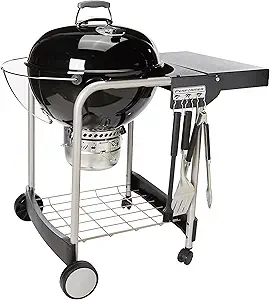
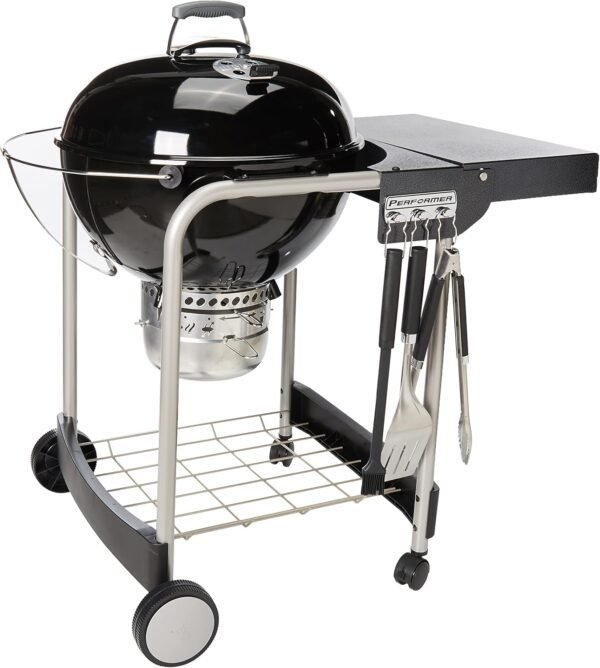
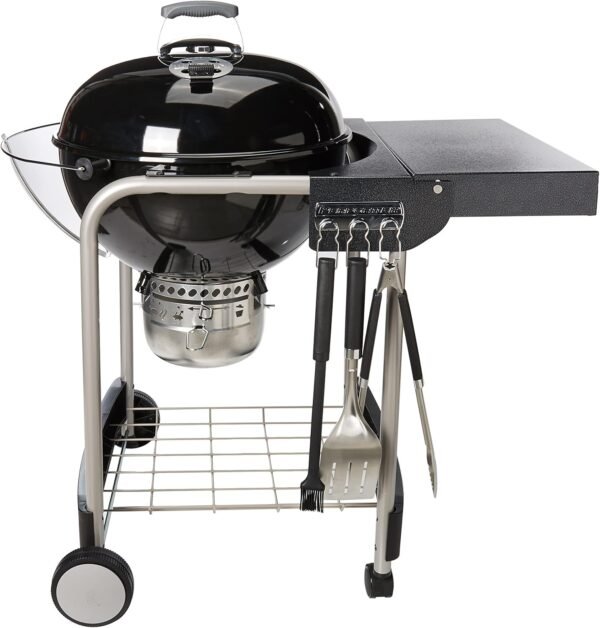
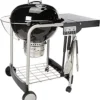
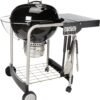
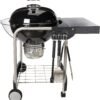
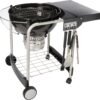
A kettle grill on three legs costs a fraction of what this does and cooks identically. Everything you pay extra for on the Weber Performer is workflow: a wheeled cart, a fold down work surface, a place to hang tools, a lid holder so you are not searching for somewhere to put a hot lid, and an enclosed ash catcher so cleanup is a lever pull rather than a dustpan. So the question is not whether charcoal is worth it. It is whether you grill often enough that the handling matters.
The answer usually comes down to frequency and space. If you grill twice a summer, a basic kettle is the rational purchase. If you cook outside most weeks from spring to fall, the fold down table is the thing you will use every single time, because the alternative is walking plates back and forth to the kitchen. Weber describes the table as sturdy painted metal that folds down for storage, which is also the answer to the space objection: parked with the table down, the cart takes up much less room in a garage.
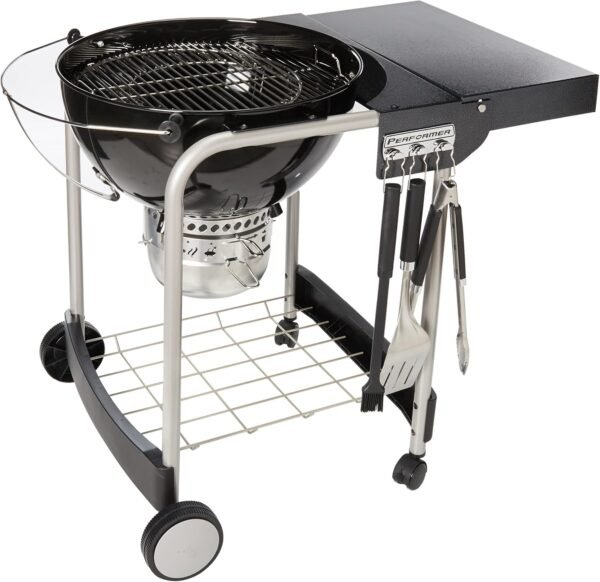
The cooking area is 363 square inches on a 22 inch porcelain enameled bowl. That is the standard Weber kettle size and it comfortably handles a family cookout, with room to set up a two zone fire, which is the technique that separates good charcoal cooking from burned outsides and raw middles. Assembled dimensions are quoted as 43.5 by 42 by 29 inches, and assembly is required.
The features that actually change a cook
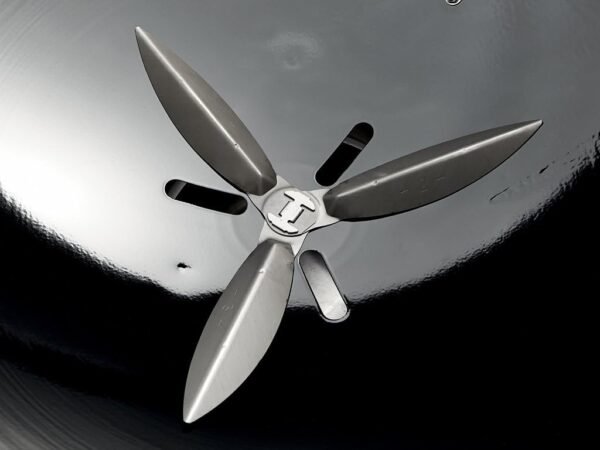
Three parts of this design do real work. The first is the One-Touch cleaning system, an aluminized steel blade assembly turned by the lid handle mechanism that sweeps ash through the bottom vents into an enclosed, high capacity aluminum catcher. Ash management sounds trivial until you have done it with a shovel. It also matters for cooking, because ash building up over the bottom vents chokes the airflow that controls your fire.
The second is the hinged Gourmet BBQ System grate. The hinges let you add charcoal mid cook without lifting the food off, which is what makes longer cooks practical on a kettle. The centre section lifts out to take Weber accessory cookware, which is a system commitment rather than a feature, and worth knowing if you like or dislike that kind of thing.
The third is the Tuck-Away lid holder, which parks the lid on the side of the bowl instead of on the ground. Combined with the glass reinforced nylon handle and its heat shield, it removes the two most common minor burns in charcoal cooking.
The specification fields that belong to a different product
Two rows in this table cannot be describing a charcoal grill and should be ignored rather than interpreted. Heating Power is listed as 8000 British Thermal Units and Main Burner Count as 1. Charcoal grills have no burners and no BTU rating, because their heat output depends on how much fuel you light and how far the vents are open. Those fields belong to a gas grill template and have been populated automatically.
A third row is simply impossible. Item Weight is given as 3.3 pounds. This is a 22 inch steel grill on a wheeled cart with a metal side table, and 3.3 pounds is roughly the weight of the lid handle assembly. The real figure is not published anywhere on this listing. If you need to know whether one person can move it into a garage, look it up on the Weber specification sheet rather than here.
Living with charcoal
Charcoal is a routine rather than a switch, and it is worth being honest about that before buying. Lighting takes fifteen to twenty minutes to reach cooking temperature, which means starting the fire before you start the food. The listing describes no ignition aid on this model, so plan on a chimney starter and newspaper or a fire starter cube. Lighter fluid works and taints the food, which is why almost every experienced charcoal cook stops using it.
Temperature is controlled by two vents, one under the bowl and one in the lid, and learning that relationship is most of the skill involved. The built in lid thermometer listed in the specification features is what turns that from guesswork into a repeatable process. More air means hotter and faster; closing the vents down brings it into the range where a roast can go on for two hours.
Cleanup is the ash catcher and the grate. Ash is not inert waste: it stays hot for many hours, and the enclosed catcher exists partly for that reason. Empty it into a metal container, never a plastic bin or a paper bag, and never on the same day if there is any doubt. That is the one genuine safety habit this product depends on.
Weather is the other ongoing consideration. Porcelain enamel on steel resists rust well but the cart hardware and the aluminized steel components do not enjoy standing water, so a cover is a sensible purchase alongside it. The listing records 1,486 customer ratings averaging 4.7 stars, a first availability date of August 2014, country of origin USA, and a rank of 68th in charcoal grills.
What would send you to something else
If low and slow barbecue is the goal rather than grilling, a kettle can do it but a purpose built smoker does it more easily. The Char-Broil bullet charcoal smoker is the simple version of that and the Oklahoma Joe Canyon combo puts charcoal, gas and a smoke chamber in one unit. The smokers category covers that end.
If the objection to charcoal is the twenty minute wait, gas removes it entirely and gives up the flavor; a portable option like the Cuisinart Grillster is the small end of that trade. And if your building prohibits open flame altogether, an indoor electric grill such as the Starfrit The Rock is what is left, with none of the smoke and none of the flavor that comes with it. The wider charcoal grills category covers the alternatives on this side.
Who the Performer is for
It is for someone who already knows they cook with charcoal, does it regularly, and wants the cart, the table and the ash system rather than a bare kettle on legs. The 363 square inch cooking area is the right size for most households, the One-Touch cleaning system and enclosed ash catcher solve the least pleasant part of charcoal cooking, and the 4.7 star average across 1,486 ratings reflects a design that has barely changed in a decade because it did not need to.
It is not for an occasional griller, who should buy a plain kettle, and it is not for anyone without outdoor space and a safe place to dispose of hot ash. Ignore the BTU and burner count fields entirely, and do not plan around a 3.3 pound weight that cannot possibly be right.