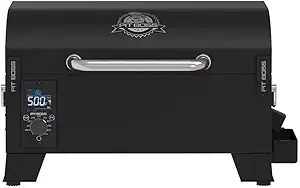
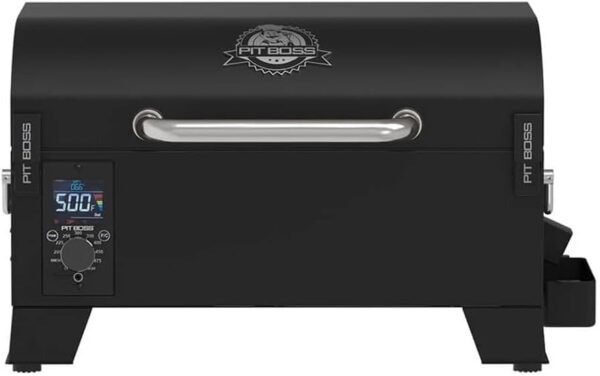
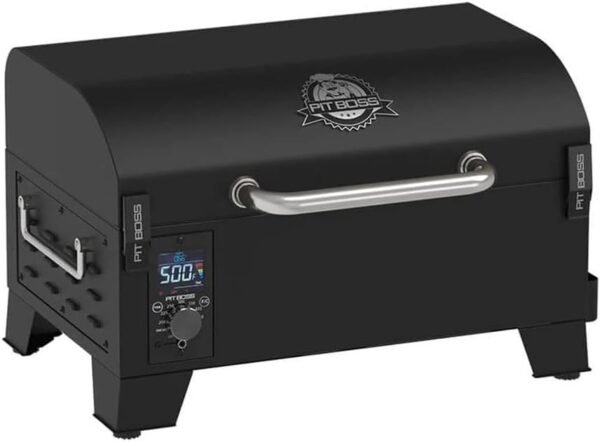
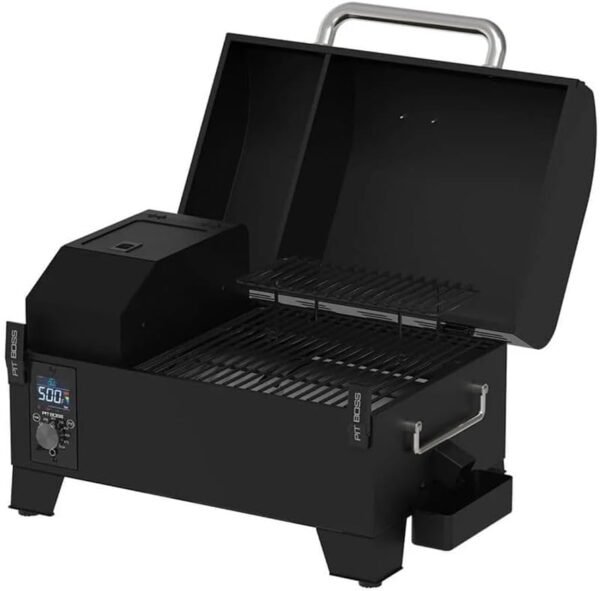
Description
Where is this grill going, and is there an outlet there?
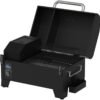
Pit Boss sells this as a travelling grill, built to go to a campsite or a tailgate, and the design supports that: 256 square inches of cooking area, lock tight latches for transport, and a body small enough to sit on a table. But a pellet grill is not a charcoal grill with wood in it. It has an electric auger feeding pellets into a fire pot, an electric igniter, and a fan driving convection. All three need mains power.
The listing never states a voltage, a wattage or whether the unit can run from a battery or a vehicle supply. For a grill marketed for camping and tailgating, that is the most consequential gap on the page. If you are planning to use it away from a building, settle the power question with Pit Boss before you buy, because a pellet grill without electricity is an empty steel box.
Where it works without qualification is a balcony, a small patio, a boat dock or a table beside a larger grill. Two hundred and fifty six square inches is enough for four to six burgers or a couple of racks of ribs cut to fit, and the tabletop form removes the storage problem that full size pellet grills create.
Pellet convection is what this cooks like, and the flame broiler is the exception
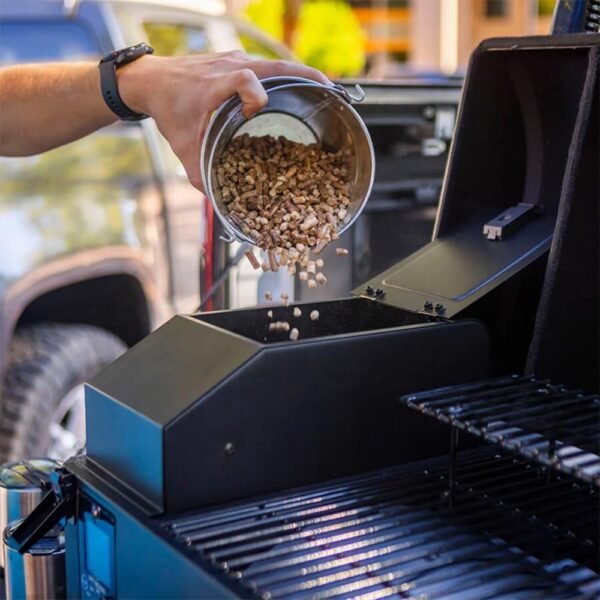
A pellet grill is essentially a small convection oven that burns wood. An auger feeds compressed hardwood pellets into a fire pot at a rate set by the controller, a fan keeps the fire burning and circulates hot air, and an exhaust vent, on this model at the back, carries smoke across the food and out. That is why Pit Boss can claim eight cooking modes from one machine: smoke, bake, braise, roast, grill, barbecue, char grill and sear are all descriptions of running the same convection at different temperatures.
The result is genuinely different from charcoal. Temperature is held by a controller rather than by managing vents, smoke flavor comes from the pellets rather than from a separate wood chunk, and the cook is largely unattended once it is running. Pit Boss also states automatic start up and cool down, which are the two moments a pellet grill needs to manage carefully, since the igniter has to catch cleanly and the auger has to clear at the end.
The exception to convection cooking is the flame broiler, which Pit Boss describes as allowing direct flame searing at up to 1,000 degrees Fahrenheit. That is a sliding plate over the fire pot that can be opened to expose the food to direct flame. It solves the classic pellet grill complaint, that convection alone browns rather than sears, and it also means part of this small tabletop unit reaches a temperature that will burn anything it touches, including you.
What a 7 pound hopper means for how long you can cook
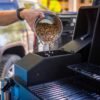
The hopper holds 7 pounds of pellets, and that number sets the ceiling on an unattended cook. Pellet consumption varies with temperature and weather, running roughly one pound per hour at low smoking temperatures and considerably more at high ones. Seven pounds is therefore something like three to seven hours depending on how you run it.
For most cooks that is ample. For an overnight brisket it is not. Pellets also absorb moisture and turn to sawdust if stored badly, which jams augers, so a sealed container is part of owning a pellet grill rather than an optional accessory.
The listing states one meat probe is included, which is what turns a long cook from guesswork into a number, and porcelain coating on the cooking surface for cleaning. There is a contradiction there worth naming: one feature bullet describes porcelain coated steel cooking racks and another describes porcelain coated cast iron cooking grates. Steel and cast iron behave differently, with cast iron holding heat much better for searing, so which one you are getting matters and the listing says both.
Living with it: weight, cleaning, safety and figures that do not agree
Two sets of numbers on this page contradict each other outright. A feature bullet gives the assembled dimensions as 24.8 inches long by 18.7 wide by 14.2 high with a weight of 43.4 pounds. The specification table gives 18.7 deep by 18.7 wide by 14.2 high and a weight of 50.7 pounds. The length is stated as both 24.8 and 18.7 inches, and the weight as both 43.4 and 50.7 pounds, a difference of over seven pounds. If you are buying it to carry, that is not a rounding error. Measure and weigh before planning to lift it in and out of a vehicle regularly.
Several specification fields describe a different kind of appliance. Main burner count is listed as 1 and heating elements as 1, on a machine that has neither a burner nor a heating element, only an igniter and a fire pot. Number of power levels is given as 3, which does not obviously match a temperature controlled pellet grill, and the listing does not explain what those three levels are.
Cleaning is the part that determines whether a pellet grill lasts. Pit Boss provides a simple access grease tray and notes that disposable foil liners are not included. Grease management is a fire safety matter rather than a tidiness one, since accumulated grease in the drip path is the most common cause of pellet grill fires. Ash also builds in the fire pot and needs clearing periodically.
The general safety points apply and matter more on a tabletop unit than on a floor standing one. This is outdoor equipment only, it produces carbon monoxide and must never be used indoors or in a garage, it needs clearance from siding and overhangs, and a table that reaches 1,000 degrees at the sear position needs a non combustible surface under it. Assembly is stated as not required, and the warranty as five years.
When a different grill is the right call
If long smokes are the goal, a larger hopper and a bigger chamber remove the refilling and the capacity limits. The Recteq Flagship 1100 review covers the serious end of pellet cooking, and the Recteq RT-B380 Bullseye review covers a mid sized pellet grill built around high heat searing.
If the appeal is smoke flavor without needing electricity, charcoal is the answer and it travels anywhere. The Char-Broil Bullet charcoal smoker review covers a vertical charcoal smoker, and the Oklahoma Joe’s Canyon combo review covers a machine that does both charcoal and gas.
And if portability is the real requirement rather than smoke, propane lights immediately and needs no power at all, which the Cuisinart Grillster portable gas grill review covers. The rest of the range sits in the smokers category and the gas machines in the propane grills category.
Who should buy it and who should not
It suits someone who wants controlled pellet cooking on a small patio, a balcony or a table, who cooks for two to four people, and who has an outlet where the grill will stand. The flame broiler, the meat probe, the automatic start up and cool down and the five year warranty are the four things that make it a coherent small pellet grill rather than a novelty.
It does not suit long overnight cooks on a 7 pound hopper, a large gathering on 256 square inches, or genuine off grid use, since the listing never establishes how the grill is powered away from a building. Anyone buying it to carry should also confirm the real weight and length, because the listing gives each of them two different values. The listing shows 57 ratings averaging 4.4 stars, ranked 17th within outdoor smokers.