
Description
What is already on your vehicle, and what are you adding to it?
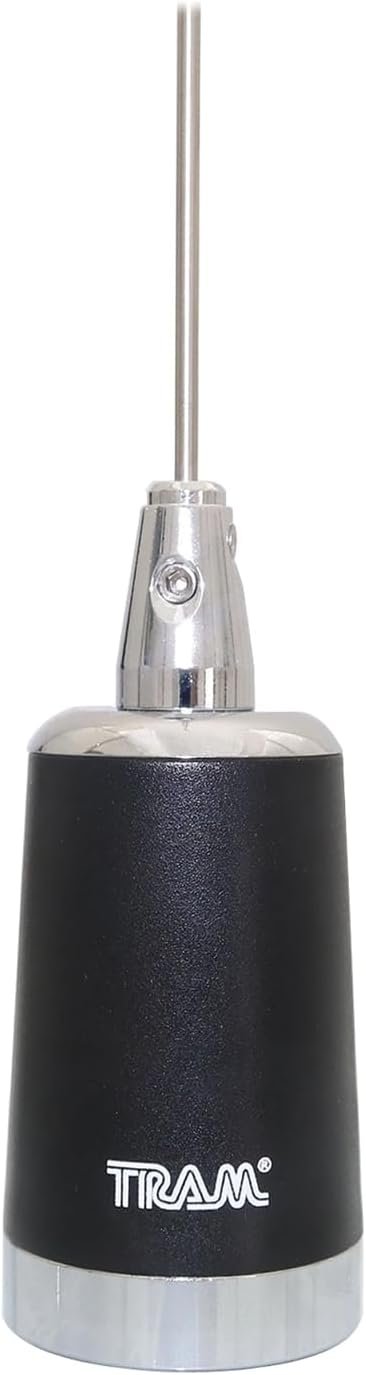
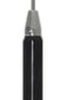
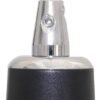
A mobile antenna purchase is really three purchases, and the listing only covers one of them. You need the antenna, you need a mount, and you need coaxial cable to connect the two. Tram states the position clearly in the last feature bullet: the antenna comes with a chrome plated solid brass base designed for NMO mounting, and the mount itself is sold separately.
NMO is the standard to understand here, because it is the reason this antenna is worth choosing. It is the mobile mounting system used across commercial, public safety and amateur radio, with a fixed thread and a consistent electrical interface. NMO mounts exist for drilling into a roof, for clipping to a trunk lip, for magnetic attachment and for permanent through hole installations. Choosing NMO means the mount and the antenna are independent decisions, and you can change one without replacing the other.
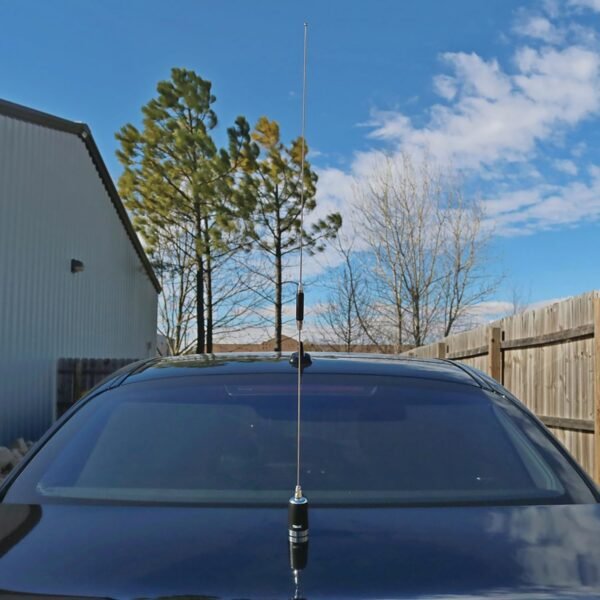
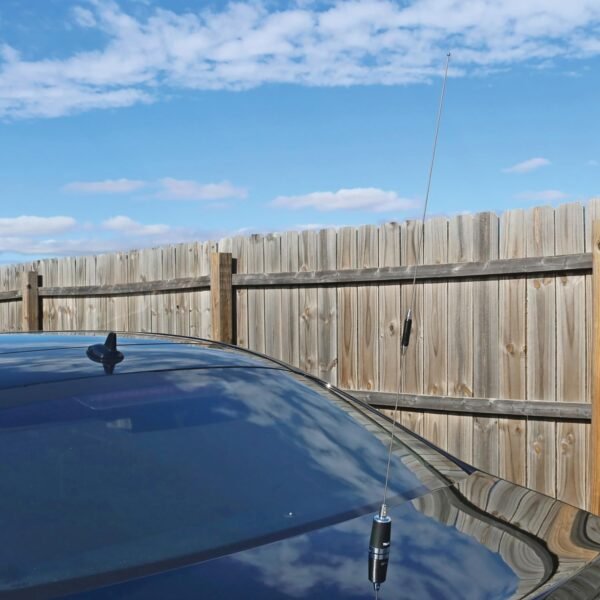
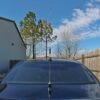
The physical size is the other planning question. The specification table gives 36.5 inches overall, while a feature bullet describes a 37 and a half inch stainless steel whip. Those two numbers do not agree, and the listing never reconciles them, so plan for something a little over three feet standing above wherever you mount it. On a car roof that puts the tip close to seven feet from the ground, which is a real consideration for garages, parking structures and drive through car washes.
The gain figures and the power rating are what actually describe this antenna
Tram publishes two numbers that matter and publishes them in the right units, which is more than most antenna listings manage. The antenna is pretuned for 144 to 148 megahertz with 3 dBd of gain, and for 430 to 450 megahertz with 6 dBd of gain.
The unit is the part to notice. dBd means gain relative to a dipole, which is a real reference antenna. Many listings quote dBi instead, gain relative to a theoretical isotropic radiator, and dBi figures are always about 2.15 higher for the same antenna. So an antenna quoting 6 dBd and one quoting 8 dBi are describing similar performance, and comparing the raw numbers without checking the unit will mislead you every time.
What gain does on a mobile antenna is worth understanding too, because it is not free. A vertical antenna with gain achieves it by flattening its radiation pattern, pushing energy toward the horizon instead of upward. On flat ground that is exactly what you want, since the repeater or the station you are working is at the horizon. In steep terrain, a high gain antenna can be worse than a low gain one, because the signal is being aimed at the hillside rather than over it. Three dBd on two meters and six on seventy centimeters is a sensible middle ground for general use.
What the 150 watt rating means and what it does not
Tram rates the antenna at 150 watts. That is a handling limit, not an output. It means the antenna and its base can dissipate the heat and withstand the voltages produced by a transmitter running up to that power without damage.
For most amateur mobile operation that is generous headroom. Typical dual band mobile transceivers run 50 watts on two meters and 40 or 50 on seventy centimeters, so a 150 watt antenna is operating well inside its limit, which is where components last. The rating matters more if the antenna is fed through an amplifier, and it matters not at all for receive.
Two construction details support that rating. The whip is stainless steel rather than plated steel, which is what survives road salt and weather. The base is chrome plated solid brass with a gold plated plunger type contact pin, and gold plating on the contact is not decoration: it resists the oxide film that builds on base metal contacts and raises resistance at exactly the point where the signal transfers into the antenna.
Living with it: installation, the ground plane and the licensing question
The single biggest factor in how a mobile antenna performs is not the antenna. It is the ground plane. A quarter wave vertical needs a conductive surface beneath it to work against, and on a vehicle that surface is the metal roof or trunk lid. An antenna mounted in the middle of a steel roof performs well. The same antenna on a lip mount at the edge of a trunk, or on a plastic panel, or on a vehicle with an aluminum or composite body, performs measurably worse. Choose the mounting position before you choose anything else.
Cable matters at these frequencies more than most people expect. Loss in coaxial cable rises with frequency, so a run that costs you very little at 144 megahertz costs noticeably more at 440. Keep the run as short as practical and use cable appropriate for UHF rather than the least expensive option on the shelf.
The licensing point deserves stating plainly, as it does for any transmitting equipment. This is an amateur radio antenna covering the two meter and seventy centimeter amateur bands, and transmitting on those bands requires an amateur radio license in the United States and in most other countries. Radio frequency exposure guidance also applies to any transmitting antenna mounted where people sit close to it.
One field on the listing is simply a category error worth naming: the department field reads “Unisex-Adult”, which is a clothing classification that has attached itself to an antenna. It says nothing about the product.
When a different antenna makes more sense
If you also want to work the HF bands from the vehicle, a dual band antenna will not do it and a motorized screwdriver style antenna will, at the cost of complexity and radio compatibility. The Yaesu ATAS-120A review covers that approach and its very specific radio requirements.
If you want a shorter antenna for garage clearance, or a different mounting arrangement, the Comet CA-2X4SRNMO review covers another NMO dual band option, and the Stryker SR-A10 review covers a different mobile design.
If the installation is at a house rather than on a vehicle, a base antenna gets height and length that a car roof cannot, and both the Diamond X30A base antenna review and the Tram 1481 fiberglass antenna review cover that. The rest of the range sits in the radio antennas category. If you arrived here looking for over the air television reception rather than two way radio, the TV antennas category is the right place instead.
Who it suits and who should look elsewhere
It suits a licensed operator fitting a dual band mobile installation on a metal bodied vehicle, who already has or is buying an NMO mount, and who wants a straightforward pretuned antenna with no adjustment required. The stainless whip, the brass base, the gold plated contact and the honest dBd gain figures are the four things that make it a serious component rather than a generic one. The listing shows 96 ratings averaging 4.4 stars, ranked 539th within radio antennas.
It does not suit anyone without a mount, since the mount is not included and the antenna is unusable without one. It does not suit vehicles without a metal ground plane, it does not cover the HF bands, and it is not a television antenna despite the category it is filed under. Anyone without an amateur license should understand it is receive only until that changes.