Description
Is your viewing room bright, dark, or somewhere in between?
Almost every meaningful difference between 55-inch televisions comes down to how they handle light, and the room decides which handling you need. In a bright living room with windows, what matters is peak brightness and how the screen deals with reflections, because a dim panel simply loses to the sun. In a dark room, what matters is black level and how convincingly the set can put a bright object next to a dark one without spilling light between them.
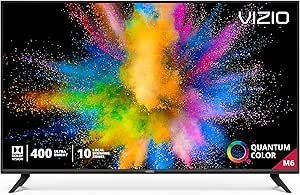
The M-Series Quantum is aimed at the second case more than the first. VIZIO builds it around an Active Full Array backlight with local dimming, which is a design intended to deepen blacks. That is the right priority for a room where you control the light and a less useful one in a conservatory.
Fifty five inches puts the seating distance at roughly six to nine feet for 4K content, and the panel is a little under 48 inches wide. Those are the two measurements to check before anything else, because a set that is the wrong size for the room cannot be corrected by any picture setting. It is worth saying plainly that this listing publishes no dimensions and no weight at all, so measure from VIZIO’s own manual for the model rather than from this page.
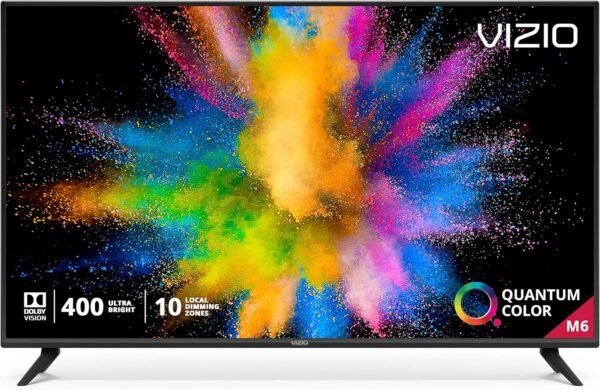
Ten dimming zones is the number that decides what this set can and cannot do
The feature list on this listing is unusually specific in one place: VIZIO states an Active Full Array backlight with 10 local dimming zones. Understanding what ten zones means is the single most useful thing a buyer can take from this page.
Full array means the LEDs sit in a grid behind the panel rather than along its edges, which gives more even brightness than edge lighting and is a genuine advantage. Local dimming means groups of those LEDs can be dimmed independently, so a dark part of the picture is lit less than a bright part. That is how an LCD approaches the contrast that self emissive panels get for free.
Ten zones across a 55-inch screen means each zone covers a large area, roughly a tenth of the picture. When a small bright object sits on a dark background, a bright star on a night sky, white subtitles on a dark scene, the whole zone containing it has to brighten. The result is a visible halo around bright objects and dark scenes that lift when something bright enters them. Sets with hundreds of zones reduce that effect, and sets with none avoid the halo entirely at the cost of never getting a deep black.
So the honest reading is that ten zones is better than no local dimming and a long way short of what the phrase suggests on a specification sheet. In practice it improves contrast on scenes with large dark and bright areas and struggles on scenes with small bright highlights.
What Quantum Color and the HDR formats add
VIZIO describes Quantum Color as delivering over a billion hues of color volume. Quantum dot technology works by converting backlight into more precisely defined red and green light, which widens the range of colors the panel can display and, importantly, keeps those colors saturated as the picture gets brighter. Ordinary LED sets tend to wash toward white at high brightness, and that is what quantum dots address.
On the format side this set supports Dolby Vision, HDR10+ and HLG, which is broad coverage. Dolby Vision and HDR10+ both carry dynamic metadata, adjusting the tone mapping scene by scene rather than once for a whole title, and having both means you are unlikely to meet content the set cannot map. What the listing does not publish is peak brightness in nits, which is what determines how much of that HDR you actually see. Combined with ten dimming zones, expect the format support to be more complete than the panel’s ability to exploit it.
Living with it: what this listing does not tell you at all
This is the shortest specification section in this batch for a simple reason. The listing has no specification table. There are no dimensions, no weight, no VESA mounting pattern, no HDMI port count, no refresh rate, no brightness figure, no model number in the specification fields, no first availability date and no customer rating data. Everything on the page is in five marketing bullets.
That is a significant problem for a set you intend to mount. The VESA pattern determines which bracket fits, the weight determines whether that bracket is rated for it, and the depth determines how far the set stands off the wall. None of it is here. Anyone planning a wall installation should get VIZIO’s specification sheet for this model first, and choose the bracket after. A universal bracket covering 32 to 65 inch sets, such as the one covered in the Mounting Dream MD2380 review, will handle the size range, but the bolt pattern still has to match.
The HDMI count matters as much. A modern living room typically needs a console, a streaming device and a soundbar connected at once, and a set with two ports forces a switch. This page does not say how many there are.
The platform is SmartCast, VIZIO’s own system, with apps accessible from the remote or from a phone app. As with any manufacturer platform, the practical question is how long app support continues, and with no date on the listing there is no way to judge how old this model is from the page alone.
When a different set is the better answer
If contrast is your priority, the step to look at is a set with many more dimming zones rather than ten, which usually means Mini LED. The Hisense 55-inch A6 Series review covers a comparable size on a different platform, and the VIZIO M65Q6-L4 QLED review covers where the M-Series line went next, with more attention to gaming features.
If you want the same brand and size with a simpler backlight and a lower price position, the VIZIO V-Series 50-inch review covers the tier below. If the platform is what you would rather change, the TCL 55S455 review covers a 55-inch alternative on a different interface.
The rest of the range sits in the LED and LCD televisions category, and the quantum dot sets specifically in the QLED televisions category.
Who should buy it and who should not
It suits a controlled light room at 55 inches where broad HDR format support and quantum dot color matter, and where some local dimming is better than none. The combination of Dolby Vision, HDR10+ and HLG on one set is genuinely useful, since it removes the question of which format a given title uses.
It does not suit a bright room, since no brightness figure is published anywhere. It does not suit anyone chasing deep contrast, because ten dimming zones will produce visible halos around small bright objects. And it does not suit a buyer who needs to plan a wall installation from the listing, because this page publishes no dimensions, no weight and no mounting pattern at all.