
Description
Which channels are you missing, and what band are they on?
Most people shop for an antenna by distance, and distance is the least useful thing to shop by. What decides the purchase is which broadcast band your missing channels sit on. American television occupies three ranges: low VHF, channels 2 through 6, high VHF, channels 7 through 13, and UHF above that. Antennas are sized to the wavelength they receive, so a UHF antenna is small and one that genuinely works on low VHF has to be large.
That is where this Winegard is different from almost everything else sold as an indoor or compact antenna. It covers all three. The description states uniform gain across low VHF channels 2 to 6, high VHF channels 7 to 13, and UHF, and the feature bullets confirm added extensions specifically for the low band. If the station you cannot receive is on channel 4 or channel 6, most flat indoor panels and most compact UHF antennas will never get it, and this one is designed for exactly that gap.
Look up your local transmitters first. Public reception tools list each station with its real broadcast channel and its direction from your address. That real channel is often different from the number displayed on screen, so check the physical channel rather than the branded one.
A yagi is a directional antenna, and that is the trade you are making
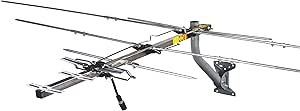
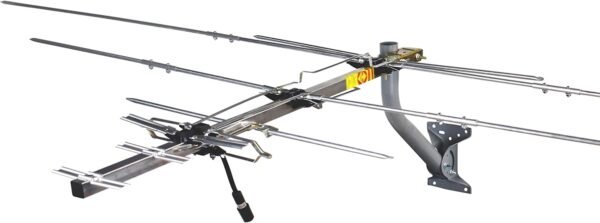
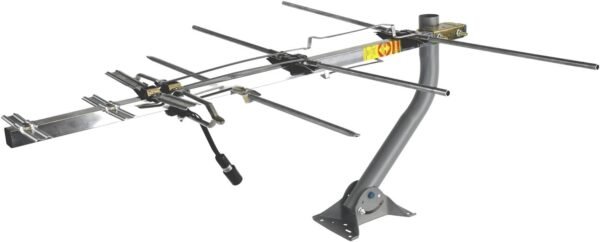
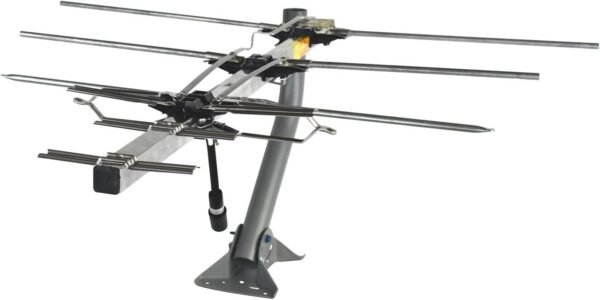
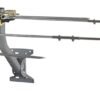
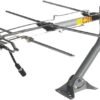
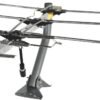
Winegard describes this as a classic yagi design, and understanding what that means settles most of the practical questions. A yagi is a line of elements along a boom: one driven element that actually connects to the cable, a reflector behind it, and directors in front. The array is directional. It has substantial gain along its axis and rejects signals arriving from the sides and the rear.
The listing calls out an increased front to back ratio, which measures exactly that rejection. It improves the wanted signal relative to noise from elsewhere, and it reduces multipath, the reflections off buildings and terrain that arrive slightly later than the direct signal and cause digital pictures to break up rather than simply look weak.
The cost of that gain is aim. A yagi has to point at the transmitter. If your local stations broadcast from two different directions, a single fixed yagi will favor one and lose the other, and the answer is either a rotator, a second antenna, or a multi directional design instead. Winegard also mentions a uniform gain curve, which means the gain does not vary wildly across the channels it covers, so one aim point should serve all of them.
Why the mile figure is the least reliable number on the page
Winegard states 70 miles in the title, the description and a feature bullet. Range figures on antennas are not measurements of the antenna. They depend on transmitter power, terrain between you and it, the height of your antenna, and whether the signal has to pass through a roof, a wall or a hillside. The same antenna will pull a station from sixty miles across flat open ground and fail at fifteen miles behind a ridge.
Read a range claim as a rough class rather than a promise. A 70 mile class antenna is a large outdoor directional design, as opposed to a flat indoor panel at 25 to 50 miles. Where you mount it changes the result more than the number on the box.
Height is the single biggest factor you control. An antenna in a roof space is compromised by the roof material, and one on a chimney or a gable is not. Broadcast reception is close to line of sight, so a few extra feet of elevation over an obstruction often changes more than a different antenna would.
Living with it: mounting, cable and one field that cannot be right
Winegard states that the kit includes a universal antenna mount and that the elements fold and lock, which is the difference between twenty minutes of assembly and an afternoon on a ladder. The extensions for low band VHF fit at the rear of the boom and are what make the low band coverage possible, so they need to be fitted rather than left in the box.
The physical size is 37 by 34.5 by 19 inches, at 5.49 pounds. That is a real outdoor structure, not something to hide behind a curtain, and while 5.5 pounds is light the wind load on an array that size is what the mount has to handle. Winegard says the classic construction reduces wind load while increasing element strength, which is a design intent rather than a rating, and the mounting hardware and mast should still be chosen for the weather where you live.
Impedance is listed as 75 ohms, the standard for television coaxial cable, so normal RG-6 and F connectors will match. The cable is not stated as included, and the run needs planning: coax loss rises with length and frequency, so a long run costs more at UHF than at VHF.
One field on this listing is simply wrong. A feature bullet reads “Power Source Type: Corded Electric”. This is a passive antenna. It has no amplifier, no power supply, no LED and nothing to plug in. That line is an import artifact, and it could lead a buyer to expect an amplified product. If you do need amplification on a long cable run, a separate preamplifier is the accessory, and it should be mounted at the antenna rather than at the television.
The listing also states UHF coverage as channels 14 to 50. That range predates the repack that moved American broadcasters into a narrower slice of the UHF band, so the antenna covers more spectrum than is now in use rather than less. Coverage is not the limitation here.
When a different antenna is the right answer
If all of your stations are on UHF, a UHF only antenna will be smaller and will have more gain on those channels than an antenna spreading its performance across three bands. The Antennas Direct 91XG outdoor UHF antenna review covers that specialized approach.
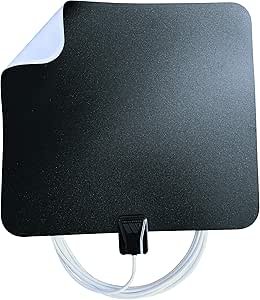
If an outdoor installation is not possible, because of a lease, a homeowners association or a lack of access, then an indoor panel is the only option and the compromise has to be accepted. The Winegard FlatWave Amped indoor antenna review covers Winegard’s own indoor product, and it is worth noting that it covers high VHF and UHF but not the low VHF channels this yagi reaches. If you want outdoor performance in a smaller and less conspicuous housing, the Televes Ellipse Mix review covers that middle ground.
Whichever antenna you choose, the tuner at the other end does half the work, and the VIZIO D32f-F1 review covers a set with a built in tuner and an RF input. The rest of the antennas sit in the TV antennas category and the sets in the LED and LCD televisions category.
Who should buy it and who should not
It suits a household that can mount an antenna outdoors or in a large attic, whose local stations lie broadly in one direction, and particularly one that needs low VHF channels that smaller antennas cannot reach. The fold and lock elements and the included universal mount make the installation straightforward, and the three band coverage is the genuine differentiator. The listing shows 338 ratings averaging 4.2 stars, ranked 804th within TV antennas.
It does not suit an apartment with no outdoor access, a location where the transmitters lie in opposite directions from your home, or anyone expecting the 70 mile figure to be a specification rather than a class. And it is not an amplified antenna, whatever the power source field on the listing says.