

Description
Where in the house does a 32-inch screen actually belong?
A 32-inch television is a room specific product, and choosing one well starts with naming the room. It belongs in a bedroom watched from six or seven feet, a kitchen where it is glanced at rather than watched, a home office, a spare room, a small apartment where the sofa is close to the wall. In each of those, 32 inches is the correct size and a larger set would dominate.
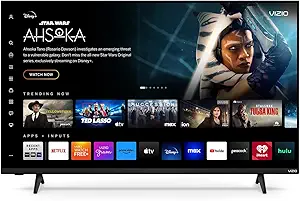
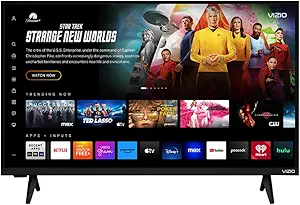
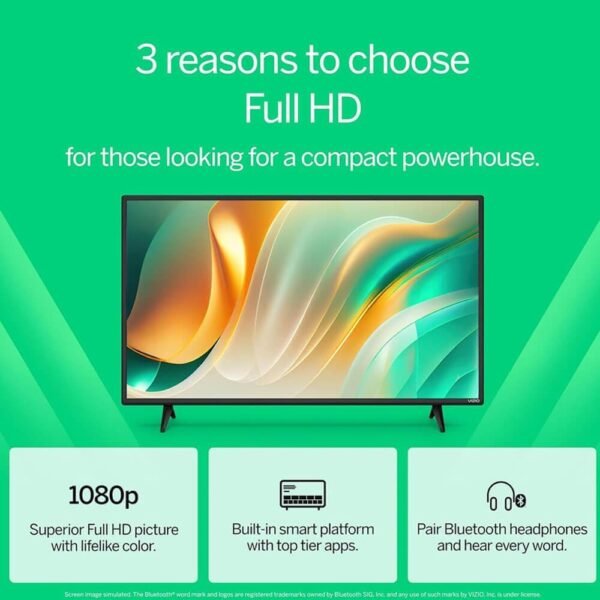
What separates one 32-inch set from another is rarely the picture and usually the practical details: the resolution, the backlight arrangement, the number of inputs and how the smart platform behaves. This VIZIO answers two of those well. It is a full HD 1080p panel rather than the 720p that is common at this size, and it uses a full array backlight rather than edge lighting, which VIZIO describes as delivering more uniform light across the screen.
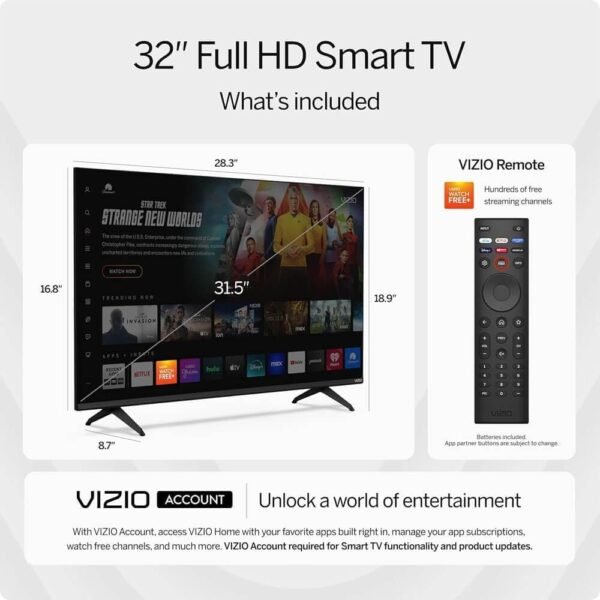
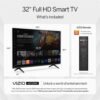
The dimensions are 28.77 inches wide, 16.96 inches tall and 2.99 inches deep, at 11.5 pounds. That is light enough for almost any bracket and small enough to sit on a dresser or a kitchen shelf. It is worth noting that VIZIO gives the screen as 32 inches in the specification table while the description states 32 inch class with a 31.5 inch measured diagonal, which is the ordinary difference between a class size and a measured one.
Full array backlighting and the refresh rate claim are what to understand here
Full array backlighting means the LEDs sit behind the panel in a grid rather than along one or two edges. On large expensive sets that arrangement enables local dimming, where zones of the backlight dim independently. On a 32-inch set at this position it more often means simply that brightness is even from corner to corner, with none of the cloudy patches and bright edges that cheap edge lit panels show on a dark scene. That is a genuine advantage and it is unusual at this size.
The refresh rate claim needs more care. VIZIO’s description states a 120 hertz effective refresh rate achieved with backlight scanning. Those last three words are the important ones. The panel is not refreshing 120 times a second. What happens is that the backlight is strobed on and off in sync with the panel, which reduces the sample and hold blur that makes motion look smeared on an LCD. It can genuinely improve perceived motion clarity. It also reduces brightness and can introduce visible flicker for people sensitive to it. It is not the same thing as a 120 hertz panel, and a games console will not be able to run at 120 frames per second on it.
What the SmartCast platform means on a set from this generation
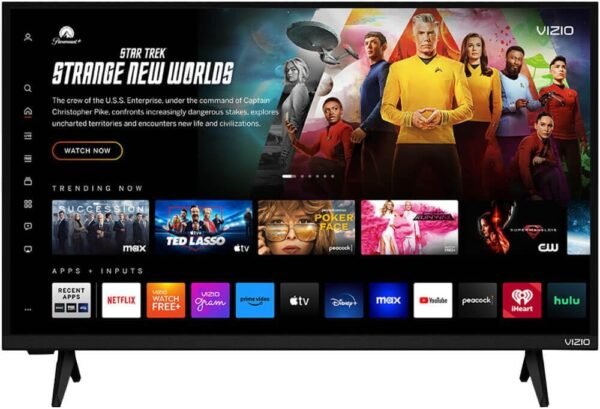
The listing describes two different things and does not separate them clearly. It says apps like Netflix can be accessed directly from the television using the remote with SmartCast Home, and it also says Chromecast is built in so you can stream from your phone. Those are two different ways of getting content onto a screen, and VIZIO’s platform of this era was in transition between them, having started as a casting only display and later added an on set app launcher through software updates.
The practical question for a buyer today is which one you get out of the box and whether the set is still receiving updates. VIZIO also names WatchFree, its free ad supported channel service, described here as over 100 live channels. Free channel services change their lineups continually, so treat the channel count as a snapshot rather than a specification.
The date on this listing is the thing to weigh most heavily. VIZIO’s description calls this the all new 2018 D-Series while the same page gives a first availability date of May 4, 2017. Either way, this is a set from around eight years ago running a smart platform of the same vintage, and app support on any smart television eventually stops. If the set is going into a room where a streaming stick will be plugged into it anyway, that concern largely disappears.
Living with it: mounting, inputs, sound and power
At 11.5 pounds, mounting is easy and almost any small bracket will carry it. The listing does not publish a VESA pattern, so check the manual before buying hardware. Three inches of depth means it sits close to the wall on a fixed mount and is unobtrusive on a shelf.
The listing is silent on the input panel, which is a real gap on a small television. The number of HDMI ports decides whether you can have a console, a streaming stick and a soundbar connected at once, and this page does not say. It also does not state whether there is an optical audio output, which is how you would connect an older soundbar or receiver. Both are in VIZIO’s manual for the model and worth checking before buying.
Sound at this size and thickness is functional rather than good, which is normal and not a criticism of this set in particular. In a kitchen it is fine. In a bedroom where dialogue clarity matters, a small soundbar transforms it.
Power is listed as 120 volts and no wattage is given. A 32-inch full array set draws modestly, and the energy guide label that ships with it is the number to use. The remote takes two AAA batteries, which the listing states are included.
When a different small television is the better buy
If you want a current platform rather than one from 2017, the Hisense 32A4NR Roku TV review covers a newer 32-inch set, and the TCL 32S327 review covers another 1080p Roku option with a well documented input panel.
If you would rather stay with VIZIO but want the current generation of the same idea, the VIZIO 32-inch V-Series review covers the successor. If smart features are not wanted at all, because the set will live behind a cable box or a console, the LG 32LJ500B review covers a simpler machine. And at the top of the 32-inch market the Sony KD32W830K review covers a better processed picture, though at 720p rather than 1080p.
The full size range sits in the LED and LCD televisions category, and if the plan is to add a modern interface to an older panel, the streaming media players category is the cheaper route.
Who should buy it and who should not
It suits a secondary room where 32 inches is the right size and where full HD resolution and even backlighting matter more than platform freshness. It is light, shallow and easy to place, and the full array backlight is a real technical advantage over the edge lit panels it competes with.
It does not suit anyone who wants a current smart platform with a long support life ahead of it, anyone who needs to know the HDMI count before buying, or anyone expecting the 120 hertz figure to mean a 120 hertz panel, because the description states plainly that it is achieved with backlight scanning. The listing shows 282 ratings averaging 3.7 stars, ranked 814th within LED and LCD televisions and 234,647th across electronics, which is a middling record for a set that has been listed since 2017.