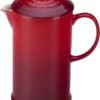
Description
Why choose stoneware over glass for a press?
Almost every French press sold is a glass beaker in a metal frame. This one is a solid stoneware pot, and that single material choice drives every practical difference. It is worth deciding whether those differences matter to you before anything else, because in brewing terms a press is a press: coarse grounds steep in hot water and a mesh plunger separates them. The mechanism is identical.
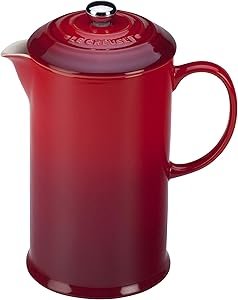
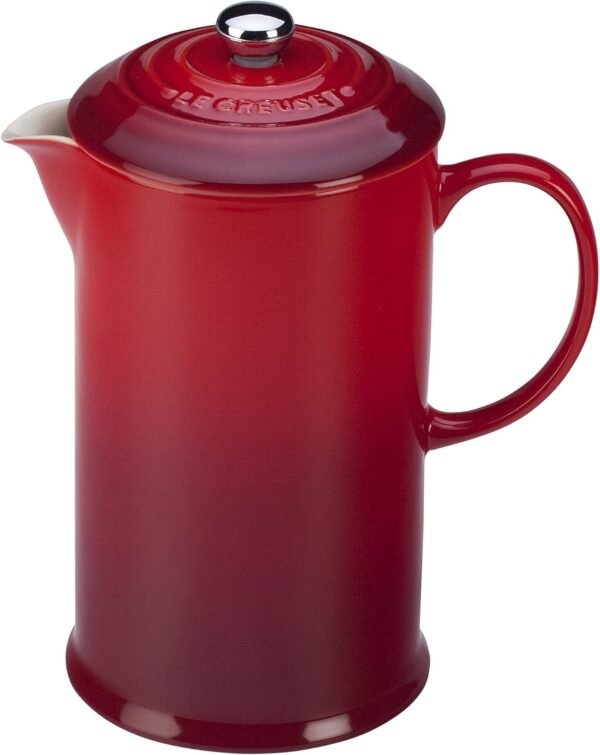
What stoneware changes is heat and durability. A thick ceramic wall holds temperature far better than thin glass, which matters because a French press brew sits for four minutes and then continues sitting while you drink it. Stoneware also survives a knock on a countertop that would end a glass beaker, and glass carafes are the single most common reason a press gets replaced. Le Creuset quotes a 34 ounce capacity, which is roughly four small cups or two large mugs, in a pot measuring 6.5 inches across and 8.5 inches high and weighing 3 pounds empty.
What stoneware costs you is visibility and weight. You cannot see the water level or the color of the brew, so filling is done by eye at the rim or by measuring the water first. Three pounds empty and closer to five pounds full is a genuinely heavy pot to pour one handed, which is worth knowing if wrist strength is a consideration. And the price is a Le Creuset price, which is a design decision rather than a brewing one.
The listing bullets describe a different product
This record needs naming rather than paraphrasing, because most of its feature bullets are not about a French press at all. They are the standard Le Creuset stoneware bakeware text, and they have been attached to a coffee press.
The bullets state that the item is safe for the freezer, oven, microwave, broiler, dishwasher and metal utensils, that its glazed surface easily releases food for quick cleanup, and that superior heat retention keeps food warm or cold for serving. Those statements make sense for a gratin dish. They do not describe an assembled coffee press, which contains a metal plunger rod, a mesh filter assembly and a lid that were never designed to go under a broiler or into an oven. Treat the oven, broiler and freezer claims as applying, at most, to the bare stoneware carafe with all hardware removed, and do not test that assumption on an expensive pot. If any of it matters to you, ask Le Creuset directly.
Two more fields that do not fit
The attribute table lists Recommended Uses For Product as Cooking, on an item whose Specific Uses field says coffee maker. And it lists Human Interface Input as Dial. There is no dial on a French press; the interface is a plunger you push down with your hand. Both fields have been populated from a template. The record also carries two separate global trade numbers and three separate barcodes, which usually indicates several color or size variants merged into one listing, so confirm you are ordering the size and color you intend.
What the description does say, and what is consistent with the product, is that the glaze is nonporous, non reactive and resistant to chips, scratches and stains, and that the press takes coarsely ground coffee or loose tea leaves. The filter is listed as reusable.
Living with a press, and the habits it rewards
Three things determine whether French press coffee is good or muddy, and none of them are the pot. The first is grind: coarse, and consistent. Fine grounds pass straight through a mesh filter and turn the cup gritty, which is the complaint people usually blame on the press rather than the grinder.
The second is water temperature. Boiling water scalds coffee and pulls out bitterness, so the usual advice is to let a kettle stand for half a minute after boiling, or to use a kettle with temperature control such as the OXO Brew adjustable temperature kettle. The electric kettles category covers that side of the setup, and on a stoneware press it matters more than usual because preheating the heavy pot with a rinse of hot water is part of the routine.
The third is not leaving the coffee on the grounds. Extraction continues after plunging, so a press left standing gets bitter. Decant what you are not drinking. This is where the heat retention of stoneware becomes a genuine feature rather than a marketing line, because a decanted pot stays drinkable longer.
Cleaning is straightforward and slightly messy. Grounds are wet and heavy and do not belong in a sink drain, so scoop them out or rinse them into a bin or compost. The glaze releases residue easily and the listing describes the item as dishwasher safe. The mesh screen is the part that needs attention, since coffee oils build up in it and turn rancid, which flattens the taste of every later brew.
One habit worth adopting on a heavy ceramic pot is preheating it. Pouring near boiling water into cold stoneware drops the brew temperature further than it does in thin glass, because the wall itself absorbs heat before the coffee ever gets it. A rinse of hot water into the empty pot, tipped out before the grounds go in, fixes that in a few seconds.
The listing records 1,589 customer ratings averaging 4.5 stars, a first availability date of February 2012, and a rank of 78th in coffee presses.
What would send you elsewhere
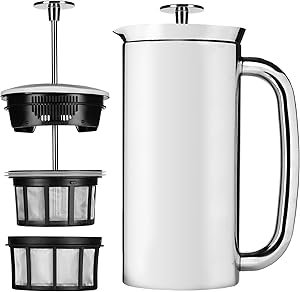
If grit in the cup is what puts you off French press coffee, a double filtered design solves it mechanically. The ESPRO P7 uses two micro filters and a stainless body, which also removes the breakage question entirely. The French presses category holds both approaches.
If you want a cleaner cup with no sediment at all, pour over is the other manual method and it uses a paper filter to remove the oils and fines a press deliberately leaves in; the Hario V60 dripper is the standard entry point. And if the appeal is coffee that keeps for days rather than minutes, cold brew is a different process again, and the Takeya cold brew maker lives in the refrigerator rather than on the counter.
Who this press suits
It suits someone who already likes French press coffee, has broken a glass carafe before, wants heat retention and a pot that matches the rest of a Le Creuset kitchen, and is content to measure water rather than see it. Thirty four ounces is the right size for one or two people, and the glaze is genuinely easy to clean.
It does not suit anyone who wants to watch the brew, anyone who needs a light pot, or anyone taking the oven, broiler and freezer claims in the feature bullets at face value, since those are stoneware bakeware statements attached to a product with metal hardware in it.