Description
Where are your transmitters, and are they in one direction?
Antenna shopping goes wrong when people buy by range figure. The number that decides this purchase is not 70 miles. It is the compass bearing from your roof to the towers you want, and whether those towers sit in one general direction or are scattered around you.
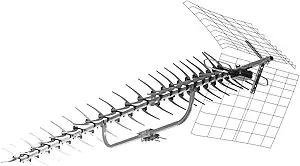
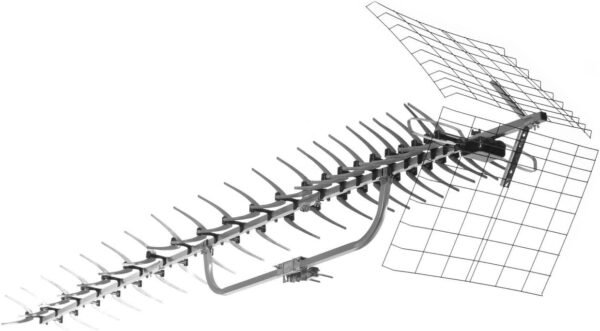
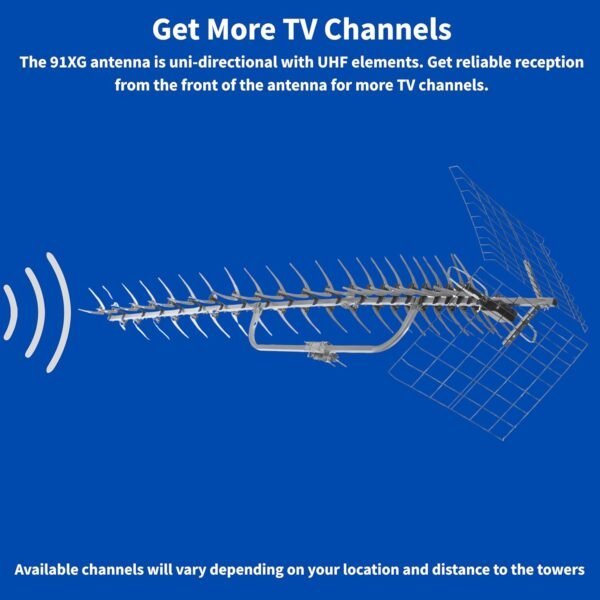
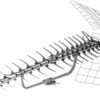
The Antennas Direct 91XG is a uni directional Yagi. Antennas Direct states its horizontal reception pattern is a 24 degree beam, which is narrow by any standard. Point that beam at a cluster of transmitters and it delivers high gain in that direction while rejecting signals arriving from elsewhere, which is exactly what you want when reflections off buildings and hills are causing pixelation. Point it at a market where the stations broadcast from three different sites and you will receive one of them properly and lose the others. If your towers are spread out, a multi directional antenna is the right product and this one is not.
The second question is the band. Antennas Direct lists the frequency coverage as UHF 470 to 608 MHz. This is a UHF antenna. If any channel you care about broadcasts on VHF in your area, this antenna is not designed to receive it and you will need a combination antenna or a separate VHF element. Look up the actual broadcast frequencies for your address, not the channel numbers displayed on screen, because the two have not matched since the digital transition.
The specification that decides it: gain, beam and physical size
Antennas Direct publishes a peak gain of 17.4 dBi, which is high for a consumer antenna and is the direct consequence of the narrow beam. Gain and beam width trade against each other. You cannot have a wide reception pattern and a strong one at the same time from the same aperture. The reflectors on this design are there specifically to reject signals coming from behind and beside the antenna.
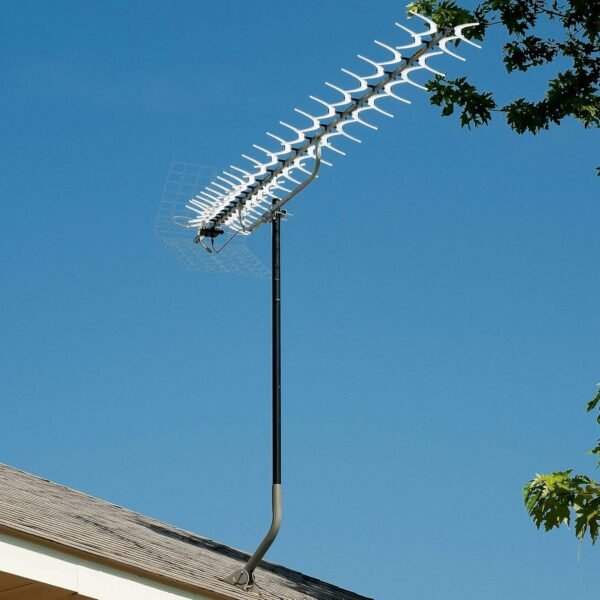
Then there is the size, and this is the part that surprises people who have only owned indoor antennas. The listing gives the dimensions as 22 inches high by 24 inches wide by 93 inches deep. That depth figure is the boom length: this antenna is nearly eight feet long. It weighs 4 pounds, which is manageable, but the wind loading on an eight foot boom on a mast is not trivial and the mounting has to be solid.
What is in the box and what is not
Antennas Direct includes the antenna itself, all weather mounting hardware, an adjustable mast clamp that allows horizontal or vertical installation, and instructions, backed by a lifetime manufacturer warranty. The company also notes snap lock assembly, which means the elements fold out rather than needing to be bolted individually.
What is not included matters more. The mast is sold separately and so is the coaxial cable. Antennas Direct makes a reasonable point that if the house previously had cable or satellite service, the coax to distribute signal through the house may already be in the walls. That is often true, and it is worth checking before buying a reel of cable. But the run from the antenna to the entry point is on you, and so is the mast, the standoff bracket or the tripod, and the grounding.
Living with an eight foot antenna
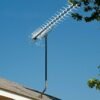
Installation location is the real decision. The listing states the antenna is suitable for attic or outdoor use, and those two options behave very differently. Outdoors on a mast gives you the gain the specification promises. In an attic you lose signal to the roofing material, and Antennas Direct says as much in its own bullets, noting that building materials and trees affect reception. Metal foil backed sheathing or a metal roof will cost you a great deal. If the attic is the only option, expect less than the published range and aim carefully.
Outdoor installation brings genuine safety considerations that belong in the plan before the antenna arrives. Working at height with an eight foot metal boom means keeping well clear of overhead power lines at every stage, including while carrying it. Outdoor antenna installations should be grounded to code, both the mast and the coaxial cable shield, which is a lightning and fault protection requirement rather than a reception one. If any part of that is outside what you are comfortable doing, this is a job for an installer.
Maintenance afterwards is close to nothing. There are no consumables and no power supply. What ages is the coaxial connection at the antenna, where water ingress into a poorly sealed connector is the usual cause of a system that worked for two years and then did not. Weatherproof that joint properly and the lifetime warranty on the antenna itself is likely to outlast the television it feeds.
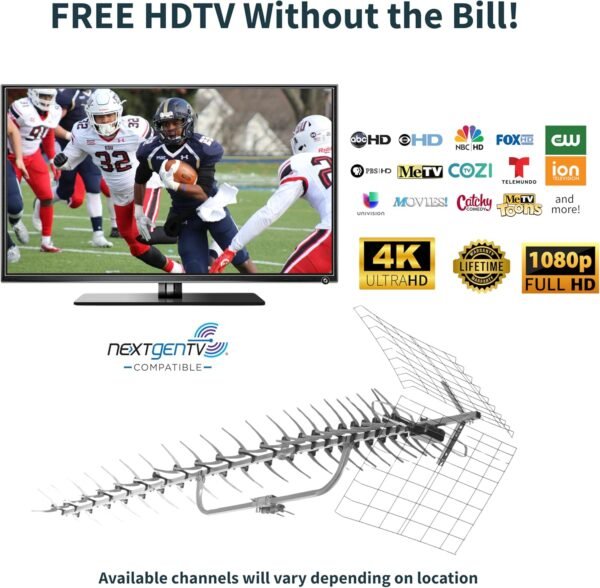
On compatibility, the listing states the antenna works with NEXTGEN TV, 4K, 8K UHD and Full HD 1080p, with no internet connection required. That is accurate in the sense that an antenna is frequency agnostic about what modulation is carried on it. Note also that the manufacturer describes the design as engineered in the United States while the country of origin field records Taiwan. Both can be true and it is worth reading the two statements together rather than either alone. The listing shows 406 ratings at 4.3 stars, a rank of 525th in television antennas, and an availability date of January 2007, so this is a long established design.
What would send you to a different antenna
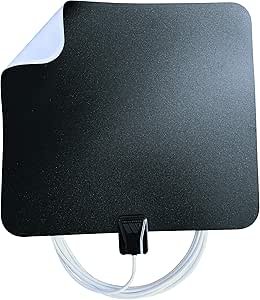
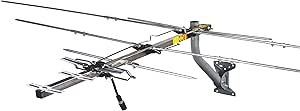
If your towers are in more than one direction, or if you need VHF as well as UHF, look at a multi directional or combination design instead. The Winegard FL5500A is a flat indoor answer for households close to the transmitters, and the Winegard YA7000C is another outdoor directional option. The television antenna category is where to compare patterns and bands.
If you are working on radio rather than television reception, that is a different set of hardware entirely. The Televes Ellipse Mix sits in the radio antenna category and covers different frequency ranges. And if free broadcast television turns out to be a small part of what you watch, a streaming device such as the Roku 2 XD may cover more of your viewing than an antenna will.
Who it fits and who should skip it
Buy it if your transmitters are clustered in one direction, if those transmitters are on UHF, and if you have a mast or roof position where an eight foot boom can be mounted solidly and grounded properly.
Skip it if your stations are spread around the compass, if any of them broadcast on VHF, or if the only mounting spot is a foil lined attic. Check your tower bearings and frequencies before ordering, because no antenna specification can make up for pointing the wrong way.