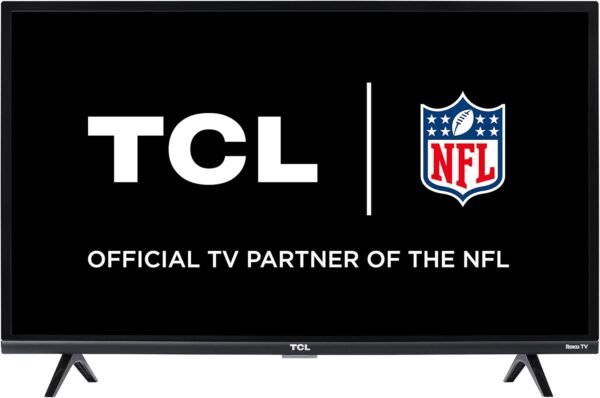
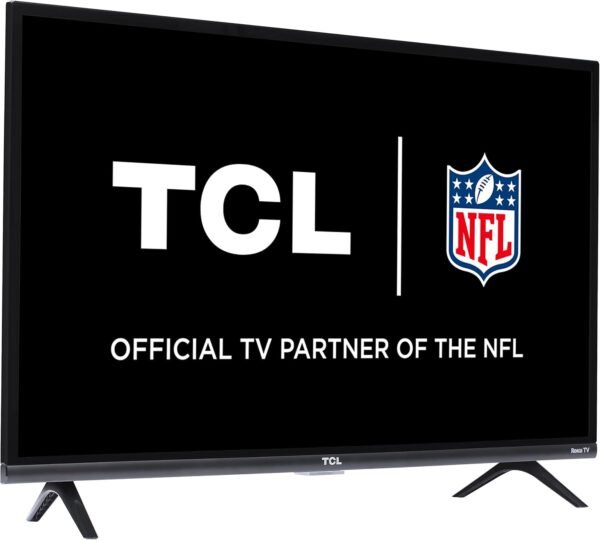
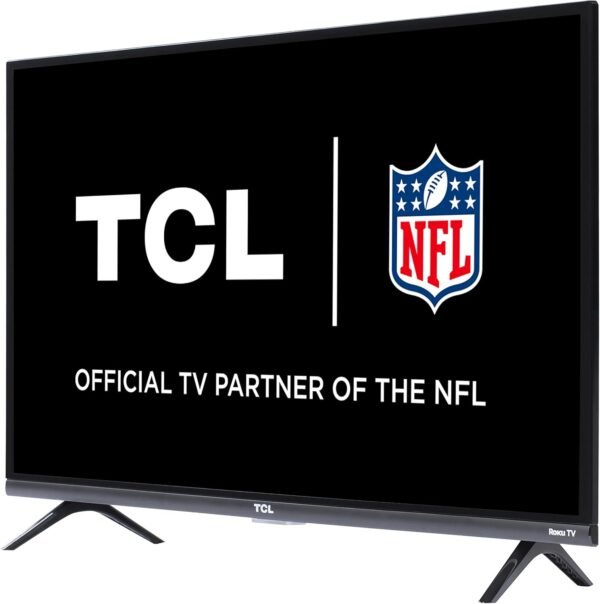


Description
What is a 32-inch 1080p television still the right answer for?
The honest starting point is that this is not a main living room television and was never meant to be. A 32-inch screen at 1080p is the right answer for a specific set of rooms: a bedroom watched from six or seven feet, a kitchen counter, a home office, a guest room, a garage workbench, a small apartment where the sofa sits close to the wall. In those places the size is the feature rather than a compromise, and paying for 4K on a 32-inch panel viewed from that distance buys resolution the eye cannot separate.
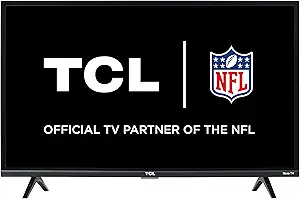
At 32 inches, 1080p is actually the higher of the two common choices. A great many sets this size are 720p, and TCL states 1080p full HD resolution here. From five or six feet that is a visible difference on text heavy content such as sports scoreboards, news tickers and game menus. It is the single strongest argument for this model over cheaper 32-inch sets.
The listed physical dimensions are 7.1 by 28.8 by 19.1 inches, and the set weighs 9.4 pounds. That combination is what makes this size practical in places a larger television cannot go. A shelf, a bracket in a rented kitchen, an arm over a workbench: 9.4 pounds is within the range of light duty mounts that a 55-inch set would tear off the wall.
The specifications that settle this one are resolution and the input panel
TCL publishes two things that matter and leaves out one that does. The resolution is 1080p and the panel is direct lit LED with a 60 hertz refresh rate, described in TCL’s own language as 60Hz CMI. That last term is a motion index rather than a panel refresh figure, and it should not be read as anything faster than 60 hertz. There is no HDR support mentioned anywhere in the listing, which is expected at this size and price position and worth stating plainly so nobody expects it.
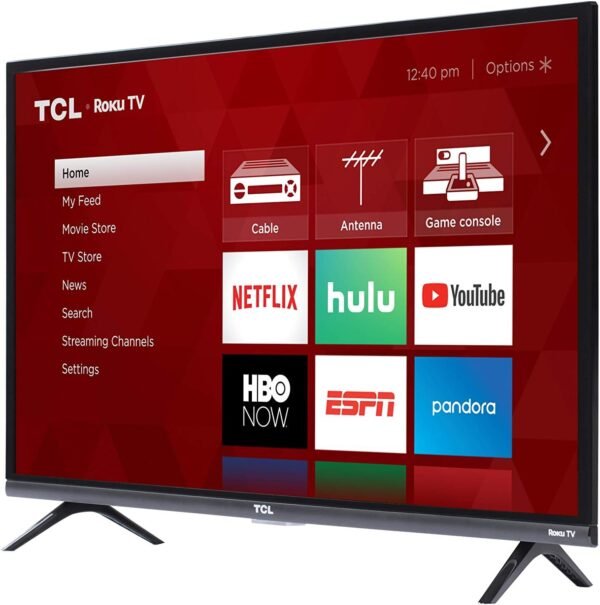
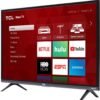
The platform is Roku TV, with a personalized home screen and access to Roku’s channel catalog, plus voice control through Amazon Alexa or Google Assistant for finding titles, changing channels and switching inputs. Wireless is dual band 802.11n. That is an older standard than the 802.11ac and WiFi 6 found on newer sets, and it is the part of this specification that will age least gracefully on a busy home network. For 1080p streaming it is sufficient.
Three HDMI inputs on a small television is not a given
The input panel is unusually generous for the size: three HDMI inputs, a USB port, an RF antenna connector, composite video, a headphone jack and an optical audio output. Small televisions frequently ship with two HDMI ports, and the third one is the difference between living happily with a console, a streaming stick and a soundbar, and buying an HDMI switch six months later. The optical output matters in particular, because it is how you get sound out to an older receiver or a soundbar that does not speak HDMI ARC.
The specification table contains several fields that are plainly wrong, and they are worth naming rather than quietly working around. Aspect ratio is listed as Unknown on a 1080p set, which is necessarily 16:9. The color name field reads TV 32S327, which is the model number rather than a color. A field called Number of Component Outputs reads Optical, which is a category error, since optical is not a component output. And the wattage is given as 5 watts in both the wattage field and the output wattage field, which is a strong sign that an audio output figure has been copied into the power consumption field. A 32-inch LED television draws considerably more than 5 watts when it is switched on.
Living with it: mounting hardware, sound and a platform from 2018
TCL publishes the mounting screw size directly, which is more than most listings do: M4 by 8 millimeters. That tells you the hardware size, though not the hole spacing, and at this weight almost any small bracket will handle the load. A universal bracket rated from 32 inches upward, such as the one covered in the Mounting Dream MD2380 wall mount review, is far more bracket than this set needs, but it does mean the same bracket can carry a larger replacement later.
Sound is built in and modest, which is normal at this size. The optical output and the headphone jack both give you an exit route to something better. Direct lit LED rather than edge lit means the backlight sits behind the panel rather than around its border, which usually gives more even brightness across the screen while adding a little depth, and the 7.1 inches of listed depth includes the stand.
The date to keep in mind is the one the listing gives for first availability: July 26, 2018, even though the product title calls it a 2019 model. That is a seven year old platform. Roku has generally been good about maintaining older televisions, but app support on any smart platform eventually stops, and buying a set from 2018 today means you are further along that curve than you would be with a new model. The 21,601 ratings averaging 4.5 stars reflect a long sales history rather than current relevance.
When a different small television is the better buy
If you want the same size on a current platform rather than one from 2018, the Hisense 32A4NR Roku TV review covers a newer 32-inch set running the same interface. The VIZIO 32-inch V-Series review covers the same size on a different platform, which is worth reading if you would rather not be inside Roku’s ecosystem.
If smart features are not wanted at all, for instance on a set used purely with a cable box or a console, the LG 32LJ500B review covers a simpler alternative. And if picture quality at this size matters more to you than resolution on paper, the Sony KD32W830K review covers the upper end of the 32-inch market, though note that it is a 720p panel rather than 1080p. The full size range sits in the LED and LCD television category, and because this set has a built in tuner and an RF input, it also pairs with an aerial, which the TV antennas category covers.
Who should buy it and who should not
This suits a secondary room where 32 inches is the right size, where three HDMI inputs earn their keep, and where 1080p rather than 720p is worth having. It suits anyone who wants Roku’s interface without adding a separate box, and it is light enough to mount almost anywhere.
It does not suit a main viewing room, anyone who wants HDR, or anyone buying with a five to seven year ownership horizon in mind, because the platform is already seven years old by the listing’s own date. It also does not suit a household on a congested network, since 802.11n wireless is two generations behind what current sets carry.