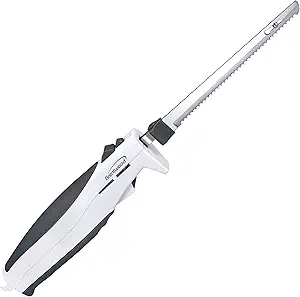
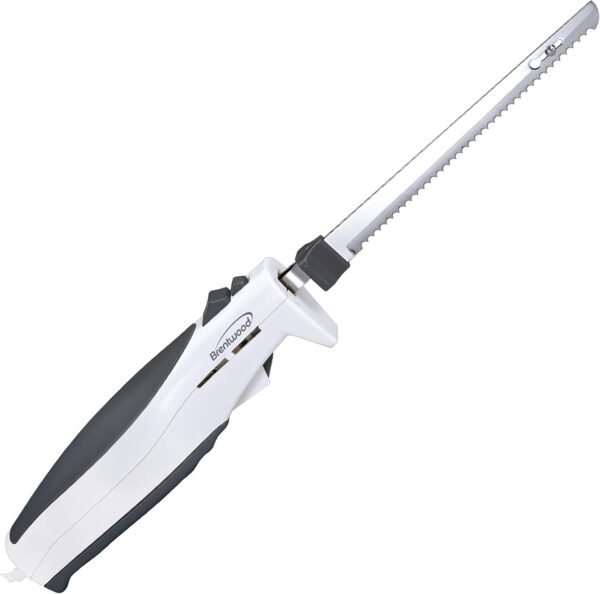
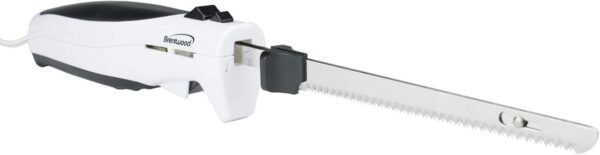
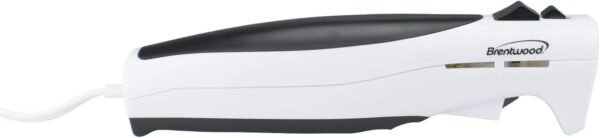

Description
How many times a year will this come out of the drawer?
An electric carving knife is one of the few kitchen appliances people buy for a specific date on the calendar. Thanksgiving, Christmas, a Sunday roast. If that is the honest use pattern, the questions that matter are how it stores, how it cleans and whether it is safe to leave in a drawer, not how fast the blades move.
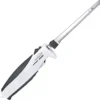
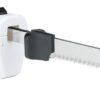
Brentwood answers the storage question directly. A protective plastic sleeve is included for the blades, and the blades themselves eject from the handle. That is the difference between a knife that lives in a drawer without hazard and one that everybody in the house learns to avoid reaching past. If a corded appliance is going to sit unused for eleven months a year, the sleeve is not an accessory, it is the feature.
The other honest question is whether an electric knife earns its place at all. The case for one is narrow but real: carving hot meat cleanly without dragging or tearing, and slicing fresh bread without compressing the loaf. Both are things a sharp chef knife does adequately and a serrated bread knife does well. Where a reciprocating blade wins is on a large bird with a heavy hand behind it, and on soft loaves where downward pressure is the enemy.
The specification that decides it: two serrated blades at 110 watts
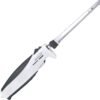
The mechanism is two serrated stainless steel blades running against each other in opposite directions, driven by a 110 watt motor and controlled by a trigger. The reciprocating action means the blades do the cutting rather than your arm, so the food is not being pushed away from you as you slice.
Blade length is 7 inches, which is the number that determines what this can handle. Seven inches will carve a turkey breast, a joint of beef, a ham and a loaf of bread comfortably. It is not long enough for a whole side of anything, and it is not a filleting tool.
The handle is described as ergonomic, in plastic and stainless steel, and the whole unit weighs 1.6 pounds. The cord is 5 feet, which sounds trivial and matters more than it should: a carving knife is used at the table or at a serving station, not next to the outlet, and five feet is often the difference between reaching and not.
A contradiction in the blade specification
The description and the feature bullets both say the blades are fully serrated, which is what an electric carving knife needs to be. The specification table then lists the blade edge as Flat and the blade shape as Straight Back. A flat edge and a serrated edge are not the same thing, and the two descriptions cannot both be right. Take the serrated description as the accurate one, since it appears in both the manufacturer description and the bullets, and treat the table entry as an import artifact. The Model Name field also reads simply Electric, with the actual model code TS-1010 appearing elsewhere.
Living with a corded blade
Safety belongs first here because this is one of the few kitchen appliances that presents a real cutting hazard while running. The blades eject only after moving a safety switch and then pressing the eject button, which is a deliberate two step action rather than a single button that could be knocked. Keep it unplugged when changing or removing blades, keep it away from children, and be aware that the blades keep moving for a moment after the trigger is released.
Cleaning is where the listing needs a caution. Brentwood says to place it in the dishwasher for cleanup. In practice that instruction applies to the ejected blades, not to the motor handle, which contains a motor and a mains cord and must never be immersed or put through a dishwasher. The listing does not make that distinction and it should. Check the manual before washing anything, and if in doubt wash the blades and wipe the handle.
The other maintenance point is that serrated blades cannot practically be resharpened at home. When they dull, they get replaced, so check that replacement blades are available for the model before you commit to it as a long term tool.
Technique is worth a paragraph because an electric knife rewards a different hand than a chef knife does. The blades do the cutting, so pushing down works against you: the correct action is to let the weight of the knife rest on the food and guide it, with almost no downward force. Meat carves better after resting, because a rested joint holds its juices instead of releasing them onto the board, and bread slices better once it has cooled fully, because warm crumb compresses under any blade. Neither of those is a property of this knife. They are the two habits that decide whether the tool looks impressive or disappointing on the day you actually need it.
Ownership signals here are modest and worth reading honestly: 57 ratings at 3.9 stars, a rank of 134th in electric knives, and an availability date of August 2018. A 3.9 average is below what you would want, though on a small sample in a niche category it is a caution rather than a verdict. The category itself is small, which is a reminder that this is a specialized tool rather than a kitchen staple.
What would send you elsewhere
If the driver is carving large cuts of meat regularly rather than annually, the appliance to spend on is the one producing the meat. A pellet cooker like the recteq Flagship 1100 or a combination unit like the Oklahoma Joe’s Canyon Combo changes what lands on the board far more than the knife does, and the smoker category covers that ground.
If the actual job is slicing and shredding vegetables rather than meat, a food processor with a slicing disc does it faster and more evenly than any knife. The Hamilton Beach 70730 is the straightforward version, and the food processor category has the alternatives.
And if slicing fresh bread is the real reason, it is worth noting that the same problem is often better solved upstream. The Zojirushi breadmaker makes a loaf that has cooled properly before slicing, which is most of the battle.
Who it fits and who should skip it
Buy it if you carve a large roast or a whole bird a few times a year, if you want the blades to store safely between uses, and if a five foot cord reaches from your outlet to where you carve.
Skip it if a sharp carving knife already does the job in your kitchen, or if you would rather not keep a powered blade in a drawer. Check the manual on what may go in the dishwasher, because the listing does not separate the blades from the handle.