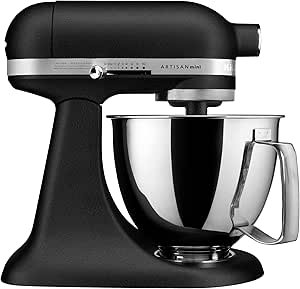
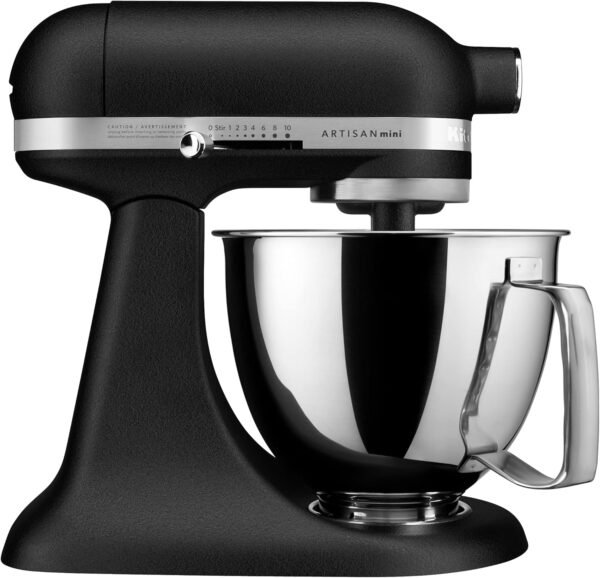
Description
How much do you bake at once, and where does the mixer live?
Stand mixer sizing goes wrong in one direction far more often than the other. People buy the large bowl because it seems safer, then discover that the machine lives in a cupboard because it will not fit under the wall cabinets, and a mixer in a cupboard is a mixer that does not get used.
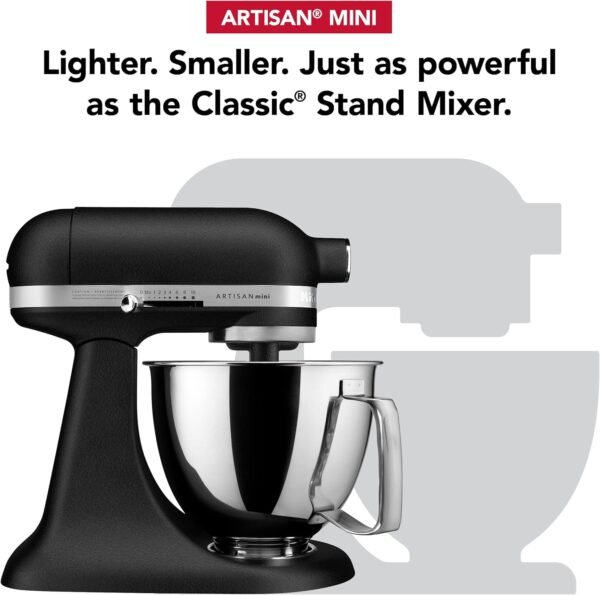
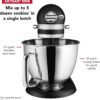
KitchenAid built the Artisan Mini around the opposite trade. The bowl is 3.5 quarts, and the machine measures 12.3 inches deep by 7.8 inches wide by 12.3 inches high at 14.3 pounds. Twelve and a bit inches of height means it fits under most wall cabinets, and 7.8 inches of width means it takes a narrow strip of counter rather than a corner.
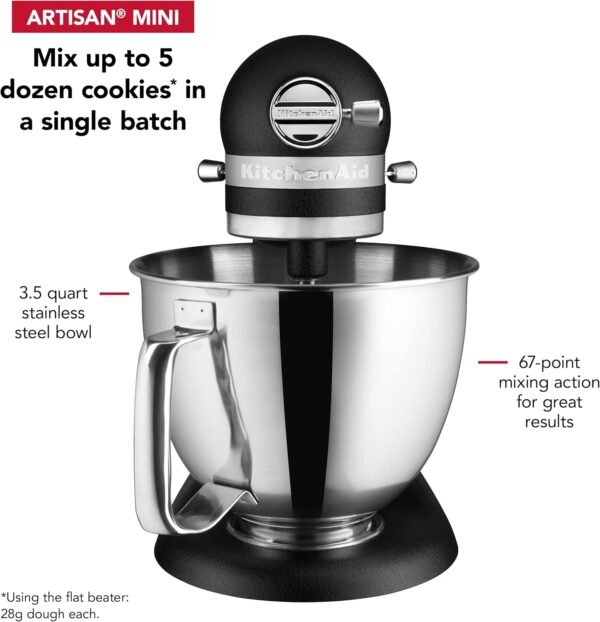
What 3.5 quarts holds is stated precisely, which is unusually honest for this category. KitchenAid says five dozen cookies in a single batch, and footnotes it: using the flat beater, at 28 grams of dough each. That footnote is the difference between a marketing number and a usable one, because it tells you exactly what was measured. Five dozen cookies is a real household batch. Two loaves of bread dough at once is not, and a bowl this size is not the machine for that.
The power claim is a comparison, and the hub is the real specification
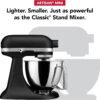
KitchenAid’s description of the motor is worth reading carefully, because it never gives a number. The claim is that the Artisan Mini has the same power as the KitchenAid Classic, is lighter and is smaller. There is no wattage anywhere on this listing, and there is no wattage on KitchenAid’s own materials for this line either, since the company describes its mixers by comparison rather than by rating.
That is a genuine gap if you want to compare against another brand, and it is less of a gap than it appears if you are comparing within the range, because the comparison to the Classic is the useful reference point. What it means in practice is a mixer sized for creaming butter, whipping cream, mixing cake batter and kneading modest quantities of dough, and not a machine to work a full bowl of stiff bread dough repeatedly.
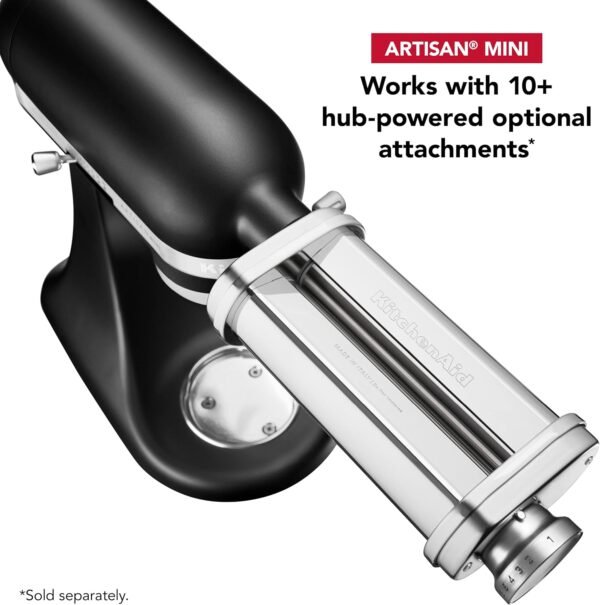
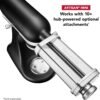
The specification that actually differentiates a KitchenAid is not the motor at all. It is the power hub on the front of the head. That hub is the same across the range, and it drives a large family of attachments: food grinders, pasta rollers and cutters, spiralizers, shredders, ice cream bowls and more. KitchenAid states more than ten optional attachments, all sold separately. Buying into the hub is buying into a system, and it is the reason people accept a mixer that does one job well rather than a multifunction machine that does several adequately.
Ten speeds, sixty seven touchpoints and what they mean
Ten speeds sounds like more than a mixer needs and is not. The bottom of the range, the stir speed, exists so that flour can be folded into a wet mixture without producing a cloud, and the top of the range is for whipping cream and egg whites where air incorporation is the whole point. A mixer with three speeds forces you to compromise at both ends.
The listing also mentions 67 touchpoints around the mixer bowl. That refers to how many times the beater passes close to the bowl wall during the planetary action, and the reason it matters is that the ingredients at the edge of the bowl are the ones that do not get mixed. A high touchpoint count means less stopping to scrape down the sides.
What comes in the box is stated clearly: the 3.5 quart stainless bowl, a Flex Edge beater, a coated dough hook and a six wire whip. The Flex Edge beater is the item to note, since it has a flexible wiper along one side that clears the bowl wall as it turns, and it is often sold as an upgrade rather than included.
The tilt head design lets you lift the head to add ingredients or change attachments, and locks in place while mixing. On a small machine that is more important than it sounds, since a mixer this light will otherwise move on the counter under load.
Living with it: cleaning, materials and two names for one color
The specification table states the item is dishwasher safe with a straight yes. KitchenAid’s own bullet is more precise: the 3.5 quart stainless bowl is dishwasher safe. The motor head obviously is not, and coated attachments such as the dough hook generally do better by hand, because dishwasher detergent is hard on coatings. Treat the bowl as dishwasher safe and everything else as hand wash unless the manual says otherwise.
The construction is described as metal and built to last, and the machine is stated as made in the USA. At 14.3 pounds it is light for a metal bodied mixer, which is the point of the Mini, and it is light enough to move between a cupboard and a counter without it becoming a chore.
One small inconsistency runs through the listing. The product title gives the color as Cast Iron Black while the specification table gives it as Imperial Black. Those are two different KitchenAid color names attached to one model code, KSM3316XBK, and the page never reconciles them. It is worth checking against the photographs if the exact shade matters, since KitchenAid’s black finishes differ noticeably from one another.
No warranty term appears anywhere on the listing, which is a gap on a machine bought partly for longevity.
When a different mixer is the better buy
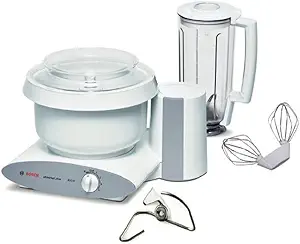
If bread is the reason you are buying a mixer, this is the wrong size and the wrong balance, and a machine built around dough capacity is the right answer. The Bosch Universal Plus review covers that end directly.
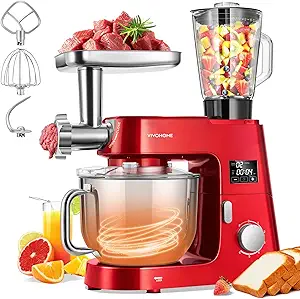
If you want one machine to replace a mixer, a blender and a grinder rather than buying attachments over time, the VIVOHOME 9 in 1 stand mixer review covers that approach with a much larger bowl, at the cost of the attachment ecosystem.
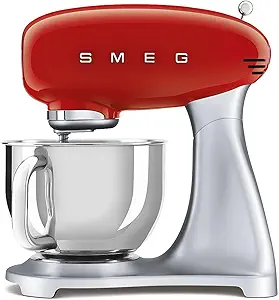
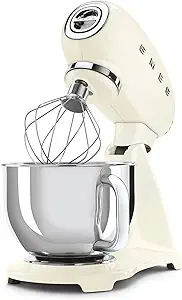
If the mixer is going to live permanently on show and appearance is part of the decision, the Smeg SMF03CRUS review and the Frigidaire retro stand mixer review both cover that. And if you bake occasionally rather than weekly, a stand mixer of any size may be more machine than the job needs, which the KitchenAid KHM512CL hand mixer review covers at a fraction of the size.
The rest of the range sits in the stand mixers category and the smaller machines in the hand mixers category.
Who it fits and who should size up
It fits a small kitchen where counter height and width are the binding constraints, a household baking in normal domestic quantities, and anyone who wants access to the KitchenAid attachment hub without the footprint of a full size machine. The included Flex Edge beater, the ten speed range, the tilt head and the stainless bowl are what make it a complete machine out of the box rather than one that needs upgrading.
It does not fit a serious bread baker or anyone doubling recipes routinely, since 3.5 quarts fills quickly and no wattage figure is published to judge the motor against. Anyone comparing by specification will find this listing gives no power rating and no warranty term, and names the color two different ways. The listing shows 4,653 ratings averaging 4.7 stars, ranked fourteenth within household stand mixers, which is a deep and strongly positive record from a product listed since April 2019.