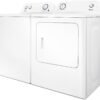

Description
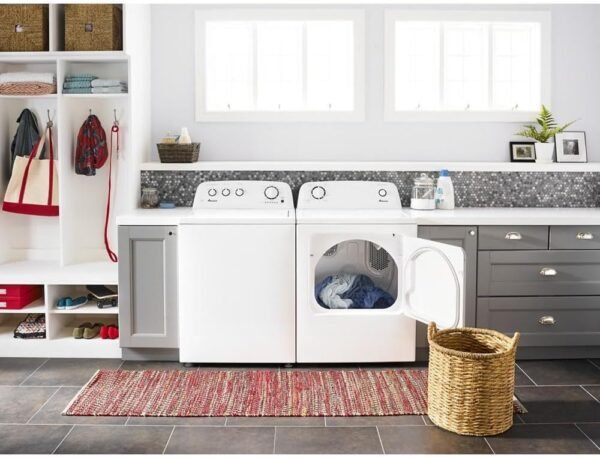
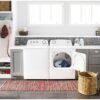
What is the washer next to it, and what is behind the wall?
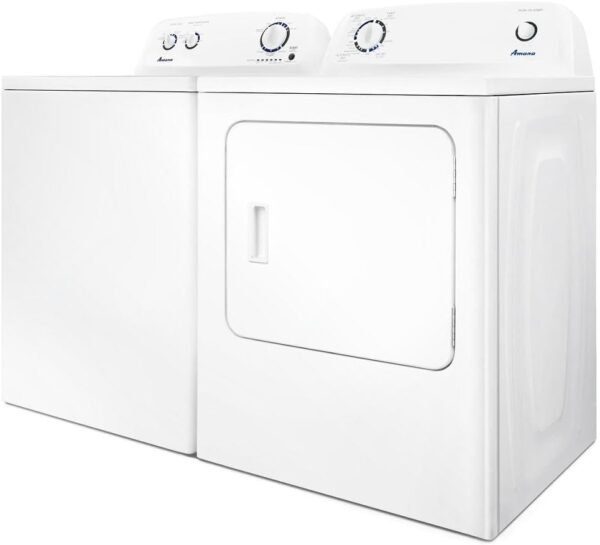
Dryer buying starts with two things that have nothing to do with the dryer. The first is the washer it will work alongside. The general guidance is that a dryer wants roughly twice the drum volume of the washer feeding it, because wet clothes need room to tumble and air needs room to move through them. At 6.5 cubic feet, this Amana pairs sensibly with a washer of around 3.5 cubic feet, which is exactly the size of the top loader in the same range.
The second is the connection. This is an electric dryer, and electric dryers in the United States run on a 240 volt dedicated circuit, typically with a 30 amp breaker and a specific three prong or four prong outlet depending on the age of the house. The cord is very often not supplied with the machine, and the type you need depends on the outlet you have. This listing states only a fuel type of electric and publishes no voltage, no amperage and no cord information at all. That is the biggest practical gap on the page and the thing to settle before ordering, not on delivery day.
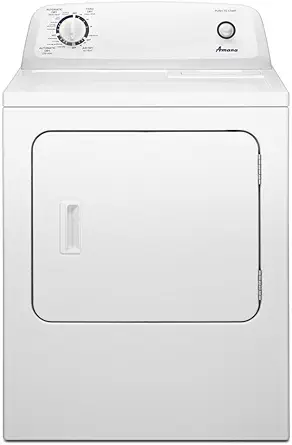
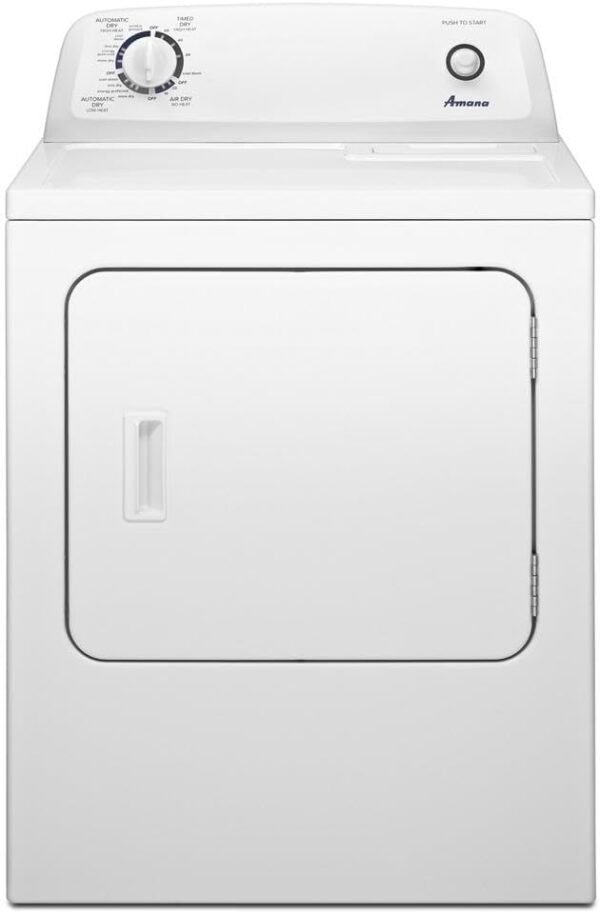
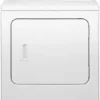
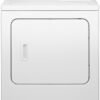
The physical size is 28.2 by 29 by 44 inches at 125 pounds, which is a standard laundry footprint. Note that a front load dryer needs door swing clearance in front of it, and the listing states the door hinges are reversible, which is a genuinely useful feature that lets you set the door to open away from the washer rather than into it.
Eleven cycles, and a listing that will not tell you what they are
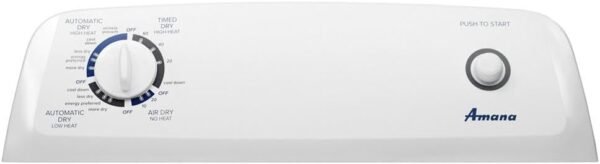
The specification table says eleven standard cycles and does not name a single one. That is a real limitation for anyone comparing dryers, because the cycle list is where the differences live: a sanitize cycle, a wrinkle prevent option, a delicate or air fluff setting, a timed dry, and above all whether the machine has moisture sensing or only runs on a timer.
That last distinction is the one that matters most and the listing does not answer it. A timed dryer runs for as long as you set, whether the clothes are dry after twenty minutes or still damp after fifty. A sensor dryer measures moisture in the drum and stops when the load is dry, which saves energy, saves time and is much gentler on fabrics, since the common cause of shrinkage and wear is over drying rather than the heat itself. If that capability matters to you, get the cycle list and the sensing behavior from Amana before buying.
There is no published drying capacity in pounds, no energy rating, no noise figure and no venting specification either.
The one certification on the page, and why it is worth noticing
Among the sparse fields is one that most listings never carry: a certification field reading ADA. That refers to the Americans with Disabilities Act accessibility guidelines, and on an appliance it generally means the controls are positioned and operable within specified reach ranges and can be used without tight grasping, pinching or twisting of the wrist.
That is a genuinely useful piece of information and it is almost never published. For a household with a wheelchair user, or an older person, or anyone with limited hand strength, an ADA compliant control layout is the difference between an appliance that can be used independently and one that cannot. On a front load dryer it also helps that the door and lint filter are at a reachable height rather than on top of the machine.
The material type field reads aluminum, which on a dryer almost certainly describes the drum rather than the cabinet, and the listing does not say which. Drum material affects how gently clothes tumble and how the drum ages, so it is worth confirming.
Living with it: venting, lint and a listing with almost nothing in it
Venting is the part of dryer ownership that gets ignored and matters most. A vented electric dryer pushes hot moist air outside through ducting, and the length and shape of that duct affects both drying time and safety. Long runs and multiple bends restrict airflow, which makes cycles longer, raises energy use and increases lint accumulation. Rigid or semi rigid metal ducting is the correct material, and flexible plastic or foil ducting is not.
Lint is the safety item. The filter needs clearing after every load, and the duct itself needs clearing periodically, because accumulated lint in a hot duct is a recognized fire risk. Neither is optional maintenance and neither appears anywhere on this listing.
The listing itself is worth describing plainly, because it is one of the emptiest in this range. The description field contains six full stops and nothing else. The three feature bullets read “Easy to use and handle”, “The product is highly durable” and “The product is manufactured in United states”, none of which describes anything about the machine. The included components field reads “Appliance Replacement Parts, clothes-dryer-replacement-parts”, which is a category path from a retailer’s own system that has leaked into a product field.
So essentially all the usable information here is in the specification table, and the table is missing the things a buyer needs. The rank of 35th within clothes dryers and 1,878th across appliances suggests a machine that sells steadily, and the 75 ratings averaging 3.8 stars are a modest sample from a product first listed in March 2015.
When a different dryer is the better answer
If the laundry space is tight, a combined washer and dryer removes the second machine entirely, at the cost of longer cycles and smaller loads. The Samsung WD53DBA900HZ washer dryer combo review covers that approach.
If you are buying both machines, the matching washer is the obvious pairing and the capacity ratio works out correctly, which the Amana NTW4519JW top load washer review covers. If you would rather have a front load washer, which spins clothes drier and therefore shortens every dryer cycle that follows, the LG 5.0 cubic foot front load washer review covers that decision.
And if the laundry is part of a wider appliance replacement, the other machine usually bought at the same time is a dishwasher, which the Bosch SHE53B75UC review covers. The rest of the range sits in the dryers category and the washing machines in the washers category.
Who should buy it and who should not
It suits a household replacing a dryer in an existing laundry space with a 240 volt outlet already installed and a vent already run, pairing with a washer of around 3.5 cubic feet. The reversible door is a real convenience for awkward layouts, and the ADA certification is a genuine reason to choose it in a household where reach and grip matter.
It does not suit anyone who needs to compare cycles, energy use or moisture sensing before buying, because this listing publishes none of that and its description field is literally a row of dots. Anyone without an existing 240 volt dryer outlet should price the electrical work before the appliance, and everyone should confirm whether a power cord is included, since the listing does not say.